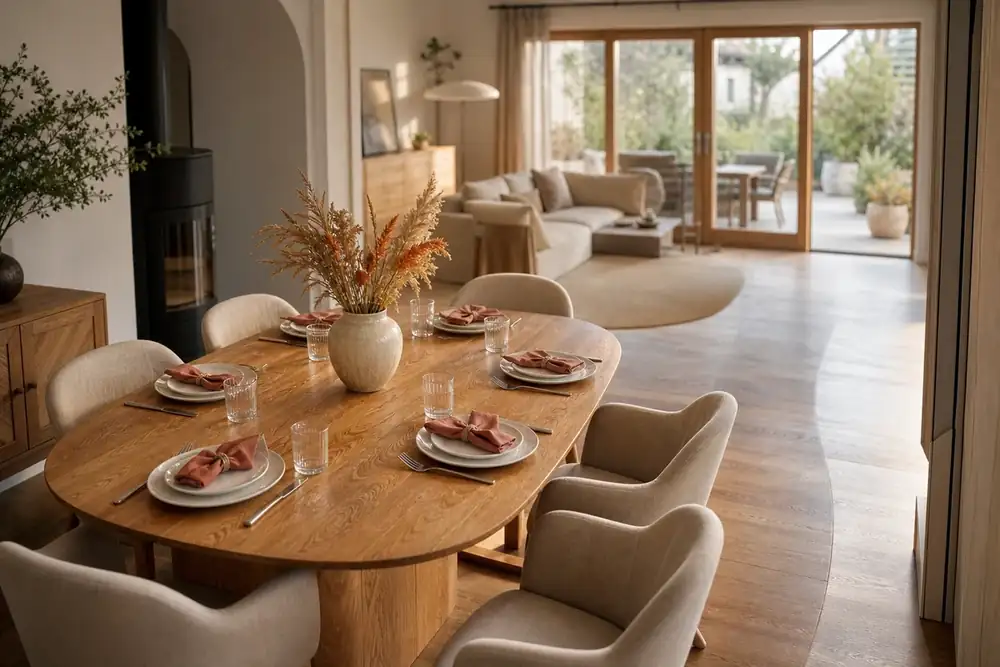
Oval dining table: How many people can it really fit? The rule of thumb
The centimeter-based answer to the purchase blocker question: Ovals cost seats but gain paths.
An oval dining table 200 cm long offers six comfortable seats, a rectangular one of the same length eight. Anyone wanting to order this trendy shape should know this calculation, because you won't see it in the furniture store.
Update, September 20, 2026: The season for large gatherings begins: On October 3 (a Saturday in 2026) and for Thanksgiving on October 4, many families will gather together for the first time since summer, and further celebrations will follow until Advent. Anyone wanting a new dining table by then should decide on its shape now. The guidelines remain unchanged: The size guide from solid wood retailers classifies approximately 50 cm of edge per person as cramped, 60 cm as sufficiently comfortable, and 70 cm as generous; this still equates to six comfortable seats at a 200 cm oval and eight at a rectangular table of the same length. For this week: Honestly count the number of guests at the last few celebrations, mark out the table outline on the floor with painter's tape, arrange the chairs, and open adjacent doors and drawers (source).
Measurement check: 60 centimeters of edge determine every seat
The basic rule is simple, but binding: Each person needs 60 cm of table edge and 40 cm of depth per place setting. If guests are to be seated at the ends, add approximately 40 cm of table length at each end. Guidelines for space requirements per person classify 50 cm as cramped, 60 cm as comfortable, and 70 cm as generous.
Why does the oval table lose seating capacity? An oval table is essentially a rectangle with rounded ends. It's precisely these curves that eliminate the need for straight seating edges: at the transitions between the long side and the ends, the 60 cm of straight edge are missing, effectively reducing the seating capacity by one or two place settings. Therefore, most standard oval table models are designed for four to six people.
For comparison: A 200 cm long rectangular table seats three people per long side plus one at each end, so eight in total. An oval of the same length can accommodate six, or seven with a very wide tabletop. If you want to seat eight people at an oval table, the formula suggests a length of approximately 260 cm (three place settings of 60 cm each on each side, plus two 40 cm sections for the end seats).
Round tables require a different calculation: diameter times pi, divided by 60 cm. That sounds plausible, but towards the center each place setting becomes wedge-shaped and narrower.
Why the oval shape still wins in many spaces
Trend reports from furniture retailers for 2026 identify organic, softly rounded shapes as a defining trend in dining areas, but still see rectangular tables as the established standard. The shift to oval shapes is therefore not automatic, but rather a matter of available space.
This is precisely where the shape's strength lies. Rounded ends protrude less sharply into doorways than right-angled corners: no bumping into the table edge, no blocked path to the patio door. However, the basic space requirement remains the same. There should be 80 to 100 cm of free space behind the chairs; otherwise, getting up becomes a game of chair-moving Tetris.
The oval shape also solves the problem of large round tables. With a diameter of around 150 cm or more, no one can reach the bowl in the center of a round table. An oval, on the other hand, extends lengthwise, keeping the center of the table easily accessible. Those who would like to compare shapes and materials will find plenty of visual material among innovative dining table designs for the modern dining room.
Practical for varying numbers of guests: Many oval models can be extended with an add-on or pull-out leaf. Compact for everyday use, accommodating four to six people, and extended to eight when guests arrive. An extendable designer table with an unusual mechanism demonstrates just how elegantly such mechanisms can be implemented.
When rectangular remains the more practical choice
There's no getting around one fact: rectangular tables make the most efficient use of space. They stand flush against the wall or in front of a bench and provide the most seating per square meter. An oval table can't do that. Its curves waste precisely the space in small, enclosed dining rooms that a rectangle with a bench utilizes.
In very compact apartments, round extendable tables are worth considering, as they take up little space on a daily basis. And for those who prefer a more spacious feel, it's better to allow 70 cm per seat instead of 60, regardless of the table's shape.
Before ordering, it's worth conducting a test, which specialist retailers also recommend when comparing oval and rectangular dining tables: Tape the table outline, including the curves, to the floor with painter's tape, arrange existing chairs, and open adjacent doors and drawers. Only then will you see whether the oval shape truly creates more freedom of movement in your own floor plan.
The ranking is clear. In passageways, open-plan kitchens, and when regularly entertaining six or more guests, the oval table wins: it maintains the length of a dining table, reduces foot traffic, and avoids the 150 cm problem of round tables. When it comes to maximizing seating in a small space, placing a table against a wall, or incorporating a bench, the rectangular table remains unbeatable. For six or more people, the round table is the least practical choice.
Applying the rule of thumb (60 cm edge, 40 cm depth, 40 cm per end seat) to your own floor plan will get you the right shape in five minutes. For households with fluctuating numbers of guests, an extendable oval dining table made of solid wood is the perfect compromise, offering both: compact for everyday use and a large dining area on weekends.