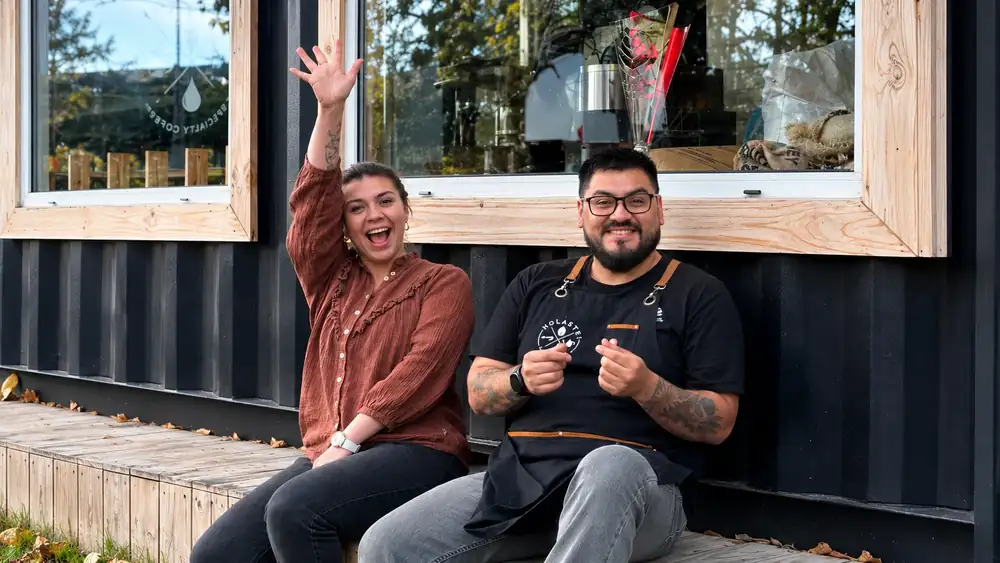
Holaste!, a specialty coffee shop at the end of the world
I arrive in Puerto Natales for the third time and head straight for what I consider one of the most remarkable coffee shops in Chile.
Puerto Natales, in the far south of Chile, rests on the shores of the Última Esperanza Sound, where the immensity of Patagonia begins to unfold amidst glaciers, mountains, and seemingly endless steppes. It's a city where the wind is part of the landscape and nature continues to dictate the rhythm of life. From here, those seeking Torres del Paine National Park depart, though Puerto Natales is much more than just a gateway.
Holaste! gained international recognition in 2025, when it was ranked 60th on The World's 100 Best Coffee Shops list. Today it holds the 21st spot. However, I believe its story cannot be measured by that recognition alone, as its true significance began in 2016, when its young founders, Catalina España (32) and Sony Guineo (34), decided to talk about specialty coffee in a city where that language was still nonexistent. More than just opening a coffee shop, they helped shape a culture in one of the southernmost territories in the world.
Catalina and Sony literally started from scratch. Catalina was born and raised in Puerto Natales. Sony, on the other hand, is from Ancud, in Chiloé, and it was precisely this Chiloé heritage that would end up becoming the project's initial capital. To raise the initial money—a little over 500,000 Chilean pesos, about five hundred dollars—they prepared and sold milcaos, the traditional potato bread of Chiloé made with Sony's family recipe. With that money, they built a small coffee cart and, in 2016, began walking the streets of Puerto Natales offering filtered coffee.
At first, they participated in fairs and events, until a year later they set up their cart at the bus terminal. Today it seems like a visionary decision, but in Puerto Natales in 2016, talking about specialty coffee was practically science fiction. Although international tourism was beginning to grow strongly thanks to the proximity to Torres del Paine National Park, coffee culture simply didn't exist. Manual brewing methods were unknown to most people; Catalina remembers more than one person approaching her cart asking if they could buy the vase that decorated the counter, mistaking the Chemex brewer for an ornamental object.
Catalina comes from a family where traditional trades shaped her life. Her mother was a homemaker; her father, a mechanic; the man who raised her, a fisherman; and her grandmother, an extraordinary seamstress and cook. She grew up understanding that doing a good job was the way forward. A fan of books, knitting, and the Aeropress, she discovered specialty coffee in 2011 and made a life-changing decision: to abandon her psychology studies to pursue her dream of opening a coffee shop dedicated exclusively to specialty coffee.
Sony inherited much more than the milcao recipe from Chiloé. Passionate about rugby and basketball, he found in coffee another space where technique and discipline make all the difference. His specialty is latte art. In 2024, he won the national Latte Art Grading System championship in the Green Pitcher category, a result that took him to the world championship held in Trieste, Italy, where he achieved an extraordinary second place.
Holaste! began as an experiment driven by intuition and obstinacy and ended up becoming one of the most respected coffee shops —and a little over a year ago also a coffee roastery— in Chile.
I see two virtues in Catalina and Sony's work that distinguish them from many coffee professionals. The first is their almost obsessive ability to interpret the coffee before roasting it. They seek to understand its origin, variety, and process to decide how much heat to apply, for how long, and with what objective. There's science involved, of course—roasting curves, records, and technique. But there's also intuition, a sensitivity that only comes after years of drinking, comparing, and being moved by a cup. I appreciate that they don't treat coffee as a sophisticated commodity or a collector's item meant to fuel the microlot craze or the exclusivity of origin. Instead, they understand and know that what they're working with is a beverage capable of comforting, moving, and telling a story.
The second is the profound human focus of their project. Entering Holaste! feels more like stepping into a Magallanes home than a specialty coffee shop. There's no pretension or grandiloquent speeches, but rather hospitality, conversation, and a genuine concern that every person—whether a resident of Puerto Natales or a traveler recently arrived from Singapore—feels welcome. The coffee ceases to be the main attraction and becomes a bridge.
That same philosophy has also shaped their relationship with the community. In a city profoundly transformed by tourism, Catalina and Sony have ensured that Holaste! remains a place for the people of Natales. While many businesses end up focusing their entire offering on seasonal visitors, they have created a space where locals continue to feel connected to the city's history.
I order two filter coffees. The first is a washed Bourbon Ají from Colombia. In the cup, it displays a bright and juicy acidity, a delicate floral expression, a silky body, and a lingering sweetness reminiscent of rose petals, raspberries, and soft honey. It's an elegant and precise coffee that evolves slowly as the temperature drops, revealing new aromatic layers with each sip. The second is a natural Icatu Amarillo from El Salvador. It's much creamier and leaves a pleasant aftertaste of ripe pineapple and peach with a hint of bitter cocoa.
I step back out into the cold of Puerto Natales, certain that Holaste! isn't just a great coffee shop at the end of the world. It's proof that excellence can be born far from major cities, that talent knows no boundaries, and that sometimes the most extraordinary stories begin with a handmade cart and a milcao recipe inherited from Chiloé.