Sorrento's seaside restaurant: prices, reviews
Soul & Fish
- Chef: Vincenzo Corcione
- Report: Michelin Guide
There's a place in Sorrento, in Marina Grande, where the sea is more than just a backdrop for dinner. The Michelin Guide has included it in its selection since 2024, recognizing its "good cuisine" that manages to blend tradition and creativity. But just sitting down is enough to understand that the story is more interesting than a simple recommendation.
Here you don't look at the sea. It happens.
And perhaps this is precisely the successful coincidence of Soul & Fish: the kingdom of Neptune meets a very human, unceremonial way of understanding beauty.
Where the sea enters through the door
You don't just get to Soul & Fish. You descend. From the center of Sorrento toward Marina Grande, leaving behind the vertical noise of the city and winding through alleys, unexpected views, and walls that open onto the blue. The fishing village is still there, with its salty soul and that irregular geometry that time and tourism have not entirely managed to restore.
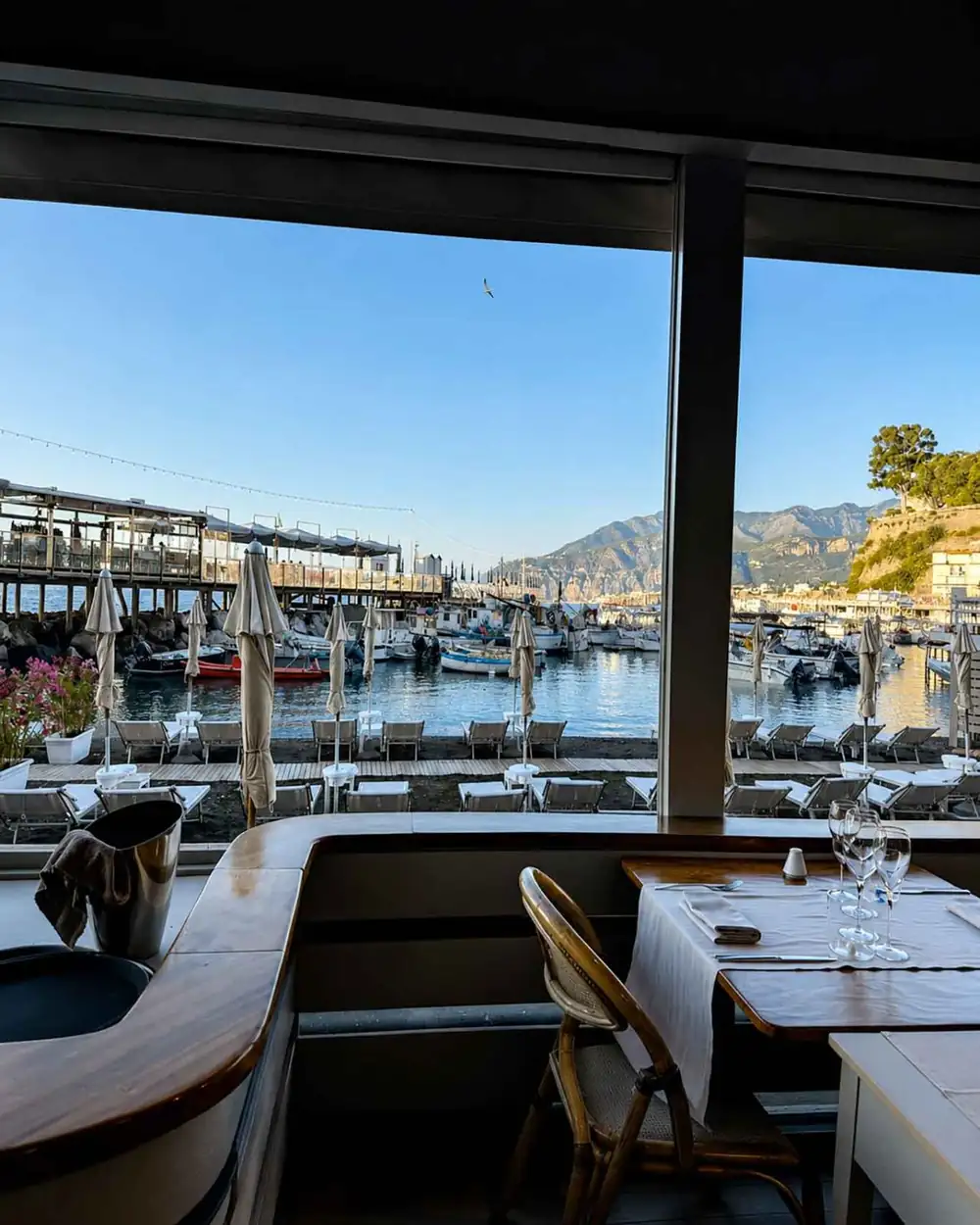
Then the sea approaches. And at Soul & Fish, it practically comes right inside. The restaurant overlooks the marina's small theater. The boats, the docks, the ropes, the slow movement of the vessels become part of the dining room. In the evening, when the lights begin to flicker on the dark surface, the harbor transforms into a natural backdrop.
There's no need to furnish it. It's already beautiful. Inside, Soul & Fish deliberately retains something of the beach resort. The wood on the floors, the natural surfaces of the tables, the rattan chairs, the suspended lamps made of woven fibers. Simple, Mediterranean materials, assembled with a care that doesn't need to be noticed.
The deep blue ceiling seems to extend the sea above your heads. The pale walls let it breathe. And then there are the windows. Large, open. The atmosphere is relaxed, essential, almost seaside. Here, the view isn't the classic backdrop placed there to make a dish more photogenic. It becomes part of the experience, complements the dinner, changes its rhythm, and acts as a counterpoint to the cuisine.
Soul & Fish keeps the soul of the seaside village intact, but brings it into a contemporary language without distorting it.
Since 1965, a story of sea, family, and grazed knees
- 1965. The sun beats down on Marina Grande. Antonino has the sea in his eyes, and Anna, the love of his life, is frying fish. The sign is Tony's Beach: a simple beach club, with yellow and red umbrellas, fish and chips, fried fish, and children running on the sand until they graze their knees. This is where it all begins.
The first acceleration came in 1995: Cataldo's son and some of his sisters took over the helm. The establishment became Da Cataldo – Tony's Beach, and the first traditional cuisine dishes emerged from the kitchen.
In 2014, Soul & Fish was born, still on the beach of Marina Grande, but with the idea of transforming that legacy into something new.
The real turning point came in 2020, when the third generation entered the scene: the five cousins Fiorenza, Fabrizio and Francesco Gargiulo, Antonino and Vincenzo Incoronato.
They're young, they've traveled, observed, and tasted. And they've brought home ideas, inspiration, and a certain desire to dare. Not to erase history. To make it evolve.
Children who once ran across the sand and returned home with grazed knees now run through the living room, kitchen, bottles, and ideas. The gesture has changed. The sea hasn't.
One family, one heart
Fiorenza and Fabrizio welcome guests without formalities: they engage, they let them breathe, they put them at ease. Something of the old beach remains here, that spontaneous familiarity that doesn't need to be declared.
Francesco, on the other hand, governs bottles and emotions with the same dangerous lightness of someone who knows that wine isn't just an accompaniment. It's conversation, humor, complicity. A small alcoholic democracy.
Then there's Vincenzo Corcione, the chef, who takes this story and brings it to the plate.
His cuisine proceeds through free thought, yet with the rigor of the wise. It explores territories, domestic memories, Mediterranean influences, and contemporary connections without ever seeming intent on proving anything. It's a cuisine that knows tradition well enough to distance itself from it.
Soul & Fish: menu, prices, and review of the seaside restaurant in Sorrento.
The Welcome: Setting the Course
Shrimp chips and seafood pie
It begins with the entrée. A welcome that's a slap of salty umami. It doesn't accompany. It sets the course. It's the first sign of a cuisine that has no particular interest in half measures. The sea isn't simply narrated: it's concentrated, altered, amplified.
Octopus, potatoes, and 'nduja: a Calabrian twist on the plot
Galician-style octopus and potato terrine with 'nduja ragù and burrata (€23).
The octopus begins with an almost reassuring imagery. Almost.
Then comes the 'nduja. Plot twist.
The dish creates a sort of millefeuille of marine sweetness: the octopus brings its fiber and intensity, the potato absorbs and softens, the 'nduja ragù penetrates with its warmth. Finally, the burrata simply teaches you how to burn better.
A robust yet delicate dish. A preparation that blends Galicia and Calabria, sea and land, softness and spiciness with unabashed vanity.
Ceviche, high-definition seafood from Soul & Fish
Local fish, red prawn and leche de tigre with passion fruit (€25).
Here the coordinates shift. A nuclear bomb in HD. The sea is stripped bare, acidified, illuminated. The shrimp brings sweetness; the white fish retains its nakedness; the passion fruit transforms freshness into something electric.
There's no balance here in the reassuring sense of the word. There's tension. Acidic, sweet, salty, tropical: the dish constantly shifts the palate's focus.
It's a dramatic shift in direction. An overdose of love, but with discretion.
The Plin, when geography goes crazy
Nerano-style stuffed ravioli with raw and cooked prawns (€28).
Piedmont remains in the shape, while Nerano enters the filling. The shrimp, however, appears in two different sizes, almost as if to remind us that the same material can tell the same story with different voices.
The pasta is precisely rolled, thin but not fragile, with the right amount of firmness that allows the filling to express itself without the ravioli losing its identity. The shrimp is incredibly fresh, almost still immersed in its element, and the dual interpretation—raw and cooked—reflects two complementary natures: the transparency of the sea on one side, the deepest sweetness on the other.
Tradition within tradition, but without nostalgia. And above all, without gastronomic cosplay.
It's a pop and cultured dish at the same time, irreverent without needing to raise its voice. A cuisine that takes something recognizable and gently forces it to become something else.
Pasta Mista, a Mediterranean inventory
Mixed pasta with rock fish reduction, fennel cream, Piennolo cherry tomatoes with orange and bay leaves (€26).
Here, the eyes become greedy. A watercolor of the sea. But one where, as you get closer, you discover layers that from a distance seemed merely color.
The first course comes from the rockfish reduction: concentrated, deep, and salty. It's not a broth accompanying pasta; it's the seabed on which the entire dish takes shape. It has that marine flavor that's not overpowering, but settles slowly on the palate, leaving a long, clean finish.
Then the fennel enters, and the light changes. Its vegetal and balsamic component lightens the density of the reduction, introducing an almost aromatic freshness and creating a necessary transition between the depth of the sea and the acidity of the tomato.
The Piennolo all'arancia is the brightest brushstroke. The sweetness and concentration of the tomato meet the citrusy part of the orange, which brings verticality, acidity, and a citrusy vibration capable of restoring order to the palate after every bite.
And then the bay leaf, carefully dosed. It doesn't show off: it stays in the background, but it lengthens the aromatic profile and ties together the vegetal and marine components.
The mixed pasta isn't just an aesthetic choice or a nod to Neapolitan tradition. The different shapes hold the sauce differently, producing mouthfuls that constantly change in consistency and intensity.
The result is a dish that Soul & Fish builds on progression.
This is where the cuisine shows its precision: it has every reason to become opulent, almost redundant, but instead it finds a dynamic balance. It shouts and whispers, it concentrates and lightens.
It's a pasta that doesn't just tell the story of the sea, it paints it. Iconic.
The Tartelletta and the dark side of the throat
Salted caramel tartlet, milk chocolate ganache and peanuts with peanut butter ice cream (€12).
The sea, for a few minutes, steps aside. The gorge remains.
Salted caramel adds tension, milk chocolate builds smoothness, and peanuts accentuate the roasted, fatty texture. Peanut butter ice cream completes the picture with a full, almost enveloping texture. A delicious dessert, fully aware of its own indulgence.
How much does it cost to eat at Soul & Fish?
The bill at Soul & Fish follows the same philosophy as the kitchen: no extravagance, but no illusions either.
Starters generally range between 20 and 30 euros, first courses around 25-30 euros, while second courses are more expensive, as is natural when you pay for fish by the kilo but also have dishes for €30. Finally, desserts are around 10-12 euros.
There's also a chef's tasting menu, five courses for 90 euros, designed to let you trust the kitchen and let it decide the course.
For a full à la carte dinner, therefore, you can expect to spend around 70-100 euros per person, excluding wine, depending on how much you enjoy the menu and the catch.
Why go to Soul & Fish
There is a word that comes back, in the end: persuasion.
Soul & Fish's cuisine is compelling because it has something to say, but it doesn't seem obsessed with explaining it. It pushes, provokes, and shifts the tone. It takes the Mediterranean, observes it closely, and then breaks it down without losing sight of the essence of the ingredients.
The technique is evident, but not flaunted. The ideas are there, but they don't overshadow the taste.
And above all, there are the people. Because a restaurant, in the end, isn't just what's on your plate. It's what happens around you.
Anna and Antonino's story continues, only with different gestures. Fried fish has become signature cuisine. Umbrellas have become windows overlooking the harbor. Scraped knees have given way to hands that dart between the kitchen and the dining room.
But the soul remains. And so you discover beauty. It, bathing in front of the tables. In the end, it sits with us. No theater. Just life. And the sea, meanwhile, continues to be sea. As if nothing had happened.
Because here it is not just before the eyes.
It is in memory, in gestures, in matter.
And most importantly, it happens.