Trattoria Al Paradiso in Pocenia, review: memories of Friuli without nostalgia
Paradiso is a small hamlet in Pocenia, in the Bassa Friulana area of the province of Udine: a land of springs, fertile fields, and rivers—the Stella above all—that have shaped not only the landscape and geography but also the local gastronomy and gastronomic history.
The history of Trattoria al Paradiso
While in the 1960s the restaurant was still a simple tavern, the "Ostarie al Paradiis," the year that began to shape its course was 1972, when Anna Maria Mauro, who had worked at the tavern as a waitress, took over the business with her husband, Aurelio Cengarle. From that moment on, the restaurant grew, both in terms of its identity and self-awareness, to become one of the most recognized establishments in the region.
Anna Maria's journey passes through two important references: the "siege Rosalie", an almost legendary figure from a noble family, and above all Gianni Cosetti, the great interpreter of Carnic cuisine at the Ristorante Roma in Tolmezzo.
From the latter comes a fundamental part of the Paradiso philosophy: the promotion of a regional cuisine capable of becoming distinctive and elegant, without losing its connection to its origins, but giving them a broader scope. Over the years, the Cengarles have not only helped define their gastronomic signature, but have also made family management and hospitality a distinctive trait, perfectly embodied in Federica Cengarle—daughter of Anna Maria and Aurelio, who runs the dining room with skill and confidence. Today, Trattoria al Paradiso is an essential destination for anyone interested in learning about Friulian cuisine, or rather, that of this part of Friuli, and its roots.
The environment
Crossing a sparsely populated countryside, the restaurant's sign—two stylized mallards, forged with joined beaks—is a call to stop and conveys the charm of the tavern, without artificial or forced reconstructions.
The restaurant occupies part of the village's ancient agricultural buildings, and the restoration—begun in 1994—respected the rural architectural culture of Friuli. The result is a setting where spaces and details interact coherently, evoking a rustic feel while simultaneously conveying warmth, elegance, and a welcoming atmosphere.
Four tastefully furnished rooms, a large central fireplace, a majolica "stube," ironed tablecloths, cupboards, decorations that are never overdone, and the use of materials such as wood and stone: in short, you find yourself in a large country house, waiting to enjoy dishes that also speak to the soul.
The paper and the plates
Paradiso's cuisine revolves around a precise repertoire that unfolds simply by observing the landscape and moving through it: here then are the farmyard animals (guinea fowl above all, as well as rabbit, chicken, and pork), game both furred and feathered (wild boar, deer, and mallard duck), snails, cheeses, mushrooms, herbs, and not forgetting freshwater fish.
Cosetti's lesson was assimilated and made his own by chef Loris Plazzotta, who created a menu that is respectful of tradition but not rigid and intelligently lightened.
Four or five options per section (starters 15-18 euros, first courses 16-19 euros, second courses 25-29 euros, desserts 10-12 euros) and the option of a tasting menu (80 euros).
Among the signature dishes is certainly the Oro del Friuli, a reinterpretation of the “toc in braide” inspired by Gianni Cosetti in which three different consistencies of Montasio cheese find perfect support in the soft polenta and the morcje, cornmeal toasted in brown butter, taking a dish with peasant roots to great heights.
Cjalsons are the best synthesis of Carnic cuisine, enclosing in a thin pastry not only a filling of which there are around forty local variations (raisins, cocoa, cinnamon, spinach, apples, pears, plums, chives, ricotta, potatoes, jam, rum, grappa, parsley, eggs) but also the history of the cramars, the street vendors who during the winter months traveled from Carnia to Austria, Germany, and Hungary, exporting fabrics and bringing back home drugs and spices from Venice.
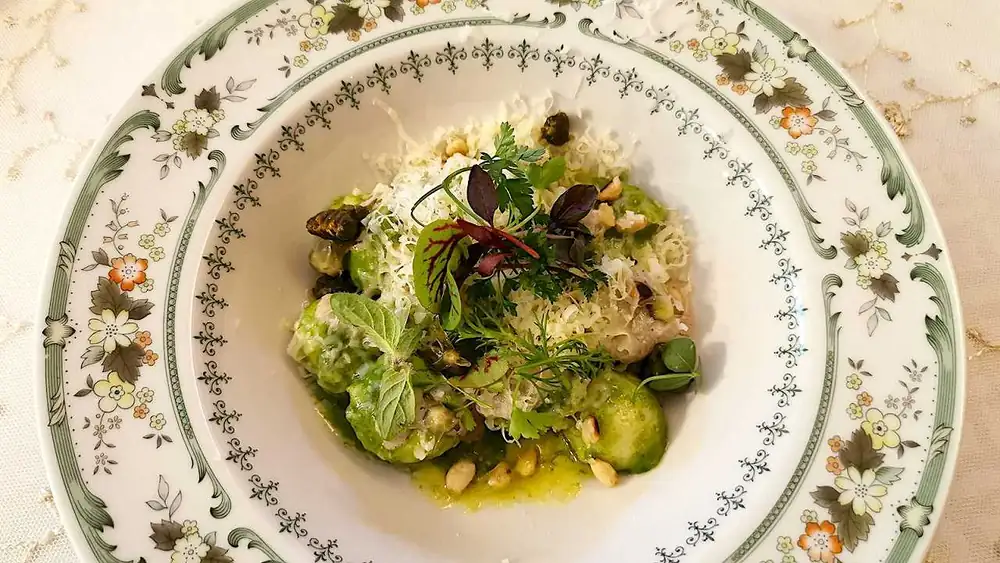
Refined flour and milk gnocchi with herbs, toasted pine nuts, and a veal marrow and donkey cheese sauce, these humble ingredients are expertly crafted to achieve today's balance between softness and crunchiness.
The Queen of the Courtyard is noble and classic, a guinea fowl stew with duck foie gras, Verduzzo sauce, vegetables, chard, and potatoes. The Pigeon is offered in several versions, reflecting a more contemporary approach. Among the desserts, the impeccable millefeuille is a must-try.
You don't come to Paradiso for "surprising" cuisine, but rather to taste dishes that are aware of their own history: brown stocks and French influences sit alongside Friulian dialect and the countryside, without class distinctions but simply contributing to a happy, rosy-cheeked enjoyment.
Final opinion:
Under the guidance of the Cengarle family, Trattoria Al Paradiso, in the Bassa Friulana area, has become a restaurant that tells the story of Friulian cuisine without remaining nostalgically anchored to the past.
The dishes tell the story of the landscape and the region through ingredients (farmyard animals, game, wild herbs, cheeses, polenta, river fish) that never stray too far from their borders but are simultaneously intelligently transformed into dishes revisited and brought to life in the present.
Rating: 8/10