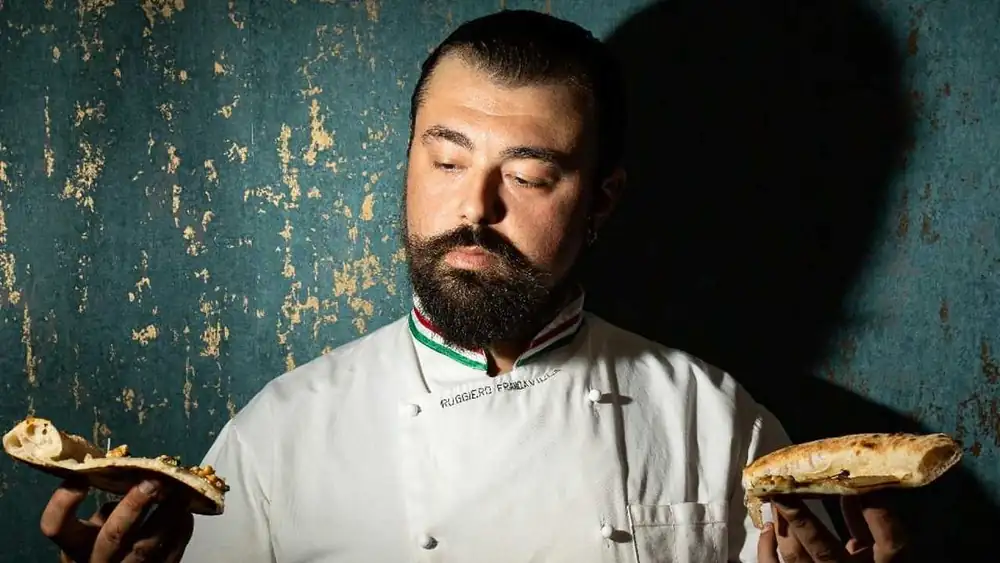
Who is Ruggiero Francavilla, the new Dallagiovanna Pizza Ambassador?
Ruggiero Francavilla emerged victorious from the long and demanding selection process that severely tested the many pizza professionals who competed in this latest edition of Molino Dallagiovanna's Pizza Bit Competition, earning the prestigious title of Dallagiovanna Pizza Ambassador for the next two years.
From the family bakery to fine dining
Ruggiero, your story begins in Barletta and your father's workshop. How did your relationship with the art of baking begin?
I'm the son of a baker, and in Barletta there's a historic bakery that belonged to my father, which I now run. From a very young age, my father encouraged me to learn about the art of baking: instead of playing soccer with the other kids, I went to work in his bakery. As I grew older, however, seeing the enormous sacrifices he made, the night shifts, and the difficult life that this profession entailed, I abandoned that path for a while and took up other studies, first enrolling in philosophy and then business administration. Later, I realized that baking was what I truly needed to do with my life, and I returned to working in the bakery alongside my father.
From traditional bread making to pizza: what was the spark that changed your perspective?
“Once I had completed my knowledge of the art of bread making, one day I went to Naples and ate at Attanasio's in Spaccanapoli. There, a light bulb went off in my head because of the dough. I fell madly in love with that world and realized I had to be able to replicate that type of pizza: I began to do countless experiments and study the material from a chemical, physical, and biological perspective, precisely because at first I couldn't replicate Neapolitan pizza. Based on these studies and experiments, I created my own reality, later veering towards contemporary pizza and specializing in this field. Later, we transformed the family workshop, turning it into a pizzeria as well as a bakery.”
There's a lot of talk about the union between pizza and fine dining, and you have significant experience in this regard: can you tell us about it?
My partner had received a job offer in Pavia. To be close to her, since I had staff who could cover for me at the bakery and pizzeria in Puglia, I sent out several resumes and landed a job at a restaurant that was looking to open both a bistro and a gourmet line, Lino, becoming a pizza chef there. Finding myself in the same environment, with a shared kitchen and working alongside renowned chefs, I began to gain in-depth knowledge of the world of raw materials and cuisine, as well as that of leavened products.
When the team was short of staff, I worked first in the bistro and then in the delicatessen, overseeing preparation and approaching ingredients in a much more in-depth manner. That's when the spark ignited: I wanted to create a union and bring refined cuisine and fine dining to pizza. Later, due to family issues, we had to return to Puglia, where my personal project was born: bringing fine dining to pizza, showcasing the local produce.
Your journey at the Pizza Bit Competition was marked by significant personal development. How did you experience the final?
Two years ago, I reached the final but didn't win. Back then, I showed up with an extremely complex pizza, designed to show off my skill in the kitchen, but I lost sight of the details. After overcoming my anger and disappointment, I realized the mistakes I'd made and entered the competition again to overcome my limitations: the performance anxiety and fear of judgment that led me to self-sabotage. This year, however, I arrived at the final with complete peace of mind and the knowledge that I could show myself and have fun.
I realized that in the previous final, I'd been held back by the fear of making a mistake during the twenty-minute competition. A minute before competing this year, my partner, who had accompanied me to the final with our two-month-old daughter, told me to do it for her. My real concern was the sacrifices and the time taken away from my family to study at night, and her words gave me unexpected strength and energy.
Your Margherita, with which you won the Pizza Bit final, had many complex preparations: can you explain them to us?
My idea was to maximize every raw material, applying the concepts of sustainability and zero waste, creating three different uses for tomato, mozzarella, and basil. For the tomato, I chose Fiaschetto di Torre Guaceto, a Slow Food Presidium from the Brindisi area between Carovigno and Brindisi, characterized by a high Brix level and a high concentration of sugars and minerals. For the base, I prepared a tomato sauce cooked at a low temperature to preserve the freshness and vivid color of the raw tomato.
Since tomatoes are rich in glutamic acid, responsible for umami, I created a reduced glaze to enhance this component. Finally, I recovered the wastewater produced by cutting the tomatoes and cryopreserved it by freezing and thawing it. Taking advantage of the fact that sugars and mineral salts thaw faster than free water, I obtained spheres with a tart, raw tomato flavor.
What processes did you use for the mozzarella and basil?
"From the mozzarella drippings, I recovered the milk and mixed it with whipped whey proteins to obtain a dried, crumbly, and savory wafer. I then made a lacto-fermented mozzarella fondue to add acidity, pairing it with the melting part of the mozzarella during cooking. For the basil, I used microgreens for the pungent note of the embryonic stage, a flavored oil for the lipid and balsamic component, and an infusion cooked at a low temperature."
All these preparations were transported vacuum-packed, taking every precaution. My goal was to present a three-dimensional Margherita rich in nuances, yet with a true Margherita flavor, as I verified by having my collaborators perform blind tests at the pizzeria. The judges themselves appreciated the fact that every element described fit perfectly on the plate.
In the semi-finals, you also proposed a pizza in which you combined Molino Dallagiovanna's Blackery blend with fermented carrot water, a great challenge.
For the test where we were required to use Blackery flour, I created a pizza centered around another Slow Food Presidium, the Polignano purple carrot. I used it to make a purple carrot and chanterelle demi-glace, along with carrot ribbons soaked in gin. From the recovered osmosis water, I formed spheres, topping the discs with dill oil, dill tops, radish sprouts, and a crystal of smoked stale bread. To avoid wasting the scraps left over from shaping the ribbons, I vacuum-sealed them to ferment and used the fermented purple carrot water as a starter in the dough.
Is using fermented water in dough a technique you also adopt in the day-to-day management of your pizzeria?
Yes, at the pizzeria we regularly work with fermented water, always with a zero-waste and recycling focus. For example, we recover the water produced by chopping tomatoes for focaccia or the whey from mozzarella, fermenting it to use as a starter for dough, depending on the availability of scraps. It's our philosophy for combining haute cuisine, sustainability, and respect for local ingredients.