Fuba in Rimini: a review of Romagna's most entertaining (and promising) restaurant
The early stages of opening a signature restaurant are characterized by an energy that any self-respecting gourmet can sense and enjoy, with the bitter knowledge that, unfortunately, it is destined to fizzle out or, in the best cases of great kitchens of thought, evolve into something else.
It's a phase in which potential clearly emerges, and where the enthusiasm that shines through is so contagious that it overshadows any necessary adjustments or unfinished steps. Over time, gestures become automatic, creativity becomes practice, service becomes perfect, everyone appreciates it, but something gets lost. It's natural, and criticizing an artist who's undergoing this process would be grotesque. Of course, combining the magic of gastronomic youth with impeccable technique and the clarity of ideas born from experience might seem like an impossible dream, but we're willing to take a risk: here at Fuba in Rimini, something exactly like this is happening.
Let's start from the beginning. Fuba is a portmanteau of the surnames of Enrico Fusi and Angelo Barletta, chefs and owners both under 30, who between them have a pedigree of truly remarkable experiences: the nearby fine dining of Magnolia (then still in Cesenatico), the restlessness of Bros, the Romagna revolution of Lucio, and then the rigor of Alfio Ghezzi and a stint in Massimo Bottura's stable (so to speak) with a stint at the Prancing Horse in Maranello, and the Spanish cuisine of Mont Bar, two Michelin stars in Barcelona.
Where is Fuba located: Rimini not Rimini
And the bar itself is the ideal vantage point from which to appreciate the work of Imanol Cuesta and Giacomo Pruccoli, talents decidedly on par with those in the kitchen, creators of an elegant and perfectly coordinated service, supported by a not-so-extensive but well-conceived wine list, enhanced by a house kombucha as a non-alcoholic option and a “por copa” service of vermouth and cider.
How to eat and how much to spend at Fuba
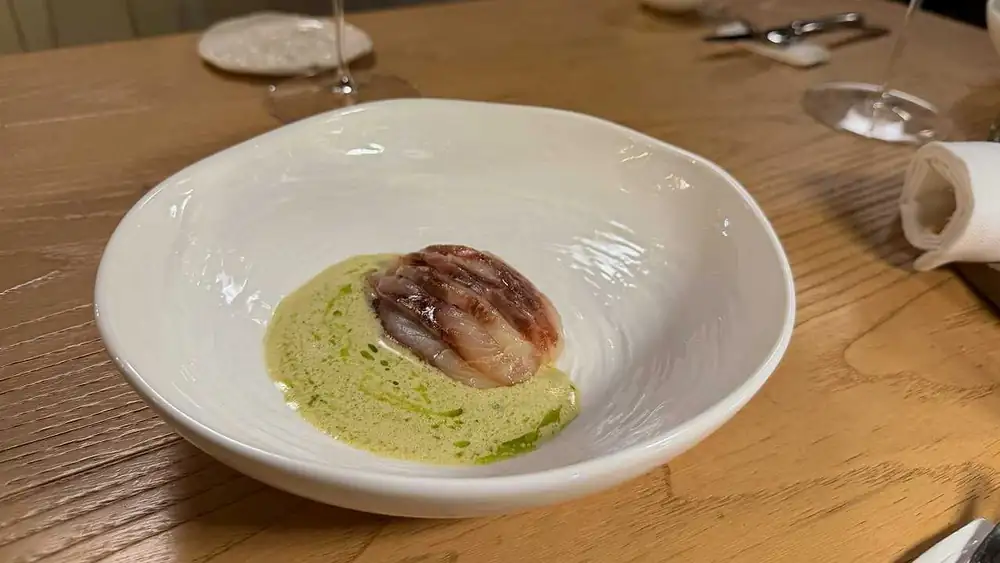
But what is driving Fuba's meteoric rise among gourmets is undoubtedly its cuisine, made up of both delicious concentrations that make it transversal and enjoyable, and details that give depth to those who want to grasp it, underpinned by a brilliant irony that gives the whole thing a fun and entertaining tone, a shining example of "fun dining."
Fusi and Barletta waste no time in pleasantries, and their signature dish is clearly defined from the first bites before the appetizers: see the mochi "like toast," yielding and gelatinous like the typical Japanese dessert and filled with a ham and fontina cheese that embodies decades of bar lunches, or the "fetta al latte," caramelized nori seaweed with squacquerone semifreddo. The Japanese inflections are evident, but the interpretation is the polar opposite of any fusion banality: Spanish synthesis and the house's signature humor create an ideal antiphon.
When it comes to pasta, the chefs are particularly on point: the "Conchiglie, conchigliacei, lardo e lauro" (Shells, shellfish, lard and bay leaves), with their increasing concentration as you dig in the spoon, the surgical cooking, the raw razor clams that insinuate themselves inside the pasta, and the clever management of fat and aromatic contrast, would bring to mind a dish conceived a few kilometers down the road, in Senigallia. It's a comparison we don't use lightly, but given the "sidecar," the stuffed and gratinated conch shell with which it's served, perhaps the reference is intentional.
The work on the bases, always enriched in tone-on-tone that gives multiple nuances and depth, is another signature of the house: the Bitter gives a bitter edge and infinite persistence to the sauce of the “Plin di faraona alla cacciatora, olives and Campari”, in which the olives, as savory as they are bitter, resolve a complex harmonious accord with disarming simplicity.
Same concept, different execution in the "Stewed Pigeon," which behind its understated name hides a truly sumptuous service. Breasts and fillets carefully separated and grilled, legs cooked slowly, melting and with crispy skin, and a chocolate-like liver to finish, are supported by a tomato composition that could be a dish in itself, characterizing the base and providing complement, contrast, and complexity in its many expressions.
For the two very young chefs, nothing is sacred, and rightly so: they play with classic sauces, such as the revisited Café de Paris sauce made with white chocolate that accompanies the lamb with bitter herbs—another memorable passage—and they subvert expectations, even transforming a Thai soup like Tom Yam into a dessert that maintains its spicy-sweet profile by interpreting it with lemon curd, chili crumble, coconut milk, and tomato oil.
There are three tasting menus: "Incipit" for €60, the vegetarian "Verde che ti voglio verde" for €55, and "Rapsodia," eight free-form tasting menus for €80, each with an equal number of wine pairing options. It's hard to ask for more from a place that opened just a few months ago and is rapidly gaining momentum, so much so that we're forced to exercise some rationality and temper our enthusiasm: the start is dazzling, the road ahead, especially given its average age, is long and ample, and we can expect a lot from Fuba. Rating: 8/10.