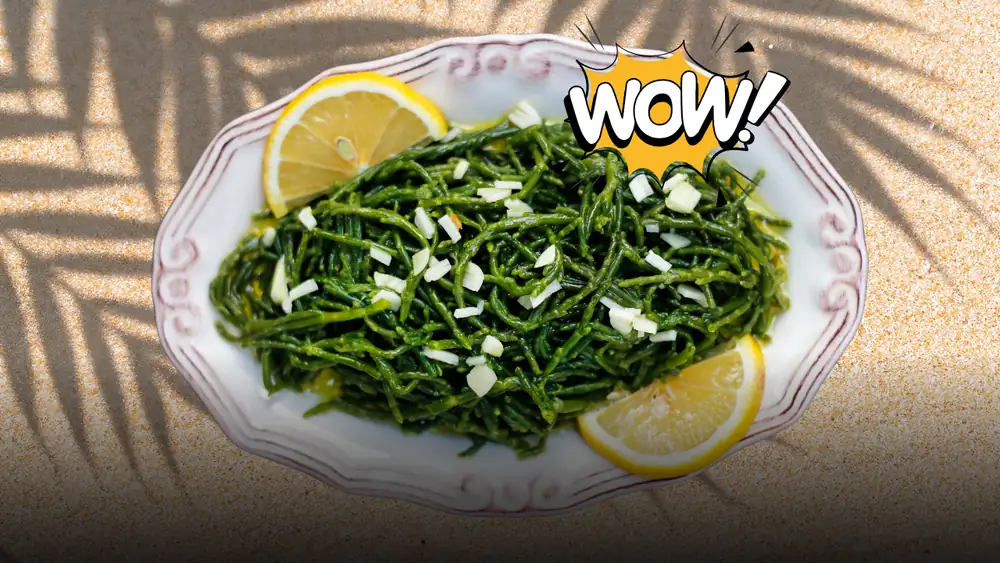
Small, crunchy, and packed with nutrients: this is why sea asparagus has become the secret ingredient most loved by great Italian chefs
It has the singular appearance of a small, branched, thornless cactus, grows lushly just steps from the waves and is conquering the menus of the peninsula's finest restaurants.
What is sea asparagus and where does it grow?
Belonging to the Amaranthaceae family—the same as spinach and beets—glasswort is a halophytic plant, capable of growing in salt-rich environments. Its fleshy stems are bright green in spring, turning red in autumn. In Italy, it grows wild along the Adriatic and Tyrrhenian coasts and in the lagoons of Sardinia and Sicily. Absorbing mineral salts directly from seawater, chefs call it a true "vegetable salt," perfect for flavoring any dish.
Nutritional properties and health benefits
Nutritionally, glasswort is a powerhouse of essential micronutrients. Nutritional information highlights its high content of minerals such as potassium, magnesium, calcium, and iodine, as well as a significant presence of vitamins A and C. It also provides an excellent supply of fiber and antioxidants. Its natural flavor allows you to flavor dishes while reducing the use of refined salt, proving a valuable ally for those who need to control blood pressure or reduce water retention, all with a very low calorie intake.
How to clean and use glasswort in the kitchen
Culinary care for glasswort is easy: simply remove the tough, woody end of the stem and rinse the sprigs under running water to remove any sand. The tender shoots can be eaten raw in salads with oil and lemon. Alternatively, blanch them for two minutes in unsalted water or sauté them in a pan with garlic and oil. It's excellent for seasoning pasta dishes, risottos, gnocchi, and as an accompaniment to fish fillets, crustaceans, or mollusks.
Why do we call it Russian salad if a Belgian chef invented it? The incredible story of the dish that conquered the world.
Created in Moscow in the 19th century by chef Lucien Olivier, the original dish featured luxurious ingredients and a mysterious sauce. Between culinary insights and popular adaptations, here's the true evolution.
Trays covered in mayonnaise, diced vegetables, and pickles regularly appear at family dinners and in kitchens across the country. Russian salad is an indisputable cornerstone of our gastronomic tradition, yet its name continues to raise questions. The answer to its origins lies in a fascinating intertwining of luxury recipes, industrial secrets, and profound historical transformations.
From the Hermitage restaurant to Olivier's secret recipe
The dish's origins date back to the 1860s in Moscow. Lucien Olivier, a Belgian-born chef at the helm of the famous Hermitage restaurant, frequented by the high society of the time, worked there. The chef created a sophisticated dish, far removed from the modern version, initially dubbed "Olivier salad."
The original version included partridge meat, quail, crayfish tails, caviar, and veal tongue. It was all finished with a touch of mayonnaise and a combination of spices, the exact formula of which Olivier guarded until the end of his days, never revealing it to anyone.
Kitchen espionage and the Soviet transformation
The dish's popularity soon sparked imitation attempts and even episodes of gastronomic espionage. Contemporary accounts tell that Ivan Ivanov, a sous-chef at the Hermitage, took advantage of a moment when the master was away to analyze the composition of the secret sauce, later creating his own variation called "Stolichny."
With the outbreak of the October Revolution in 1917 and the decline of aristocratic cuisine, the recipe underwent a radical popular transformation. In the Soviet Union, the original expensive ingredients were replaced with cheaper, readily available ones: salami or chicken replaced game, while potatoes, carrots, and peas replaced caviar and shellfish. Exported abroad, the dish took the name of its homeland, while remaining known in Russia simply as "salade Olivier."
Piedmontese Myths and Regional Variants in Italy
Alongside the official historical reconstruction, there are several popular theories linked to our country. A Piedmontese tradition attributes the invention to a court chef of the Savoy family. During a visit of a tsar to Italy in the late 19th century, the chef created a salad made from beets and cream, called "insalata rusa" (meaning red) in dialect, later modifying the ingredients.
While historical sources firmly support the Moscow origin, these legends testify to how deeply rooted the dish has become in Western European culture, becoming a timeless classic.
Why incorporating lentils into your weekly menu is good for your health: zero cholesterol and plenty of plant-based proteins.
Considered a poor man's food for centuries, lentils have proven to be a powerful source of health benefits. The Italian National Institute of Health's guidelines recommend regular consumption to reduce cardiovascular risk, aid digestion, and manage weight.
Often served as an occasional side dish or a staple of the holiday season, lentils are actually a nutritional treasure trove of the highest order. Historically considered the "poor man's meat," these small legumes pack an extraordinary punch of essential macro and micronutrients. Incorporating them into your daily menu on a regular basis is a strategic choice for those who want to improve their diet without impacting the family budget or overall calorie intake.
The nutritional profile between proteins, fiber and zero cholesterol
From a compositional standpoint, this food is particularly complete and balanced. Lentils boast a high vegetable protein content, a very low lipid content, and a total absence of cholesterol. Furthermore, they are particularly rich in essential minerals such as iron, potassium, phosphorus, magnesium, and zinc, in addition to a significant amount of B vitamins, especially thiamine (B1) and niacin (B3). The high content of dietary fiber, mostly insoluble, plays a key role in both regulating intestinal activity and nourishing the colonic microbiota.
The benefits for the heart, blood sugar and weight control
The recommendations included in the Guidelines for a Healthy Diet edited by the National Institute of Health suggest consuming legumes at least three times a week. This regular consumption guarantees direct effects on systemic health: the low glycemic index of lentils allows for a gradual release of energy. This avoids glycemic spikes and is recommended for those with diabetes or on calorie-restricted diets. At the same time, the combination of potassium, folate, and fiber helps control blood pressure and reduce fat absorption, thus protecting the cardiovascular system.
Cooking pairing tips and digestibility
To fully exploit the potential of lentils, modern nutrition recommends pairing them with grains like rice, spelt, or pasta. This combination provides a complete amino acid profile, comparable to that of animal proteins. To optimize the absorption of non-heme (i.e., plant-based) iron, experts recommend pairing them with foods rich in vitamin C, such as lemon juice. Finally, for those suffering from digestive difficulties or irritable bowel syndrome, using the hulled variant allows you to benefit from the nutrients while reducing the impact of external fibers.
Pumpkin tortelli, the sweet flavor of autumn that smells of tradition.
From the Mantua plain to Italian tables, pumpkin becomes the protagonist of a dish that combines flavor and tradition.
Autumn arrives, and with it the return of the queen of Mantua's tables: pumpkin. Sweet, colorful, and versatile, it is the soul of one of the Po Valley's most iconic dishes, pumpkin tortelli, a specialty rooted in history that still today represents a profound connection to the land and family memories.
The dish originated between Mantua and Ferrara during the Renaissance, when pumpkin, brought from the New World, became a prized ingredient in court kitchens. The Gonzaga family, in particular, made it the centerpiece of a recipe in which the elegance of fresh pasta meets the sweetness of the vegetable and the aroma of mustard. Since then, pumpkin tortelli have never ceased to embody tradition, moving from aristocratic tables to Christmas Eve lunches in peasant homes.
The dough: the art of simplicity
Like all great Emilian cuisine, this recipe begins with an egg dough: 00 flour and eggs in the classic ratio of one egg for every 100 grams of flour. It's kneaded vigorously until smooth and silky, then left to rest, covered, for at least half an hour. Once rolled out thinly (about 1 mm thick), the dough is cut into 6-7 cm squares, ready to accommodate the filling.
The heart of the dish: the pumpkin filling
The real secret to pumpkin tortelli is the sweet and fragrant filling. The traditional Mantuan recipe calls for delica or Mantovana pumpkin, a variety with dry flesh and an intense flavor. After being sliced and baked in the oven for about 40-50 minutes, the pumpkin is mashed and combined with grated Parmigiano Reggiano, crumbled amaretti biscuits, finely chopped apple or pear mostarda, and a sprinkling of nutmeg. The result is a soft and aromatic mixture, perfectly balancing the sweetness of the pumpkin with the slightly spicy and citrusy note of the mostarda.
Some variations call for adding a little breadcrumbs to dry out the filling or melted butter to make it creamier. But the rule remains the same: the flavor should be harmonious, neither too sweet nor too salty.
The closing: a gesture of mastery
Each square of pasta is filled with a small dollop of filling in the center. It's folded into a triangle, sealing the edges well with your fingers or the prongs of a fork, then finished with a pastry wheel, giving the tortelli their characteristic shape. There are regional variations: in Mantua they're thinner and rectangular, while in Ferrara they take the shape of cappellacci, larger and rounder.
Cooking and seasoning
Tortelli are cooked in abundant salted water for a few minutes, until they float to the surface. The traditional sauce is simple and irresistible: melted butter and sage. The butter, left to brown slightly, envelops the pasta with a delicate aroma, while a sprinkling of Parmigiano Reggiano enhances the overall effect. In some more modern versions, a light reduction of balsamic vinegar or a cream of aged cheese is added, but never overpowers the unmistakable flavor of the pumpkin.
A dish that tells the story of a territory
Pumpkin tortelli aren't just a dish, they're a symbol of belonging. They speak of a cuisine born from the earth and transformed into art, where nothing is wasted and every ingredient has meaning. In the Mantua area, they're a holiday staple, prepared by families, often by several hands, with slow, precise gestures passed down from generation to generation.
Today, they are also a staple in gourmet restaurants, where chefs and enthusiasts reinterpret them with new textures and combinations, while still respecting their original essence: the sweetness of pumpkin as the heart of a memory.
The taste of memory
Soft, golden, and fragrant with nutmeg and sage, pumpkin tortelli are much more than a recipe: they're an embrace that tastes of home and the changing seasons. Each bite holds the story of a cuisine that unites northern and southern flavors, tradition and innovation, past and present. And while the first leaves fall outside, the scent of pumpkin baking in the oven continues to remind us that true beauty, in the kitchen as in life, always comes from the simplest things.