Vizinhos do Rei Restaurant blends flavors and memories in the heart of Odivelas
The Vizinhos do Rei restaurant doesn't close when lunch ends.
This way of operating reveals the personality of the restaurant even before the menu arrives. The cuisine is Portuguese, the atmosphere maintains the charm of an old-fashioned tapas bar, and Odivelas is present in the products, the recipes, and the history of the building.
The identity of the Vizinhos do Rei restaurant is thus built upon national flavors, the relaxed pace of service, and the connection to the local area. The new management has restored a space linked to the city since the 1940s, preserving the memory of a place where several generations gathered around snails, beer, and conversation.
Today, this continuity translates into a kitchen open from 12 pm to 11 pm, a menu that changes throughout the day, and a growing relationship with local producers.
Restaurante Vizinhos do Rei keeps its kitchen open during the afternoon.
The culinary structure of the Vizinhos do Rei restaurant is based on two complementary roles. Executive chef Eduardo Duarte defines the strategy and gastronomic concept, while chef Luís Silva leads the kitchen and oversees the daily preparation of the dishes.
With over 30 years of experience, Eduardo Duarte has built a career linked to catering, large events, Casa do Marquês, and Cidade do Futebol. He also led the Blanco project in Santo Estêvão and collaborates in the gastronomic field with Food Saria.
The invitation to join this new phase came from Paulo, one of the restaurant's partners, at a time when it became necessary to review the restaurant's concept and break some routines. The work being done seeks to bring the menu closer to local products, the region's former agricultural activity, and the conventual tradition of Odivelas.
Next to the stoves, chef Luís Silva coordinates the daily operations of the kitchen. Brazilian and passionate about Portuguese cuisine, he works with the flavors and recipes that define the national table.
Brazilian influence may appear occasionally through certain combinations or dishes like escondidinho (a type of shepherd's pie). These offerings will be occasional, as Portuguese cuisine remains at the heart of the concept.
At lunchtime, the restaurant offers a daily changing set menu, consisting of one meat and one fish option. Once lunch is over, the stoves keep firing and the appetizers take center stage.
At the Vizinhos do Rei restaurant, the transition from lunch to afternoon happens without interrupting service. The pica-pau (a type of fish) and limpets revive part of the tradition of the old establishment and adapt to a less formal moment, where the meal can extend at the pace of those who remain at the table.
For dinner, more elaborate dishes appear. The pork cheek is slow-cooked and served with sweet potato purée and a sauce made with wine, cheese, and spices.
The octopus also comes with sweet potato puree and grilled or sautéed vegetables of the day. The meal can begin with shrimp or other appetizers designed for sharing.
The menu at the Vizinhos do Rei restaurant maintains recognizable ingredients and avoids transforming Portuguese dishes into overly complex compositions. The technique seeks to enhance the flavor without masking the raw materials.
For dessert, the connection to Odivelas returns to the table. Odivelas white marmalade, a historic product of the municipality, is used in a contemporary presentation without losing the identity that made it one of the gastronomic symbols of the region.
At the Vizinhos do Rei restaurant, the Odivelas white marmalade cheesecake creates a direct connection with the region. The convent pudding follows the same path, recovering the flavors linked to sweets prepared with eggs and sugar in Portuguese convents.
The proximity to the Monastery of Saint Denis and Saint Bernard makes this presence particularly significant. The menu is not limited to referring to local tradition: it uses some of its products and flavors in the construction of the current gastronomic proposal.
Sustainability at the Vizinhos do Rei restaurant starts in the café.
The connection with producers from Odivelas takes shape through a partnership for the organic cultivation of mushrooms. Lion's mane, shiitake, and pleurotus are among the varieties chosen to be included in the menu.
In the kitchen, mushrooms are prepared simply, preserving the texture and characteristics of each species. The product takes center stage on the plate, without being hidden by overly elaborate combinations.
The model adopted by the Vizinhos do Rei restaurant begins with the coffee grounds consumed daily. After being collected and stored, they are delivered to local producers to be incorporated into the substrate used in cultivation.
Weeks later, some of these mushrooms return to the kitchen. The process creates a small cycle between consumption, reuse of waste, organic production, and cooking.
This collaboration allows the Vizinhos do Rei restaurant to work with products grown in the municipality and maintain a direct relationship with the producers. At the same time, it shows how waste produced every day can return to the food chain.
The same cup of coffee that concludes a meal can, therefore, contribute to the cultivation of an ingredient that will later appear on the menu. Sustainability emerges as a practice integrated into the functioning of the household and not just as an idea associated with the design.
Wines at the Vizinhos do Rei restaurant come from different regions.
The wine component is overseen by Pedro Martins, one of the project's partners and a sommelier trained at the Lisbon School of Hospitality.
The selection covers regions such as Lisbon, Dão, Douro, Alentejo, Bairrada, Colares and the Azores, accompanied by some international references. The diversity allows you to find wines for different occasions, from afternoon snacks to more structured dinner dishes.
The wine list at the Vizinhos do Rei restaurant follows the same flexible rhythm as the cuisine. It's not just designed for main meals, but also for moments that extend into the afternoon.
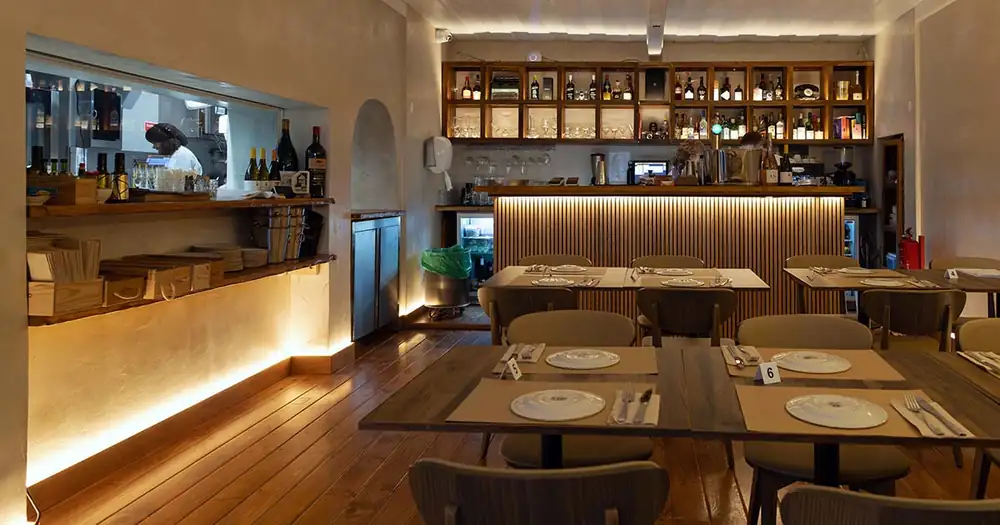
The bar occupies a significant part of the room and contributes to the space's identity. Like the kitchen, it adapts to the changing pace between lunch, afternoon tea, and dinner.
Outside, Largo D. Dinis adds another dimension to the house. The octagonal bandstand, the trees, and the proximity to the monastery frame a terrace where the connection with the city remains ever-present.
According to information provided by officials, an underground watercourse crosses the site and passes under the building towards the main church of Odivelas. The spring is part of the stories associated with the square, although its relationship with the religious architecture is not documented.
Restaurante Vizinhos do Rei continues a story that began in the 1940s.
The commercial history of the Vizinhos do Rei restaurant began in the 1940s, when the building housed a neighborhood grocery store that sold wine and served meals to passersby in the square.
In the 1950s, the space evolved into a snack bar. Between the 70s and 80s, the snails and beer made the establishment well-known in Odivelas and gave it the popular nickname "house of snails".
According to testimonies from former distributors of Central de Cervejas, collected by the current owners, the establishment was once the largest point of sale for snails and beer in the São Paulo region.
The popularity also attracted some well-known figures from culture and sports. Amália Rodrigues and Eusébio were frequent visitors to the establishment, and there are old photographs that document their presence there.
In the 1990s, the establishment came under the management of Mr. Francisco. For almost four decades, the former owner kept the place running and preserved its popular character.
As the owner aged, the business gradually lost the momentum it once had. In recent years, the space functioned mainly as a traditional tavern, until the possibility of new management arose.
The building's history extends beyond its commercial activity. Inside, vestiges remain of what would have been an old passageway leading to the Monastery of Saint Denis and Saint Bernard.
The use of this access point is not documented and remains among the stories passed down through generations. The mark preserved on the wall, however, reveals the physical proximity between the building and the convent complex.
The new phase of the Vizinhos do Rei restaurant recovers this succession of memories without attempting to fully reproduce the old establishment. The past remains in the identity of the space, while the cuisine and service respond to the current routines of the city.
A personal connection to Largo D. Dinis
When Mr. Francisco decided to leave the business, three partners who grew up in Odivelas took over the space. The project was planned for about two years before opening in June.
The owners' relationship with Largo D. Dinis had begun long before. The first photographs of their lives, baptisms, school reunions, and various family gatherings became associated with the monastery and the nearby streets.
The connection between the Vizinhos do Rei restaurant and the square also stems from these memories. Taking over the business meant returning to a place that has been present in the lives of the three partners and preventing a place known to several generations from disappearing from the city.
The renovation respected the traces of the past without keeping the space confined to the old tavern. The dining room, bar, kitchen, and terrace were reorganized, while the menu recovered flavors linked to Portuguese identity and the region.
The first few months brought difficulties, changes, and adjustments. The team now considers that the house has reached a more mature phase, although the project continues to be refined.
The future of the Vizinhos do Rei restaurant remains linked to the city.
The next phase involves preparing the terrace for the colder months. The intention is to create an enclosed structure that allows for maintaining outdoor comfort during the winter.
The menu will receive new proposals at certain times of the year, reflecting the seasonality of ingredients and the work developed with local producers.
Paulo and his partners admit they want to grow the project, but their priority is to consolidate the business. Pedro's experience, built over about 25 years managing beach restaurants and bars, is key to this evolution.
The old grocery store, the "house of snails," Mr. Francisco's tavern, and the current restaurant belong to different periods of the same address. Each stage left traces that help to understand the identity that is sought to be preserved today.
At the Vizinhos do Rei restaurant, this identity is born from the encounter between Portuguese cuisine, products from Odivelas, and the memories of those who have known the square since childhood. The place has changed, but the table continues to fulfill the function it has had for several decades: bringing together food, time, and conversation.