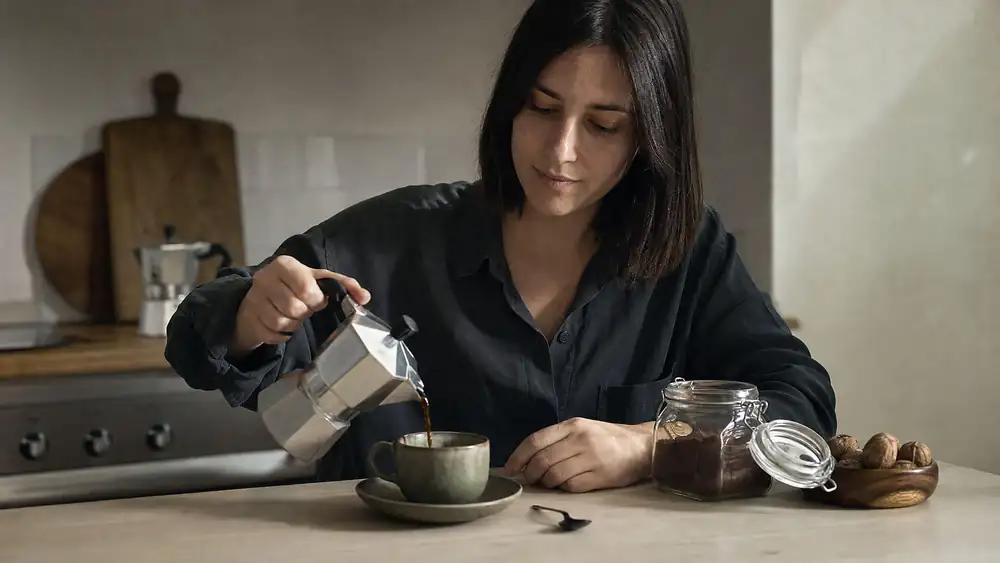
Moka pot: how it works and how to care for it for intense coffee
That unmistakable bubbling and the aroma that fills the house first thing in the morning have a name: the moka pot.
How a moka pot works (and why it's not an espresso)
Three parts and little else. A lower reservoir for water, a funnel-filter where the ground coffee is held, and the upper chamber where the beverage collects. When heated, the pressure increases in the reservoir, the water rises through the funnel, passes through the coffee, and rises ready to be served.
It's worth debunking a myth. The idea that a moka pot works solely with steam is incomplete: the pressure comes from the combination of air trapped above the water and the steam generated during heating, according to a study by JE Illy and colleagues published in the International Journal of Heat and Mass Transfer (2008). This is why the water can begin to rise before it boils.
And the espresso? It's completely different. A moka pot operates at approximately 1-2 bars of pressure, compared to around 9 bars (±2) in a professional espresso machine. The moka pot doesn't produce a technical espresso: it offers a concentrated and intense coffee, versatile enough to enjoy black or with milk.
Common mistakes that ruin coffee
A large proportion of bitter or weak coffees are due to two common oversights:
- The heat is too high. Keep it at a medium or low temperature and remove the coffee maker as soon as it starts to bubble. If you leave it on too long, it will overheat and the coffee will taste burnt.
- The wrong grind. Not as fine as for espresso, which clogs and over-extracts, nor so coarse that the water passes right through: aim for medium or medium-fine. Spread it out without tamping, because compacting it slows the water flow and increases bitterness.
Then there are the minor details, which also take their toll. Don't fill the reservoir above the safety valve; it needs to be free to do its job. When you're finished, let the coffee maker cool down on its own: cooling it under the tap causes a thermal shock that damages parts and seals.
Aluminum or stainless steel: which one suits you best?
The decision comes down to observing your kitchen. Aluminum conducts heat very well, it's the material of the classic Moka Express, and it darkens with use—a purely aesthetic issue, comparable to how a honey-blonde hair color like Julia Roberts' needs specific care to maintain its shine. Stainless steel is more resistant to impacts, can withstand mild soap, and is usually the choice of those who cook with induction. There's no clear winner.
Be careful with induction hobs, because it's not enough for the coffee maker to be metal. Aluminum models require a specific ferromagnetic base; steel models may or may not be compatible depending on their composition. Before buying, check the manufacturer's specifications.
How to clean and maintain an Italian coffee maker so it lasts for years
Proper maintenance separates a moka pot that lasts a season from one that will last for decades. For classic aluminum models, Bialetti recommends letting the coffee maker cool down, disassembling it, and washing the parts by hand with lukewarm water. Avoid dishwashers, harsh detergents, abrasive scouring pads, and strong limescale removers: all of these will damage the aluminum and affect the flavor. If you're looking for more quick cleaning tips for home use, check out these 5 tips for cleaning blinds in 10-15 minutes without taking them down.
Regularly check the parts that wear out the most: the gasket, the filter, the safety valve, the handle, and the knob. The gasket needs replacing when it loses elasticity, cracks, or the coffee maker starts leaking water or pressure. Bialetti suggests changing it at least once a year as a preventative measure, although the actual frequency depends on usage. Is the filter clogged? A soft brush will do the trick, without enlarging the holes. And remember: darkening of the aluminum doesn't necessarily mean it's broken. Focus on the condition of the gaskets, filter, and valve, not just the exterior appearance. To keep spare parts readily available, many people organize them in IKEA boxes for €18.99.
Almost a century later, it's still in the kitchen
The Moka Express was born in 1933, when Alfonso Bialetti developed it in Omegna (Piedmont, Italy). After World War II, his son Renato was key in transforming it into an industrially manufactured product with international distribution. The famous little man with a mustache, created by illustrator Paul Campani, joined the brand in 1953 and became one of its most recognizable symbols.
And it's not just a case of clinging to the past. In 2024, Spanish households consumed 83,000.28 tons of coffee and tea, according to the 2024 Food Consumption Report in Spain from the Ministry of Agriculture, with a value of €1,593.21 million and 1.77 kg per person. This figure doesn't distinguish between brewing methods, but it confirms the extent to which coffee is part of the daily routine, just like a good gratin—one of those 5 easy recipes that use leftovers with less cheese and a crispier crust—can become a Tuesday dinner. The moka pot fits in here because of its control, simplicity, and low cost per cup. It also has another advantage: it outlasts single-use capsules because you can replace a gasket or filter instead of throwing the whole thing away. Of course, there are no absolutes: the real impact also depends on the coffee's origin, energy consumption, and what you do with the waste.
Ultimately, the Italian coffee maker remains relevant because it offers something hard to beat: control, simplicity, and an intense coffee with very few components.