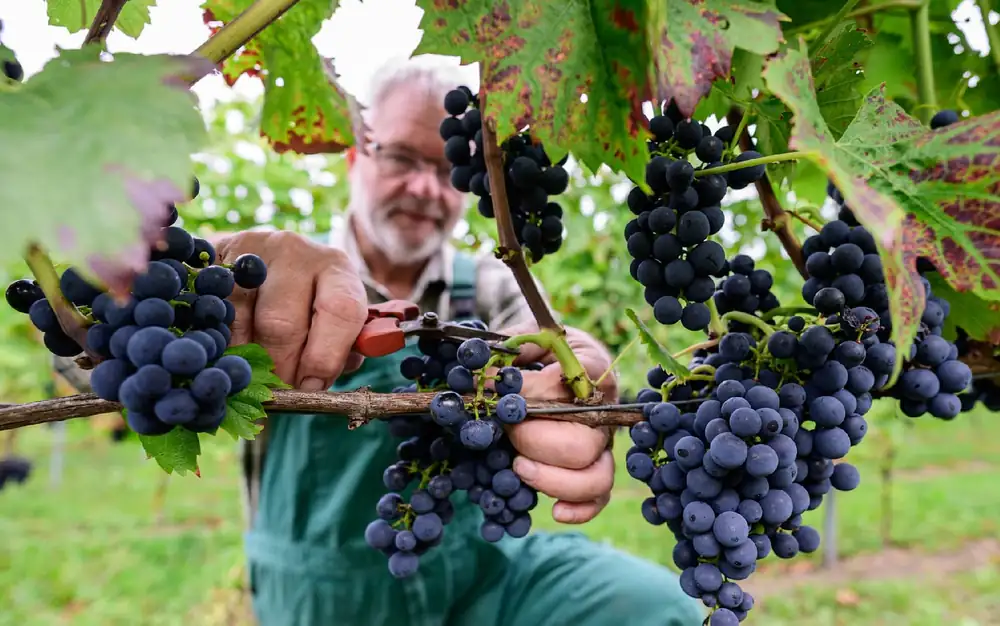
Wine harvest in the north: Solaris instead of Riesling
Winegrowing in northern Germany is becoming increasingly popular due to rising temperatures.
Master winemaker Christian Wolfgang lets the small red Regent grapes slip through his fingers, tastes one, and critically examines the green seeds. "They're still too green," the expert observes. Only when the color of the tiny seeds turns brown is the grape ready for harvest, he explains at the largest vineyard in Lower Saxony, covering almost seven hectares in Himbergen-Groß Thondorf.
35,000 vines of ten different varieties stand in neat rows across four hectares; the first grapes for the new wine are already in the barrel and with customers. Winemaker Jan Alvermann is pleased with the progress, but he could do without heavy rain in the final days before the harvest. Viticulture is very labor-intensive; once or twice a week, he and his team walk the vines, inspecting the fruit, removing bad grapes, and tearing off leaves that cast too much shade.
Since 2018, the former farmer, who previously cultivated 80 hectares of grain and potatoes and cared for 120 fattening bulls, has focused on vegan organic wine. "I stopped farming in 1997, simply because it wasn't viable anymore. For economic reasons," he explains in his farm shop, "Witt-Wein." "Witt" is Low German for "white," and that's the wine he mainly offers. The fruity and fungus-resistant Solaris is his best seller.
Winegrowers in the north as beneficiaries of climate change
Business is booming for the wine, although marketing requires a lot of effort, explains Monika Alvermann. The couple has a stall at every wine festival in the area. Their annual festival, featuring a tasting of the new Federweißer (a young, partially fermented wine), attracts around 1,000 visitors to their farm each season.
Jan Alvermann initially built up a freight forwarding company and then pursued the idea of winegrowing. In his youth, he worked at a vineyard in Rheinhessen, where he learned the basics. "We are the beneficiaries of climate change; growers in Denmark and Sweden have already noticed this," he explains. A neighbor is now growing melons in the Lüneburg Heath.
Because of the climatic conditions – colder and wetter than southern regions – the Alvermanns rely on so-called Piwi grape varieties (fungus-resistant grape varieties). These include Souvignier Gris, Solaris, Muscaris, and Monarch, among others. "We have the advantage in the north that the berries aren't as stressed," explains the winemaker.
It's getting too warm for Riesling.
In the southern wine-growing regions, ripening has shifted forward by four to six weeks in the last 20 years. "There, they then talk about dealcoholization because the sugar content eventually becomes too high." This is making it too warm for the popular Riesling, he says. "Here, we have naturally ripened wine where we don't have to think about how to remove the sugar."
The only winegrowing operation in the Uelzen district has purchased a machine for the harvest. "The timing is difficult to plan; I usually know about three days in advance," the farmer explains. "But the helpers like to know three weeks ahead, only to often cancel at the last minute."
The grapes are transported to a winery in Dexheim near Mainz for processing. Bottled – around 26,000 bottles – the wine returns to the estate. They expect the 2026 vintage next April. "Consumers are keen on fruity varieties, which suits us very well," says Alvermann.
While prices in mass-produced wines have been falling for years due to oversupply, he's finding more and more buyers for his wines priced between €8.50 and €14. The business is slowly becoming profitable. His son Simon has already expressed interest in continuing the business with the long-lived vines. The 19-year-old is currently training to be a winemaker, while his brother Henry, four years younger, is already doing an internship in the Palatinate region.
More white wine than red wine in Lower Saxony
According to the Lower Saxony State Office for Consumer Protection and Food Safety (LAVES), there are currently 51 winegrowing operations in Lower Saxony. The planting of wine grapes for wine production is only permitted with prior authorization from the Federal Office for Agriculture and Food (BLE). The BLE approves new plantings for Lower Saxony every year.
Nationwide, the area under vine cultivation is permitted to increase by 0.3 percent annually according to German wine law. The Federal Office for Agriculture and Food (BLE) distributes this 0.3 percent across Germany. According to the Lower Saxony State Office for Consumer Protection and Food Safety (LAVES), if applicants from Lower Saxony apply for a total of less than five hectares, each applicant receives 100 percent approval.
Overall, white wine production outweighs red wine production in Germany, including in Lower Saxony. According to Laves, white grape varieties are cultivated on 25.49 hectares, with Solaris being the dominant grape at 9.7 hectares. Red wines are produced from only 5.93 hectares, with Regent and Rondo (both 1.7 hectares) being the most prevalent varieties.