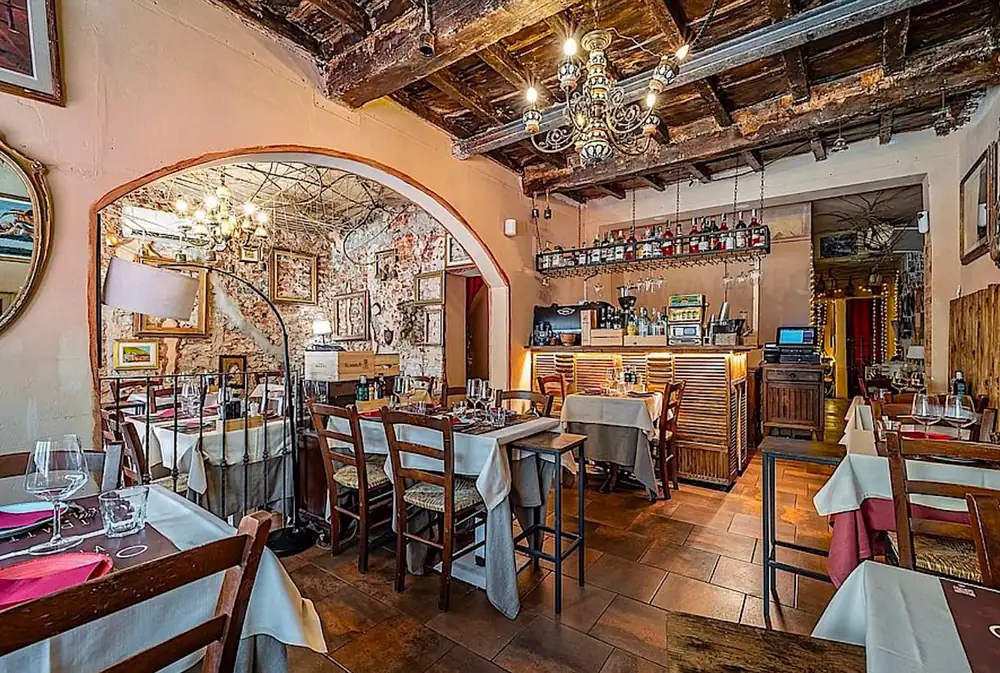
Neighborhood taverns in Florence, where Florentines eat
Florence's neighborhood osterias: here, customers greet them by name, tourists are in the minority, and the food is authentic.
Our 6 neighborhood restaurants in Florence
"We have a regular clientele here; we work closely with the neighborhood," says Francesco Carzoli of Osteria Pratellino in Campo di Marte. "There are tourists, but they're certainly not the majority, and they're still choosing us consciously." Their cuisine is Florentine and Tuscan, but not stereotypical. "For example, we don't always have steak, we don't always necessarily have red meat. We work a lot with farmyard animals, sheep, game, and lots of vegetables," he comments. Among the delicacies prepared by chef Matteo Caccavo, originally from Borgo San Lorenzo, are the warm terrine of boiled Chianina beef with homemade giardiniera, mayonnaise, and salsa verde; the pumpkin risotto with Mugello blue cheese and toasted almonds; and then stewed pheasant or scottiglia: it's a Maremma recipe, it's a kind of cacciucco made with wild boar, deer, fallow deer, roe deer or whatever you can find at the time among the hunted animals.
The risk of it becoming a tourist trap was high, yet, even though many families have owned it over the years, this place is still authentically Florentine. Trattoria Sostanza, also known as Il Troia, has been around since 1869. Il Troia was the first chef, Guido Campolmi: he was always covered in sauce and cooking oil, hence the nickname. Today, the atmosphere is the same (but without the grease): some customers have been eating here for fifty years, there are tables to share, the menu is written on a sheet of paper, and, like in the true osterias of the time, there is no coffee machine (they recommend going to the bar next door). Among the most famous dishes, we recommend their buttered chicken breast, artichoke tart, tortellini in broth, and, of course, the Florentine steak. Among the desserts, the meringue pie is excellent.
The connection to the neighborhood is already in the name: if you search their website or Instagram page, you'll find Antica Mescita with the words "San Niccolò" next to it. We're in Oltrarno, in an osteria that feels like a real place. Sure, there are tourists at the tables, but the Florentines who live in the area are much more numerous. The cuisine here is quintessentially Tuscan: minimal frills and no signature dishes or anything like that. The chef, Luigi Barbiere, prepares the great Tuscan classics, starting with the pappa al pomodoro, for example, which is famous here. In September, once you're back from vacation, we recommend their pappardelle with wild boar, ossobuco, peposo, and the carceral stew with tripe, lampredotto, and francesina.
We chatted with Francesco Brogi, the owner of this trattoria in the Borgo Santo Spirito area, and discovered that he's the real deal: friendly, dynamic, and has a healthy following on Instagram, where he posts hilarious reels of recipes, anecdotes, and jokes in Florentine ("I'm famous, like me!"). "We've been here for 35 years," he told us, "it's always the same family. Sure, we get tourists, but a lot of Florentines come, too." In September, he'll be cooking up a variety of fugos, prepared in a variety of ways, and his mother's ragù: "My mother is Giovanna, she's my inspiration. Hers is a rich sauce, 80 percent beef and 20 percent pork, with dried mushrooms and good tomatoes." And then there are meatballs with beans, stew, tripe, and ossobuco.
Located in the heart of the historic center of the San Giovanni district, the hordes of tourists are inevitable. Yet the La Grotta Guelfa restaurant (established in 1907, inside the Palagio dei Capitani di Parte Guelfa, with a room dedicated to the Calcio Storico Fiorentino) maintains the authentic feel of a real, truly Florentine place. This is thanks to the hard work of three partners and friends, Roberto Carlo Caprarella, Antonella Romano, and Eddy Ndokaj, who put their heart and soul into it. "It's true, we get a lot of tourists, but we also have many regulars," Gilda Felletti, manager of the beautiful, old-fashioned dining room, tells us. "We're on Via Pellicceria, between the Duomo and Piazza della Signoria: very central and therefore appealing to both travelers and Florentines." The cuisine is unmistakably Tuscan: from tortelli mugellani with pecorino cream and truffle to pici with duck, from Florentine steak to fillet steak with green pepper and cognac. Also not to be missed is the ossobuco sautéed with tomato and onion: "Tanta roba" as they say in town.
This lovely trattoria in the Santa Croce area (behind the famous square) has only been open for a year and a half, but it's already extremely popular and truly a neighborhood restaurant. "In the winter, practically everyone here is Florentines," owner Michael Costa tells us. The secret to such rapid success? "I think it's the friendly atmosphere, the friendly service, and the seasonality of the dishes," he says. "For example, you certainly won't find ribollita here year-round, but only when there's cavolo nero, so from November to February." The September menu will then include tagliolini with porcini mushrooms and sausage, risotto, also with porcini mushrooms, sliced mushrooms, and pumpkin, endive, and pecorino flan (but only from mid-month onward).