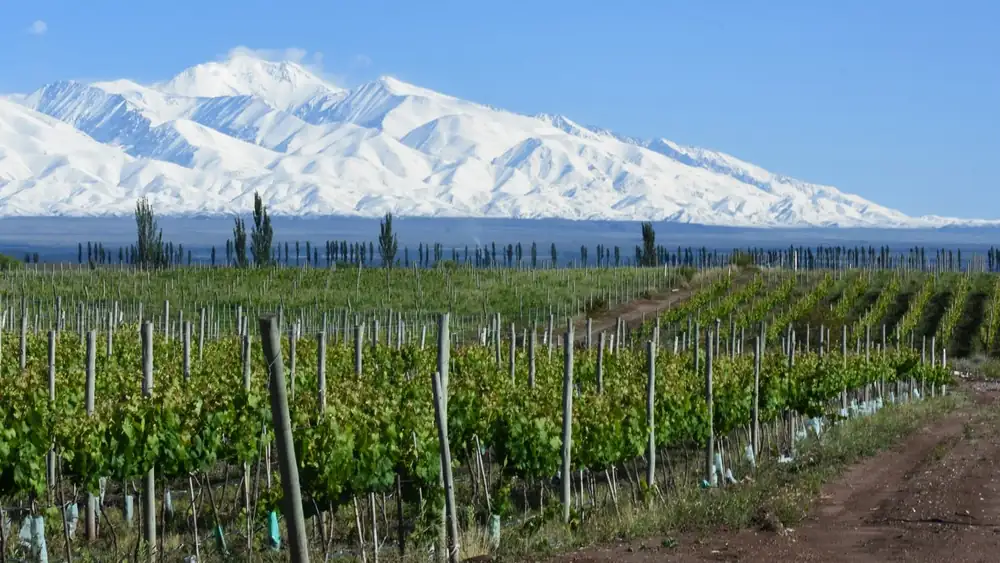
From Gualtallary to El Cepillo: how wine changes within the Uco Valley
Altitude, temperature, proximity to the Andes Mountains and a network of very different alluvial soils create wines that can go from exuberance to austerity, from wild tannins to delicacy and from breadth to an almost sharp tension.
To say "Uco Valley, Argentina" is no longer enough. Within this territory encompassing Tupungato, Tunuyán, and San Carlos in Mendoza, a relatively short distance can significantly alter the conditions in which grapevines grow. Altitude, exposure, temperature, and, above all, the soils change. Rivers and streams descending from the Andes have deposited materials for thousands of years, forming alluvial fans with varying combinations of sand, silt, clay, gravel, and large stones. In some areas, these stones are also covered with calcium carbonate.
But even within the same area, the map isn't homogeneous. The depth of the bedrock, the proportion of sand or silt, the presence of limestone, and the soil's water retention can change within just a few meters. That's why it's best to think of the Uco Valley as a succession of small landscapes, not as a single terroir. These differences also begin to be recognizable in the wines. More than in a list of aromas, they appear in the structure: how the tannins feel, how much space the wine occupies in the mouth, its tension.
Gualtallary: exuberance under tension
In the northern part of the Uco Valley, Gualtallary occupies some of the highest areas of Tupungato. Vineyards lie above 1,300 and 1,400 meters, in an environment where solar radiation, cool nights, and significant temperature variations influence the ripening cycle. Underground, the diversity is equally striking. There are alluvial profiles with sand and silt, abundant stones, and areas with a high presence of calcium carbonate. In some vineyards, the roots quickly encounter stones; in others, the upper layers are deeper.
In the glass, Gualtallary is often associated with highly expressive wines. There are fruit notes, floral aromas, herbs, and a sense of energy that often coexists with firm tannins and marked acidity. In the more chalky areas, a reactive, almost chalky texture appears on the tongue. Not all the wines are large or expansive. Earlier harvests and gentle extractions can lead to a more fluid expression. But even in these cases, a certain underlying intensity usually remains. Perhaps that is one of the keys to Gualtallary: not so much weight as energy and exuberance. This is noticeable in the Gran Enemigo Torrontés from El Enemigo Wines and in the Finca Las Cerrilladas Malbec from Zuccardi Valle de Uco, with that chalky texture highlighting the tannins.
Altamira: less volume, more contour
While Gualtallary tends to widen, Paraje Altamira seems to move in the opposite direction. Located in San Carlos, this Geographical Indication (GI) occupies part of the alluvial fan formed by the Tunuyán River. Its soils consist of sandy loam matrices, gravel, and stones at varying depths, with areas where calcium carbonate coats these materials. Generally speaking, Altamira is at a lower elevation than the higher areas of Gualtallary. Its summers can be warm during the day, but the cool nights and the wide temperature range maintain a distinctly Andean character.
Words that seem contradictory often appear in wine descriptions: elegance, austerity, firmness, and power. Malbecs can feel serious, with firm, even solid tannins, but not necessarily aggressive. Fruit, flowers, and herbs are present, though they tend to be secondary to the wine's shape on the palate. Some wines seem longer than they are wide, more vertical than expansive. This isn't about less intensity; it's about a different geometry on the palate. Clear examples include Jardín de Hormigas Los Amantes from Altos Las Hormigas and Gran Revancha from Mendel, both wines from calcareous soils.
The Chacayes: texture and strength
Los Chacayes, in Tunuyán, offers a different kind of structure. The area sits atop alluvial deposits with a significant presence of gravel and stones. These are generally poor, fast-draining soils in a dry mountain landscape. From here emerges one of the Valley's most recognizable profiles: reds with firm, sometimes rustic, tannins, conveying a sense of power and a certain wildness. In Malbec, Cabernet Franc, and blends, texture often takes center stage. Wines with robust tannins, taut palates, and a structure that may need time to integrate are the result. The Raquis Chacayes wines and the Matervini Malbec blend come from these stony soils, which explain their power.
But Los Chacayes also demonstrates why it's dangerous to turn an area into a formula. Not all its soils are the same. In some areas with a higher concentration of limestone and less washed stone, the tannins can be finer and sharper. If, in addition, the winemaking avoids intense extractions, the result can be much juicier and more delicate. Within the same Geographical Indication (GI), then, the soil and the winery's interpretation can significantly alter the final character. Chacayes, from Raquis, is a good example of this other side, more refined than wild.
San Pablo: the cold oasis
Towards the Andes Mountains, San Pablo takes the Valley's diversity to another extreme. There are vineyards at nearly 1,400 meters, very close to the foothills of the Andes. But San Pablo is a mountain oasis; its vegetation, trees, and streams are proof enough. Its verdant landscape reveals a humid microclimate influenced by the meltwater, a far cry from the extreme, desert-like climate of other areas such as Gualtallary. Incredibly, in San Pablo, it's even possible to have a dry-farmed vineyard. The environment is colder, frost is a factor in production, and ripening cycles tend to be longer. The soils are once again alluvial and stony, with areas where the stones show significant accumulations of calcium carbonate.
In the wines, the vocabulary changes. Freshness, delicacy, fluidity, floral notes, herbs, salinity, and a particularly pronounced acidity emerge. It is also an area where white wines find favorable conditions. If Gualtallary speaks of intensity and Altamira of austerity, San Pablo clearly speaks the language of cold and tension. The wines Aluvional San Pablo, from Zuccardi Valle de Uco, and Un Lugar en los Andes exemplify this well.
The Trees: when freshness has muscles
But being near the mountains doesn't necessarily mean delicate wines. Los Árboles, in Tunuyán, has very stony soil profiles. Sandy loam matrices may appear on the surface, while at depth the amount of alluvial rocks, gravel, and sandy layers increases, promoting rapid drainage. Freshness is a constant, but the texture differs from that of San Pablo. Here, the wines can be harsh, tense, with firm, sharp tannins.
There are Malbecs with robust structures, yet permeated by fruit, floral notes, and intense acidity. Others combine red fruit flavors with sharp tannins. Two cool, mountain-like locations can feel very different. The acidity might be shared, but the wine's architecture is not necessarily the same. Chañares Estate, from Viña Cobos, and Tomero Cuartel 41, from Bodega Vistalba, showcase the area's stony character.
The Brush: the cold of the south
In the southern part of the Valley lies El Cepillo, in San Carlos. This is an area where the cold and frosts take on particular importance. Low temperatures can reduce yields, affect ripening, and significantly impact viticulture in this region.
Two contrasting profiles emerge in their wines. On one hand, there are austere, herbal, and restrained examples, such as the Single Vineyard El Cepillo from El Enemigo Wines. On the other, there are Malbecs with intense flavors, firm acidity, and wilder textures, like La Gran Nave from Canopus. Perhaps there's no need to try to resolve this apparent contradiction. The cold climate can serve as a common denominator, while different soils, exposures, harvest times, and winemaking methods ultimately shape distinct styles.
The Valley is not a flavor
For years, much of the narrative surrounding Argentine wine has relied on altitude. And altitude matters. But the current map of the Uco Valley shows that it's not enough. Between Gualtallary, which can exceed 1,400 meters, and areas of Altamira nearing 1,000; between the stony soils of Los Chacayes and the cold of San Pablo or El Cepillo; between bare rock and rock covered in calcium carbonate, many things change before the grapes even reach the winery. And then the winery arrives.
Therefore, it would be risky to claim that Gualtallary "tastes" inevitably one way and Altamira another. But recognizable trends do emerge. Gualtallary leans towards exuberance and energy. Altamira towards austerity and contour. Los Chacayes focuses on texture and the strength of the tannins. San Pablo takes freshness towards delicacy. Los Árboles combines that same freshness with structure, and El Cepillo adds the extreme cold of the south. The Uco Valley is no longer just a high-altitude region; now it invites us to contemplate every small portion of that mountain. It has ceased to be a single flavor and has become a system of differences; we will see, with time and the wisdom of the producers, how these landscapes translate into identity in the glass.