The new wave of operators redefining Mexican dining in Australia - hospitality
If you grew up in Australia, it’s likely that there’s a certain type of “Mexican” food you would have been exposed to. It came in yellow boxes and led to chilli con carne and hard-shell tacos becoming a staple in many households.
“One of the biggest discussions we have around this time every year is about tomatillos, because the tomatillos in Australia are only seasonal for six to eight weeks of the year,”
But as diners have become more familiar with regional Mexican cuisines, operators have responded with tighter concepts, labour- intensive techniques, and a renewed focus on ingredients. “Mexican restaurants are having a moment,” observes Jenna Davies, the owner of Collingwood restaurant Santito. “Especially in Melbourne, there have been a lot of new restaurants opening.”
“The difference is that the restaurants that are opening now are more niche and leaning into different regional aspects of the cuisine,” says Davies. Santito is evidence of this. The restaurant is harnessing the energy of Mexico City’s taquerias with a small menu that sees almost everything prepared fresh daily.
“It’s a lot of work, but I think in order to replicate what is happening in Mexico with the cuisine and the culture, it needs to be prepped fresh with fresh ingredients. I think that’s the length that restaurants in Australia are going to now, the ones that have opened in the last one or two years,” says Davies.
Santito opened in the latter half of last year, around the same time that homestyle Mexican diner Maiz y Cacao relocated to Queen Street. In the year prior, Hotel Nacional on Hardware Lane joined the city’s Mexican ranks with its 100 per cent gluten-free menu. With the constant influx of newcomers, the city’s style of Mexican food has slowly shifted, a change that Davies says Collins Street restaurant Mamasita paved the way for.
But it’s not only Victoria experiencing the renaissance. In Sydney, newcomer Arre (from Chef-Owner Roy McVeigh, who is also behind Potts Point Mexican restaurant Sonora) has stepped in to fill the former Comedor venue on Australia Street in Newtown.
It follows on from the 2025 opening of Liquid & Larder restaurant Lottie in Redfern’s Baptist St precinct and nearby QSR Radio Taco, which is dishing up slow-cooked birria tacos from its coveted 12-seat space.
Aus-Mex ingredients
As operators deepen their culinary appreciation for the diversity, quality, and uniqueness of Mexican food, they’re developing more authentic and considered offerings. But in doing this, they’re facing a whole new world of challenges – from the drive to find the right produce (and whether it’s even possible), to the question of how operators can instil an Australian perspective on the menu, while respecting Mexican authenticity.
Adelaide is also part of the recent groundswell of Mexican restaurants, with the arrival of Picoso Mexican Bar y Cocina, led by ex-Restaurant Botanic Head Chef Oliver Luxton. The restaurant promises traditional Mexican techniques through a more modern, easy-going lens, and Luxton is bringing his knowledge of native Australian produce into the mix.
Drawing on his experience working at Adelaide’s Restaurant Botanic under Executive Chef Jamie Musgrave, where native Australian produce leads the menu, Luxton says Picoso is digging deeper into Australian native ingredients than would typically seen in a Mexican restaurant. Beach succulents have found their way into Picoso’s salsa verde, while sea celery has uniquely herbaceous notes that work well alongside coriander.
“There are so many crossovers,” says Luxton. “People are actually realising how nicely Australian ingredients can work with Mexican cooking.” Davies has been experimenting with locally- grown ingredients to replace difficult-to-source produce, like the tomatillos that generally make up salsa verde.
“One of the biggest discussions we have around this time every year is about tomatillos, because the tomatillos in Australia are only seasonal for six to eight weeks of the year,” she says. Outside this tight season, tomatillos are largely only available canned. Santito has experimented with green tomatoes as a substitute, but Davies says replicating the flavour profile of a traditional salsa verde remains difficult.
“It is so hard to replicate a lot of the ingredients that are in Mexico in Australia. For example, the limes that you get in Mexico don’t even compare the limes that we get here.” “The biggest one for us is the corn,” says Davies. “We actually spent about four months looking at importing corn from Mexico.
We had meetings with an importer, but four months into the process we found out that to get it through customs, it needed to be processed and ground at a facility. By that point we were like, ‘Well, if it’s not the corn kernels anymore, then there’s no point’.”
A tonne of corn
In the end, Davies ended up finding an Australian black corn supplier that she’s tight- lipped about.
“We had to order a tonne,” says Davies. She’s not exaggerating – when the delivery arrived, it came in massive bags that they had to store around the venue.
But now, they’re getting to the end of their first tonne, and looking to order the second. The reason for the tonne of corn comes down to Davies’ interest in nixtamalizing in-house.
“Nixta-what–?!” You might be asking. It’s a word you may only know if you’ve spent time thinking about the ins and outs of making tortillas.
Nixtamalization is the process of soaking and cooking corn and other grains in an alkaline solution — and it’s a key element of making tacos. The alkaline solution breaks down the corn’s cell walls, helping essential vitamins and amino acids become bioavailable.
Without this nutrition-boosting element, diets heavily reliant on raw corn can lead to deficiencies. It also improves digestibility, enables dough formation by gelatinising starches and causing proteins to bind, and enhances flavour.
Davies thinks the Santito team might be the only ones in the country doing nixtamalizing in-house at this stage. The reason to do it, she says, is that the presence of the corn flavour in fresh tortillas is much more pronounced.
“They just taste fresh. You can’t really compare them to a store-bought tortilla,” says Davies. “The fresh tortilla brings out all the flavours in the meat, the salsa, the cilantro, the onion and so much more than the store-bought tortilla.
It brings it all together.” Davies estimates that Santito makes between 300 and 400 tortillas on a busy day.
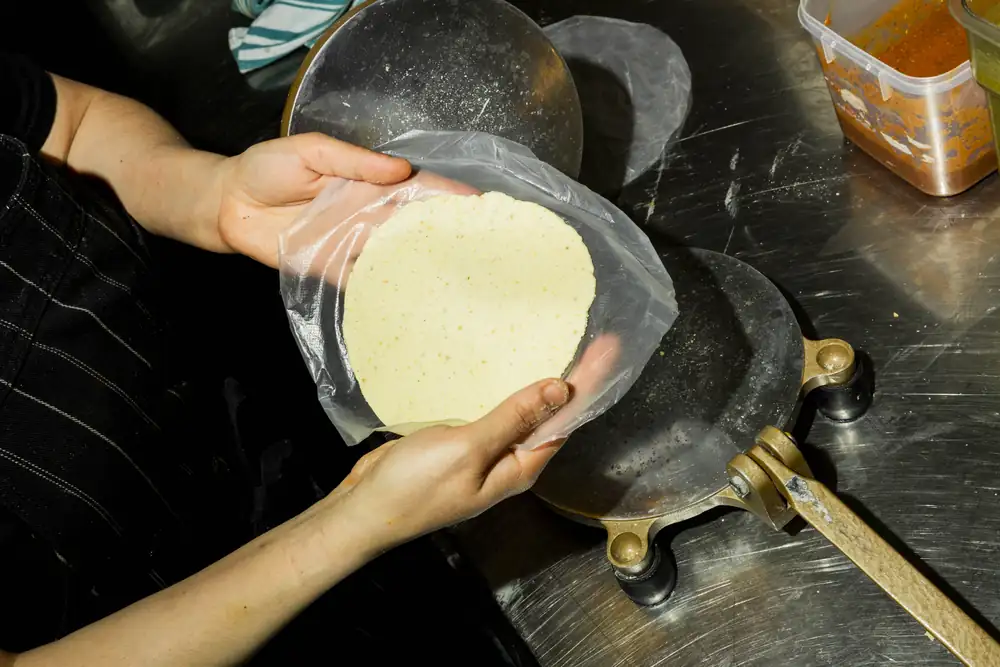
The entire turnaround process takes about 24 hours: The corn is nixtamalized overnight before being ground with a Molino – an imported corn grinder which grinds the nixtamalized corn over volcanic stone. It comes out not as flour, but as dough.
They then roll the dough at the start of service into little balls, press them in a tortilla press by hand, and then cook them to order. According to Davies, the tortilla is not only the most overlooked thing on Mexican menus – it’s also the most important. “It’s not just the vessel to hold the meat and hold the taco together.
It really does contribute to the entire flavour. And until you’ve eaten the taco in Mexico with a freshly made tortilla, you don’t really realise what you’re missing,” says Davies. “We said to ourselves, if we’re really going to do this and lean into the taqueria concept, we need to make our own tortillas.”
Luxton is also reverent of the tortilla-making process. “You’ve got to treat tortillas with love and care,” he says. “Every day, the temperature of the room and the humidity might change the dough. You’ve really got to make sure your water level is right, not just using tap water — you’ve got to use warm water that’s been purified.” For many restaurants that are making tortillas in-house, it often means buying pre-nixtamalized corn — something which Luxton has been doing — although he’s exploring the concept of nixtamalization for down the line.
He says the appeal is about keeping it traditional. “It’s given me a challenge to learn and understand the foundations. It changes the whole concept and experience of a fresh tortilla.
It changes the texture, the flavour, the aroma,” says Luxton.
Looking forward
The new wave of Mexican dining isn’t necessarily defined by a single style, or adhering to textbook Mexican ingredients. Rather, it’s defined by a willingness to invest time, research, and care into developing menus that respect and consider the quality and diversity of Mexican cuisine.
As Davies points out, “each time a new restaurant opens, the bar gets set higher”. Photography: Picoso by MJ Manolo; Santito by Chege Mbuthi and Julia Sansone
Resources
Lorem ipsum dolor sit amet, consectetur adipiscing elit. Fusce ac ornare lectus.
Sed bibendum lobortis...
- Who: Mexican
- Percentages: 100 per cent
- Figures: 100 per cent