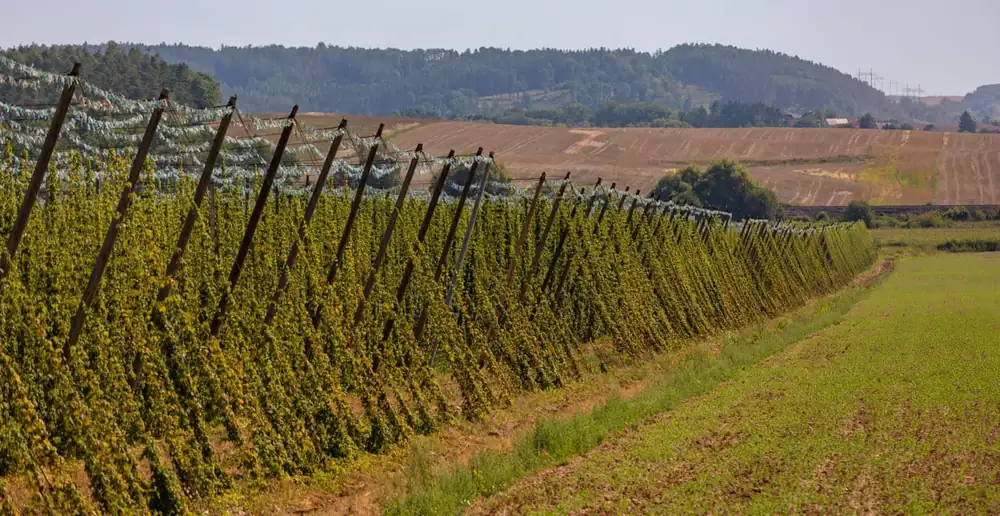
'Saaz es nuestro oro': los científicos checos cultivan lúpulo que puede sobrevivir en una Europa más cálida
Es el país que consume más cerveza per cápita que ningún otro, pero en los últimos años la República Checa se ha visto afectada por sequías y olas de calor, lo que dificulta el cultivo del lúpulo Saaz, uno de los elementos clave de la cerveza de fama mundial del país.
It is the country that drinks more beer per capita than any other but in the last few years Czechia has been hit by droughts and heatwaves, which make it harder to grow the Saaz hops, one of the key elements that goes into the country’s world famous beer.
The US brewery BarrieHaus Beer Co in Tampa, Florida, purchases abroad them for its Czech-style pilsner called the “Bublina”, which won the 2024 World Beer Cup; their brewmaster, Jim Barrie, states Saaz “has a character that’s difficult to truly replicate”. Even so, in recent years there has been an increase in summer temperatures and a decrease in rainfall in Czechia, which has affected the Saaz variety in particular. This reduces the amount of water available for the plant to use and makes it harder for the plants to stay cool during hot summers.
Per to Dr Pavel Donner, also of the Hop Research Institute, “Czech cultivars, Czech genetic resources, are not habituated to live in such high temperatures.” Only about 25% of Czech hop holdings are irrigated, making them highly vulnerable to irregular rainfall. The higher temperatures and lack of water result not only in fewer cones, but as well less alpha acid, a compound that gives hops their characteristic bitterness.
With less acid, brewers need to use more hops to achieve the same level of bitterness, which can change the flavour of the product. That variation creates challenges for brewers, who rely on consistent expectations when they put in their yearly hop orders.
Going to Barrie, the droughts and higher temperatures in recent years have made BarrieHaus’s Bublina harder to produce. “We’ve definitely seen more year-to-year variation in alpha acid levels, aroma intensity, and overall availability, especially with dry spell pressure in Czechia. For example, I haven’t seen a Saaz varietal over 2.5% in years,” he said, referring to the lower alpha acid levels in the drought-afflicted hops. “This last crop of Saaz was the least appealing sensory-wise since we opened in 2019.” That change in quality, as well as the drop in yields, may be one reason why imports of Czech hops to the US eased by roughly half after a particularly brutal drought in 2022. The stakes are especially high this year, as Czechia begins to move into the hop-growing season during the driest spring since record-keeping began in 1961. “We don’t know what’s coming,” told reporters Donner. “The estimations can be made in June or July.
Until then we just depend on the conditions.” This is why Nesvadba’s breeding work is so weighty. Working with home brewers to test new hop cultivars, he has created three varieties on the original Saaz hop that are able to thrive with less water and higher temperatures.
Earlier this month, Nesvadba unveiled a new lager crafted using his “Saaz Shine” variety at the Hákův brewery’s pub in Prague. An hour before the keg-tapping, dozens of craft-beer enthusiasts crowded in and waited, eager to try the new cultivar.
As Nesvadba proudly held up the first glass of the drought-resistant brew in the dimly lit basement bar, the crowd burst into applause and began to line up to fill their own mugs. The event illustrated the excitement for novel varieties even in Czechia, which takes its beer tradition seriously.
The new varieties are also encouraging innovation in places that have never had a hop trade.