Alexandre Couillon, La Marine*** en Noirmoutier: el mar en la sangre
Una pareja. Un compromiso inquebrantable. Un restaurante en el puerto de Noirmoutier. Una isla desierta en invierno. Atún capturado con anzuelo en alta mar. Una lonja. El chef va allí todos los días. Su menú es lo que encuentra allí. Hoy habrá atún del Atlántico. La población se ha recuperado.
Alexandre Couillon and his wife took over his parents' business, a restaurant in the port of Noirmoutier. Every day the chef goes to the fish market and chooses his menu from what he finds there. Atlantic tuna returned to the menu when the population recovered, after being absent for a while.
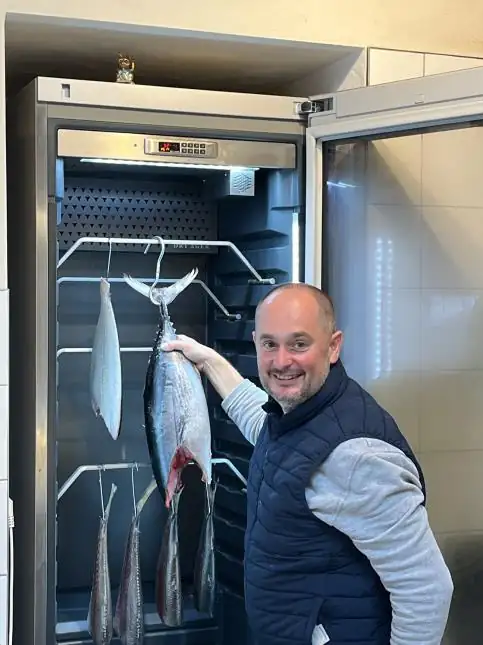
For Couillon, preserving marine resources depends more on the fishing method than the species. Hook and line fishing, or longlining, a long line with hooks held between two buoys and two anchors, is more respectful of the fish than trawling, and this is reflected in the flavor. Trawled fish are kept in tanks with water or ice; their flesh absorbs water, becomes mushy, and loses firmness when cooked.
But line-caught fish is more expensive: a kilo of pollock caught this way costs €28-30, compared to €10-12 for trawled fish. Some line-caught fishermen, however, don't respect the fish, leaving broken bones and splashes of blood. Respecting the fish also means fishing legally. In the case of tuna, there's a regulated fishing season, specific techniques, onboard storage, and handling in port: a chain that culminates in the cooking process.
A pivotal moment in the chef's training was a visit from Toru Okuda, the three-Michelin-starred Japanese chef who was opening his restaurant in Paris. Okuda invited him to work in the kitchens of his Tokyo restaurant. There, he says, he discovered another world: humility, respect for the fish, and incredible precision in every movement. The work, according to the chef, is rigorous: scraping it thoroughly, removing the bloodline, trimming the fish, cutting off the head, patting it dry, letting it air dry if necessary, and finally, filleting it.
Couillon also makes use of the trimmings: the belly pieces are for the staff's meals, and the tail pieces for the fishmonger. He wants to develop the sale of trimmings, an inexpensive fish that lends itself to many preparations, such as a curry stew. With tuna, he collects the gelatinous tissue between the vertebrae and all the bones: he roasts it like meat, cooks it very slowly, and obtains a juice that he reduces. Instead of making a sauce with butter, he whisks this gelatinous tissue to thicken it.
The preservation of marine resources resonates with customers, although the chef still has to combat prejudice. Horse mackerel, for example, was once plentiful and was being fed to cats. Couillon wants to stop talking about "noble fish" because, in his opinion, a fish is only truly noble based on what happens to it from the boat to the cutting board. Climate change also plays a role: the waters are warming, and croaker and scorpionfish are appearing.
Looking to the future, Couillon wants to pass on the craft and recover what, in his opinion, has been somewhat lost: social evolution, working hours, labor costs, and traditions, along with rigor. Several former employees have left with this vision, one to Japan and another to the United States, and both have achieved Michelin stars.