Una ruta personal por el norte con Islares
Un viaje gastronómico por las cuatro regiones del norte de España en un solo restaurante. Eso es lo que ofrece Julen Bergantiños en Islares, donde construye una narrativa histórica y territorial en su primer proyecto personal, que celebra un exitoso primer año.
A gastronomic journey through the four northern regions of Spain in a single restaurant. That's what Julen Bergantiños offers at Islares, where he constructs a historical and territorial narrative in his first personal project, which is celebrating a successful first year.
A well-rooted identity, with solid arguments, attachment to a territory, its products and culinary traditions; the training and personality of a chef to formulate proposals.
Unique elements and, finally, professionalism in the dining room to convey to the diner the essence, philosophy and soul of the restaurant are key aspects that distinguish top-tier establishments from places where food is simply served, where they go through the motions day after day, or from franchises that strive to globalize the food industry from minimum standards to conquer the masses.
In Spain, a country with a highly valued traditional cuisine, the lines that distinguish between districts, regions, or, more recently, autonomous communities, have always been more or less well-defined and documented in specialized publications. We recall the old adage that in the north they stew, in the center they roast, and in the south they fry. To some extent, this still holds true.
Over the years, administrative borders have become blurred in the culinary world, but access to local products and their characteristics still remains a differentiating factor for many restaurants.
No one doubts the benefits of the Mediterranean diet, but the Cantabrian diet is not far behind, as demonstrated by Islares, a restaurant named after the Cantabrian town where this Basque chef with Galician roots enjoyed family holidays during his youth.
Is there a shared identity in the gastronomy of northern Spain? Undoubtedly, I believe that must be the answer. Despite the unique characteristics of each region, since prehistoric times, the areas bordering the Cantabrian Sea have shared many commonalities: in their understanding of food, in the raw ingredients that make up their larders, in culinary techniques, and even in the sociological concept of sharing a meal.
From concept to plate
Julen Bergantiños is 33 years old and has a decade of experience in the kitchen, some of it at top-tier establishments like El Celler de Can Roca (Girona). Although originally from Baracaldo, where his ancestors emigrated from Galicia, Julen doesn't hide his attachment to all the regions of northern Spain: to Galicia, where his family home and roots remain (his surname gives him away); to Asturias, a land he passed through, but also a must-see destination, during his childhood and youth when visiting his grandparents; to Cantabria, where he always enjoyed his holidays, specifically in Islares, where his in-laws now live; and to the Basque Country, where he was born, grew up, and began his working life as a waiter before honing his skills as a chef and developing his career in Catalonia and Castile and León.
A year ago he went all in and opened his own restaurant, dedicating all his savings to Islares, in the center of Bilbao, opposite the Guggenheim Museum, in a very touristy area.
An unbeatable location. A small, welcoming space with seating for around twenty diners… It's the ideal setting for a small team (María Simón, head chef, and Marco Arca, head waiter and sommelier) to develop the cuisine that has been maturing in Julen's mind over the last few years. Islares is a young, gastronomic restaurant, with a strong connection to northern Spain.
Up to this point, it could be just another project among the many that spring up every year across Spain, born from the dreams of well-educated young people eager to break into the complex world of haute cuisine. But Islares, with Julen as its driving force and mastermind, goes further. It's simply unique, neither better nor worse than others, but undeniably appealing and offering excellent options.
The restaurant has two tasting menus that are very intentionally called N-634 (96 euros), in reference to the National Road 634 that runs from Santiago de Compostela (La Coruña) to Donostia (Gipuzkoa), and A-8 (74 euros) - the Cantabrian motorway, which goes from Irún (Gipuzkoa) to Baamonde (Lugo).
Whether you travel along the old national road or the modern motorway, you don't go to Islares to eat conventional dishes, nor is it a fusion cuisine, ultramodern and outlandish, but you go to enjoy good seasonal produce, selected with discernment, and with contemporary techniques and presentation, but behind which there is a reason.
From tradition to creativity
Julen Bergantiños' cuisine has a story, a narrative that takes tradition and experiences as its starting point, rooted in his family and professional background, in the history of the gastronomic heritage of northern Spain, but with a respectful treatment of the products and creative touches that allow him to interpret concepts to achieve unimaginable results.
Behind every dish lies a story: whether it's the revival of a recipe or the combination of two ingredients for a specific reason and with a concrete purpose. The concepts employed are the fruit of study, research, reflection, and analysis, always enriched by the chef's creative contribution, who personally comes to the tables in the dining room to offer the necessary explanations to the diners.
These dishes, without the gastronomic narrative, would simply be good suggestions; with the narrative, they are something that provokes reflection, that invites one to look to the sources for something exceptional.
From beginning to end
This restaurant offers a glimpse into how northern ingredients and recipes can be integrated and evolved with a touch of creativity in a natural way, but not without meticulous work with the best seasonal products and reliable suppliers. At Islares, the tasting menus evolve throughout the season and change completely with each season.
The wine list also reflects this identity. It features only wines from Denominations of Origin or northern regions, omitting any wines from other parts of Spain or other countries. The commitment is absolute.
The N-634 menu, with four starters, eight courses, two desserts and petit fours, begins with a marmita consommé that evokes the celebrations when we are fully immersed in the bonito fishing season.
These are followed by the mojojón tigre, a mussel tartlet; the anchovy skewer on sobao pasiego and a lacha sheep yogurt cream; and the Galician sea anemones, less salty and sweet than those from the south according to the chef.
No starter would be complete without tomato, in this case from Erandio, stewed for 40 minutes in its own juice, with a cream of sea lettuce from Noja that provides salinity and some pulientas cántabras (corn porridge).
The langoustine with Mos chicken fat and its escabeche was impeccable. Bergantiños works with endangered breeds, believing that fostering demand will incentivize producers. In Islares, they don't cook with oils and flours; they work with lard to maintain consistency with tradition.
Then they propose some trout roe (Galician trout) macerated for four days in androlla butter (an Ourense chorizo) and mountain carico broth.
The scallops from Muxía are served with kanala soup, a recipe that had disappeared from common use and was found in an old book. It's a cockle and clam soup with chicken broth, parsley, garlic, and warm txakoli wine, a typical resourceful dish from the Urdaibai region.
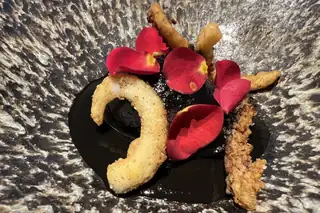
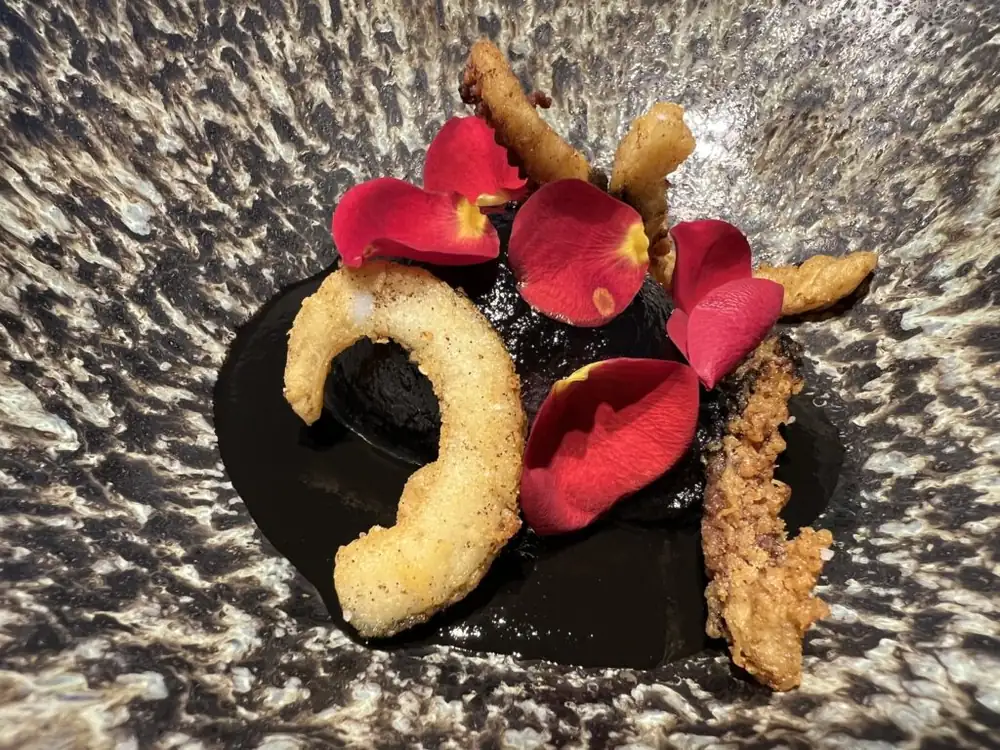
The purple onion from Zalla is cooked with squid from the Liendo area. Like.
The garnish is the typical fried squid rings, and for decoration, some rose petals.
The stew of Celtic pig trotters is exquisite, made from another endangered breed that Julen wants to help by including it on his menu. The trotters are stewed in green sauce following a 1929 recipe from a farmhouse in Aranzazu. The dish is completed with samphire from Plentzia and breaded cod cheeks.
The recital continues with the Cantabrian bonito, confit, accompanied by a Guernica piperade, red peppers, and a toasted mushroom juice, the result of a very sweet and tasty reduction.
A meeting between the Cantabrian product, in this case the Tudanca cow, and the Basque Country, which welcomes it in a sukalki garnished with Galician potato from Melide, sardine garum and butter from the water of the Cantabrian sea.
In the desserts, both the latxa mamía with morangueiras macerated in txakoli and the Basque cake of Asturian blueberries with a ganache, these red fruits are succulent and predecessors of some petit fours in which he pays homage to a pastry shop in Bilbao: rice cake, chocolate truffle from Arrese and mini carolina of meringue, lemon and txakoli.