Kaupé, el escaparate marino de Ernesto Vivian en Ushuaia
Ushuaia es la ciudad más austral del mundo y de Argentina, ubicada en Tierra del Fuego. Se puede llegar por aire o por tierra, cruzando el Estrecho de Magallanes en ferry desde Chile.
Ushuaia is the southernmost city in the world and in Argentina, located on Tierra del Fuego. It can be reached by air or by land, crossing the Strait of Magellan on a ferry from Chile. It's a popular destination for tourists from all over the world, who come to ski on its cross-country trails, and for Argentinians themselves who want to experience island life, just a few hours from Antarctica. Its landscapes and cuisine are its main attractions.
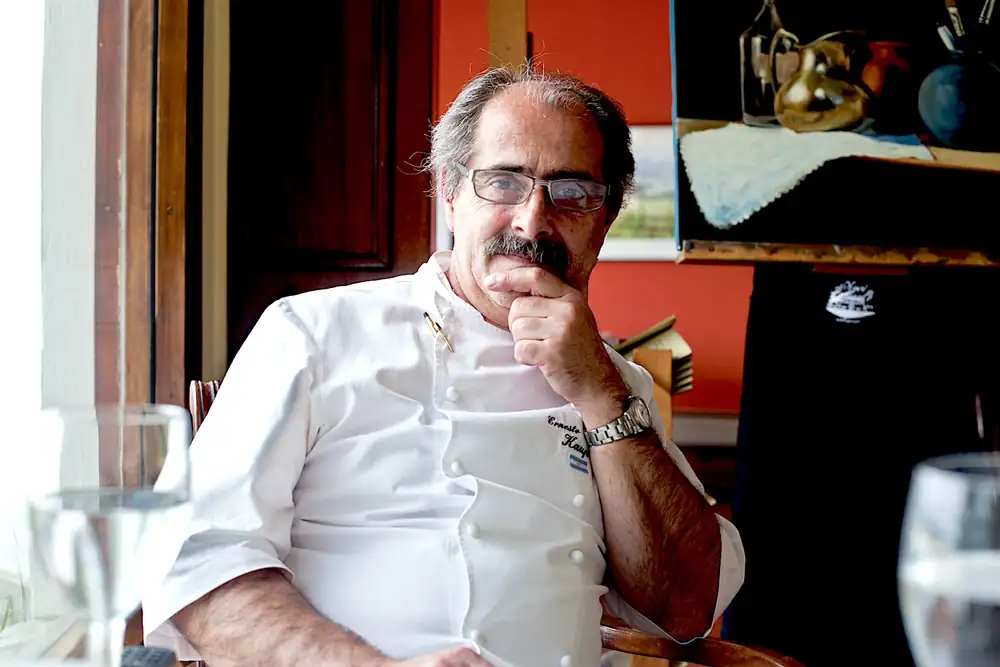
“Kaupé is the story of our family’s life, uniting a passion for cooking with the serious intention of providing a high-quality gastronomic experience” is how chef Ernesto Vivian presents his restaurant, located high on a street in the rolling hills of Ushuaia. For 34 years, his work has been constant, guided by the same fundamental principles: presenting the bounty of the Beagle Channel in meticulously crafted dishes.
Sober, quiet, and panoramic, Kaupé's dining room offers views of the Bay and the Channel, and below, the bustling activity of Ushuaia, a city blanketed in snow during this extreme winter. One star reigns supreme in this magnetic fascination with discovering the island's gastronomy: the Fuegian king crab.
“We’ve served it since we started” explains Ernesto Vivian, although in its current version he chooses to present it in its natural state. This way, the product’s pure flavor is magnified in its simplicity. The Seafood Tasting Menu exemplifies the gastronomy of this area in four courses. “What are the flavors and products that define Ushuaia, and therefore Kaupé?” I ask him. “Our clientele values our approach of not over-compromising and preserving the quality of the products we use” says Vivian.
She's referring to king crab, spider crab, scallops, mussels, octopus, sea bass, scorpionfish, cojinova (a type of fish), Magellanic lamb, and Patagonian toothfish, a fish that has cemented Vivian's cuisine as one of the island's pioneers. "We were the first to use it with excellent results," she says. At her Seafood Tasting (85,000 pesos, about $93, wine pairing included), she serves it en papillote.
It is a coveted species that lives in the dark, icy waters of the Southern Ocean and Antarctica. Fishing for them is not easy; they live at depths of 2,000 to 2,500 meters. "They can live up to 50 years," adds Ernesto; some specimens measure up to three meters and can weigh 200 kilos. Their skin is dark in color, and their flesh is white and firm.
The tasting menu concludes with a scallop ceviche. Kaupé, in the Selk'nam language (one of the indigenous peoples who inhabited the island), means "to be at home," and one ingredient unites the thirteen tables in the dining room: the presence of the chef himself. In this way, the diners complete the story told by each dish, episode by episode. There are no secrets; it's old school.
A self-taught cook
It's no coincidence that the restaurant is called Kaupé. Kaupé began in the 1990s, when Argentina was experiencing one of its recurring economic crises, and the Vivian family had no connection to the culinary world. "I have no formal training in gastronomy," explains the man who is now considered a mentor by young chefs in Tierra del Fuego. Born in Buenos Aires in 1955, he trained as an electrical technician. Once in Ushuaia, he became the head of the local office of Gas del Estado (the state-owned gas company).
Those were years when the family's finances were tied to the national economic situation, preventing them from making grand plans. He and his wife would host gatherings at their home with friends, who were always busy cooking. His life changed, and in 1990 he transformed his house into the Kaupé restaurant. At that time, Ushuaia only offered tourist-oriented options with limited appeal. Ernesto Vivian's arrival on the culinary scene redefined the landscape. In 1993, he quit his day job to dedicate himself exclusively to cooking.
“You could say I’m self-taught, a reader of gastronomy books since I started in the business, back in the days before the internet” he says. His learner’s spirit is evident in the warmth and lighting of the dining room, and the understated simplicity of the menu, which reflects his pursuit of purity. “I want to preserve the product by intervening as little as possible, so that it can be appreciated for what it is” he explains. It is there, where the Andes Mountains and the American continent end, that his exploration of the bounty of the Beagle Channel and the islands plunges into the southern seas.
The menu focuses on specific dishes. Starters include beef carpaccio with artichokes, capers, provolone, and olive oil, and warm, creamy spinach with king crab. The main course is a standout: Patagonian toothfish with sage and lemon. Also noteworthy is the cooked king crab with a sauce made from cream, tomato, mustard, and cayenne pepper. For dessert, Vivian suggests a Kaupé crepe with apple, banana, orange, cream, strawberry pulp, and liqueur, served warm.
Salmon ban
“Throughout our history, we have never worked with salmon; we don’t consider it a local product, the vast majority of which comes from Chile” he says, raising a flag shared by the chefs of Ushuaia. The salmon farming industry is rejected for the negative consequences it has on the marine environment. Leading restaurants exclude it from their menus and even proudly display stickers clarifying their stance on their entrance doors.
Tourism floods the city with cruise ships anchoring in the port. They arrive from all over the world, and thousands of people clog the streets and main entertainment venues. “Many come looking for salmon, and some restaurants offer it” Vivian points out. King crab is also a product that elicits mixed opinions: overexploited on both sides of the Beagle Channel, the focus is on the lack of controls in its fishing.
Vivian demonstrates common sense in addressing a problem that divides chefs in Tierra del Fuego. “As long as it’s protected, with priority given to local businesses, I don’t think we’ll have any problems” she states. The main buyers are Europe and Asian countries, primarily China. For many, it’s the red gold of gastronomy. “Fishermen need to realize that today’s foreign demand is thanks to the work of local chefs” she says.
Send the centolla
Celebrated at Kaupé, the king crab is presented in a minimalist dish, barely boiled.
Can we speak of a Fuegian gastronomy? “Without a doubt” says Ernesto Vivian, and he establishes two criteria for understanding it, both related to geography. The Argentine part of Tierra del Fuego has only three towns: Río Grande and its steppe landscape to the north, facing the Atlantic coast; Tolhuin, in the transition zone between the steppe and the mountains; and finally Ushuaia, the provincial capital, the only Argentine city beyond the Andes Mountains.
“In Río Grande, they don't consume much seafood, and lamb is in high demand” he says, though he hopes that will change in the future. In Ushuaia, the sea is enclosed by the Beagle Channel, and the connection to its products is daily. Its inhabitants consume fish and shellfish, which can be bought at fish markets, and many residents source their products from the artisanal fishermen of Puerto Almanza, the southernmost town in Argentina with fewer than 100 inhabitants, most of whom are fishermen. Kaupé relies on them for its supply.
The Beagle Channel stretches 240 kilometers along the southern coast of the island. The Yaghan people were the original canoeists who navigated it, calling it Onashaga. It was discovered by Europeans in 1829, when the British ship HMS Beagle, under the command of Captain FitzRoy, sailed through it. The crew included a member who would go down in history: the naturalist Charles Darwin.
“The diners who visit us are looking for high-quality, well-prepared products and efficient, yet unobtrusive, service” emphasizes Ernesto Vivian. He acknowledges that the island is experiencing a gastronomic boom thanks to “young and talented” chefs who have elevated Tierra del Fuego's cuisine to a very high level with new techniques and presentations. “We live upstairs” Vivian confesses, referring to the fact that his restaurant is still very much a part of the family dynamic. Being at home, that's what Kaupé is all about.