De la IA a la artesanía
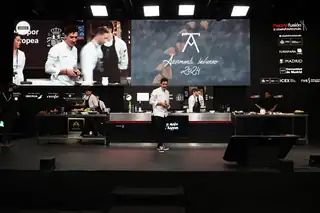
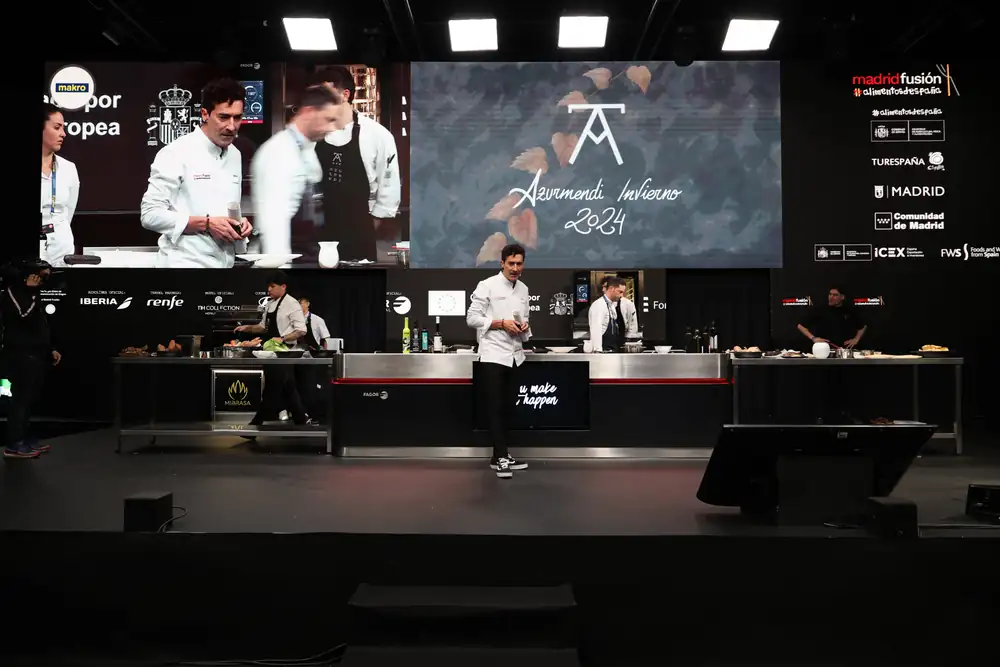
El físico Eneko Axpe propuso un experimento al chef Eneko Atxa (Azurmendi***): elaborar un menú completamente mediante inteligencia artificial.
Physicist Eneko Axpe proposed an experiment to chef Eneko Atxa (Azurmendi***): to run a menu entirely created by AI. The conclusion was that it "didn't quite measure up" for his restaurant, but they did foresee some benefits, such as "quick and efficient" adaptations of dishes for customers with food intolerances or allergies. "It's another tool to continue evolving and working, so that diners are happier," said Atxa.
Axpe broadened the scope: more sustainable recipes are also possible, as AI can analyze the carbon footprint of the ingredients; lower-calorie recipes, adapted to dietary restrictions…
Therefore, he argued that it “has great potential in gastronomy.” For example, if instead of drawing on everything found on the internet, it relied solely on the work of a chef, “it would be like a digital brain for a restaurant.”
At the Dreams space, created by Madrid Fusión and the Alícia Foundation, which was packed for its opening, Ferran Adrià, attending as an audience member, commented that this technology “will revolutionize the world” but wondered “if it will be able to create a technique that doesn't yet exist” as the most renowned chefs do. Therefore, he sees it more “as a source of knowledge than of creation.”
Adrià also took center stage at another roundtable, the one dedicated to the French label Fait Maison, which, starting in 2025, will require French restaurants to specify what they do and do not prepare in their kitchens. In other words, they will have to indicate when they use ready-made meals.
The participants in the round table, Joan Roca (El Celler de Can Roca), Pedro Subijana (Akelarre), Pedro Sánchez (Bagá), Nandu Jubany (Can Jubany), and Albert Boronat, agreed that if you're going to do a worse job than a specialist, it's best to consult one. And once again, Ferran took the microphone and reminded everyone of the many things that are purchased in a restaurant: wines, spirits, ham, caviar… In most cases, bread too.
He noted that only 3% of Spaniards spend 70 euros on dinner, so the artisanal side of haute cuisine must coexist with restaurants that rely on processed foods. “It costs more to buy a croquette than to make it” Sánchez affirmed, at a time when “the hospitality sector has fewer staff and the food industry is growing.”
But what if haute cuisine copied the tricks of the food industry to make its products appealing? This was the question posed by researcher David Chamorro, former creative director of Aponiente and current director of Food Idea Lab. Chemical baths, ultrasound, terpenes, peptides, and even opiates are being used to spice up recipes, achieving more intense flavors, more pleasurable, even addictive, sensations, using less raw material. Like Eneko Atxa's presentation, his opens up a myriad of technical possibilities, but also an ethical debate. Do these shortcuts fit within the discourse of craftsmanship, memory, and identity that governs global haute cuisine today?
History as inspiration
On the other side of this dystopian future, the congress offered examples of how history can continue to inspire avant-garde cuisine. One of the day's main events was a tribute to Arte Cisoria, the first gastronomic treatise in the Castilian language, which recently celebrated its 600th anniversary. Enrique de Villena's magnum opus, "one of the most learned men of the 15th century", comprises in some twenty chapters the different techniques and instruments used at the time to cut almost anything edible. "The role of carver or cutter was then one of the most prestigious professions at court," noted culinary history journalist Ana Vega.
On stage, chef Javier Brichetto butchered a wild boar, Gastón Verdi revealed the secrets of the almost extinct profession of knife sharpener, and blacksmith-turned-chef Alatz Bilbao, from the Bakea restaurant, showed the knives he has recreated based on sketches collected in Arte Cisoria.
Along these lines of using history as a creative catalyst, the work of Paco Morales from Córdoba also aligns with this approach. He has built the menu of his newly three-Michelin-starred restaurant, Noor, around the Andalusian culinary legacy. “It’s not about doing a revival” he clarifies, “but about using ancient ingredients and recipes as inspiration to create contemporary dishes.”
For now, the most pressing issue is trying to address a climate challenge that is already disrupting the biorhythms of producers and chefs, such as the Belgians Nicolas Decloedt and Caroline Baerten, who are able to adapt their menu to the 24 “micro-seasons” experienced by their trusted garden. “We are living through a very serious moment” warned Pedrito Sánchez, from Bagá in Jaén, “with 30 degrees Celsius in January and a very worrying water shortage; we chefs have to raise our voices!”
Lest in the future there be no human palates left to savor the recipes devised by artificial intelligence.
Joel Castanyé, from La Boscana* (Bellvís, Lleida), is guided by nature, giving the fruit of his land the place it deserves on the table: "We try to do with fruit what Ferran Adrián did at elBulli with cooking and the results are wonderful."
The restaurant, with just eight tables, sources its ingredients primarily from a 60,000-square-meter estate and offers dishes such as persimmon sausage, apple water, grilled red kiwi with sour cream, caviar, and olive oil; figs stuffed with king crab; and nectarine curry with lobster. Furthermore, they collaborate with Eurofragans to create soaps for the restaurant using fruit peels and scraps, and they dye fabrics with Teresa Puig.
The technical display came from Oriol Castro and Eduard Xatruch, this time without Mateu Casaña, who brought to the Madrid Fusión stage some of the new procedures they have developed at Disfrutar*** (Barcelona), such as meringues without egg white, which can be applied to sweet and savory preparations; aerated gelatins with gracilagel, with which they achieve "the best of sponges, very spongy and tender" such as the corn one with caviar and melanosporum truffle or the nixtamalized coulant, with which they also go from savory (with squid sauce) to sweet (with pumpkin seeds).
All this without losing sight of tradition, as in their version of the calçotada with this variety of freeze-dried tender onion, with a flaky texture and romesco fermented with koji.
Andreu Genestra championed fats, beyond the "liquid gold" of extra virgin olive oil. In his case, he used shea butter, from a North African nut, to make a vegetable butter that enhances the flavor of gnocchi with roasted carrot, smoked fennel bulb, and Mallorcan soup broth; sobrasada fat from Xesc Reina to coat a grilled lettuce heart with choricero pepper cream, roasted garlic, and oven-baked egg yolk; and tuna fat, which he extracts from the tuna belly using a dehydrator and uses for a béarnaise foam with tuna skin, codium seaweed, samphire, and candied apple. "From tuna to its fats," he explained in this presentation, in which "fat becomes a culinary technique" rather than just an ingredient.
All this took place on a day when the croquette once again reigned supreme in the competition organized by Madrid Fusión and Sánchez Romero Carvajal. With six finalists, it was a very close competition, the jury noted, with Carlos Griffo of Quinqué (Madrid) emerging victorious. With a creamy interior and a crispy breadcrumb coating, the chef explained that he infuses ham bones in fresh cow's milk to make a béchamel sauce with butter and olive oil, to which he adds "finely chopped ham, but not shavings."
Since the restaurant opened five years ago, it has been one of the most requested items on its menu, and he did not hesitate to acknowledge that his mentor was Nacho Manzano (Casa Marcial).
In addition, Cenador de Amós*** won the award for best restaurant bread made by its staff, and José Manuel Marcos, from Pastelería Crujiente, won the award for innovation in cooking for his original chocolate panettone.