Lucía Grávalos, will the third time be the charm?
"Yes, yes, and yes." That's how vehemently and emphatically Lucía Grávalos, a chef from Calahorra in La Rioja, answers the question that titles this review. "Now I'm on my own, I've learned from all my mistakes, and I'm running the business in a way that I feel comfortable with.
"Yes, yes, and yes." That's how vehemently and emphatically Lucía Grávalos, a chef from Calahorra in La Rioja, answers the question that titles this review. "Now I'm on my own, I've learned from all my mistakes, and I'm running the business in a way that I feel comfortable with. I practice a personal, traditional cuisine, after having spent too much time pleasing people who weren't the real customers. We opened three months ago and we're full four days a week."
This is how Grávalos, in her thirties, refers to Desborre, her third capital project in just four years, in the heart of the Madrid of the Habsburgs.
Before that, he had tried his luck at the ambitious and interesting Mentica, in Chamberí, which was wiped out by the pandemic, and at that unclassifiable and somewhat crazy proposal that was the ephemeral Amicitia, where he practiced a kind of permanent and nonsensical four-hands with the Catalan Albert Jubany, who was never there and, as things stand, was not expected to be much either.
In the space that once housed (coincidence or not) the classic Riojan restaurant Algarabía for decades, with seating for around thirty diners, the energetic and highly visceral Grávalos doubles down, with some variations, on the formula she already applied at Mentica: almost absolute prominence for local produce, with special emphasis on garden vegetables, treated from a modern perspective in which technique plays a fundamental role. In this case, with the added element of a very strong commitment to sustainability and the pursuit of minimal waste.
Although there is the option of choosing between two set tasting menus of five and eight courses, the most fun thing to do in this bistro (Grávalos calls it a food house, but it is a textbook bistro) is to go à la carte and choose several dishes from one of its five sections: Bar, Garden, Sea, Pasture and Desserts.
The bar is very traditional: fried piparras peppers, wood-roasted peppers with a notable smoky touch, a baroque version of the "marriage" between boquerón and anchovy, with crispy brioche, fried green pepper sponge, piparras peppers, olive oil spheres and chive flower, and wonderful low-temperature fried torreznos, although the pico de gallo with mint and the kimchi mayonnaise that accompany them suffer from excessive timidity (I mean, they could at least be a little spicy).
The vegetable garden is the main course. First, some medium-sized asparagus from Navarre, bursting with flavor, cooked and braised, with a smoked hollandaise sauce and wild asparagus.
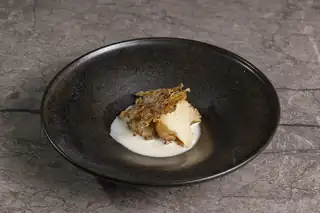
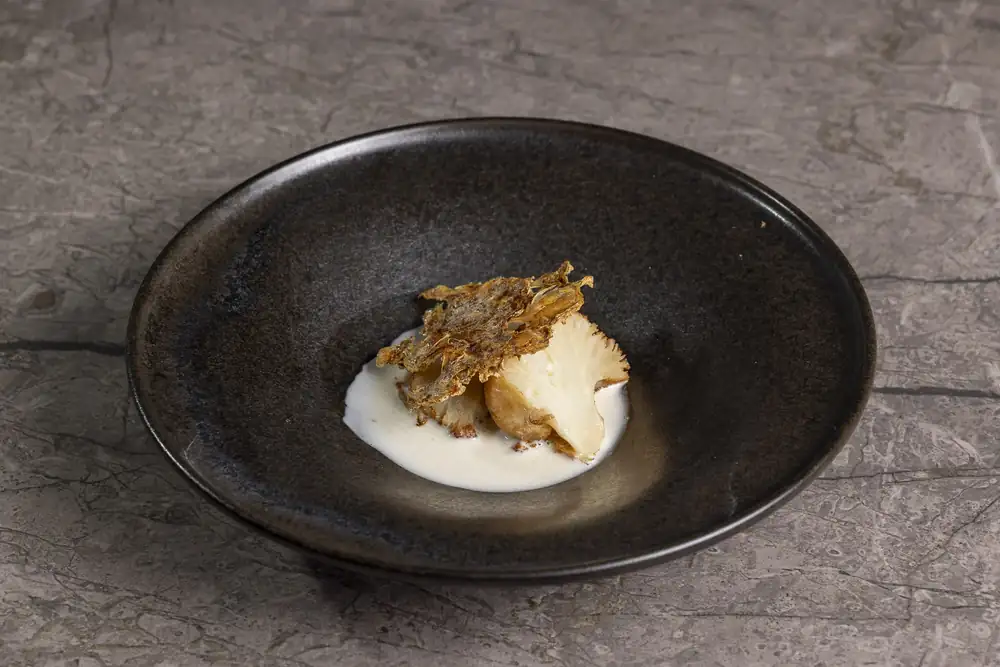
Next came the cauliflower with béchamel sauce and noisette butter, a tribute to his grandmother, which had already become the signature dish at Mentica and remains so here, stripped, moreover, of that caviar which added so little to it, except for a higher price. The cauliflower, as it's called in Calahorra, is a symbol of that town's identity.
Del Mar, a sumptuous sauce of pig's trotters and chorizo accompanies a piece of desalted cod with very little bite and rather meager flavor (signed Barquero) that falls short of what one expects from cod Rioja-style. Even though the sauce is perfect for dipping bread, which it is.
The wild roe deer is the star of Pasto. True to his principles, Grávalos uses every part of the animal, and thus we find three dishes made with the leg: a simple tartare with egg yolk; an excellent sandwich with pickles; and a succulent piece of meat (almost like loin) cooked at a low temperature with bone broth, mashed potatoes, and peas. Two out of three.
Dessert is serious business, especially for those who aren't big on sweets (although it's present, thanks to the natural sugars in the vegetables), and it's already a classic of the chef's: Green Chromatic. Wild asparagus mousse, osmotically dehydrated asparagus, cucumber ice cream, crispy broccoli, and peas. Well, what could be an appetizer anywhere else.
The wine list, original, daring, and very reasonably priced, offers lesser-known but interesting labels. There's a lack of fortified wines, which would pair so well with this type of cuisine, but I'm assured they'll be arriving soon.