Chat qui rit in Venice, review: fine dining between the lagoon and the Orient
To measure the geographical distance of the Chat qui rit from the ideal center of Venice, Piazza San Marco, a stopwatch would suffice: three minutes. To calculate its gastronomic distance, however, one would need to use parsecs and astronomical units.
To measure the geographical distance of the Chat qui rit from the ideal center of Venice, Piazza San Marco, a stopwatch would suffice: three minutes. To calculate its gastronomic distance, however, one would need to use parsecs and astronomical units.
While the heart of Venice is also the area most at risk of standardization, of a tourist-oriented offering, or at the very least, of a narrow focus on dishes that offer a limited (but undoubtedly reassuring for visitors) glimpse of the city's culinary history, a restaurant like Chat qui rit stands apart, offering a diverse, vibrant, and cosmopolitan experience. The most classic, picture-perfect Venice revolves around it: the Orseolo Basin and its choreographed gondolas at rest, the hypnotic elegance of the Contarini del Bovolo staircase, the aura of the Teatro La Fenice. Chat qui rit doesn't forget places and history, but broadens its horizons, transcending the lagoon and adopting a different language. And it risks a great deal: far from the common understanding of tradition and uniqueness, it paradoxically becomes one of the most complex, gastronomically diverse, and intellectually stimulating versions of them in the city.
The place
Looking at it today, after a renovation that transformed its appearance, it's hard to believe that the restaurant's history dates back to the postwar period. Originally a cocktail bar, in the 1980s it became a self-service restaurant seating over a hundred people. Its "white-collar" feel persisted until 2014, when Giovanni Mozzato, a former rugby player and then a finance professional, decided to transform the family restaurant into a completely different space, both in form and substance. Halfway between fine dining and a more casual feel, the renovation reveals the hand of expert interior designers, but it's not an exercise in style. The aim was to blend the past with modernity, creating a space that can be experienced simultaneously as a bistro, a wine bar, and a restaurant.
The color palette plays on the material tones, with lighting and wood elegantly complementing each other and creating a warm atmosphere that encourages a long linger. A white coffered ceiling, typically Venetian Istrian stone columns and walls, wood paneling, and a counter; a large table framed by Flos Skygarden lamps and high stools, low tables accompanied by leather armchairs by Dialma Brown, round marble tables that become jewels under Karman's Sahara lights, antiques, Murano glass, and a wall with impressive wine racks, which previews one of the most interesting and extensive wine lists in the entire city (approximately 500 labels), literally assembled by Mozzato, a sommelier and passionate scholar. The impression is certainly that of a refined yet accessible venue. The aim is certainly to stand out, but it is not ostentatious. The affability and courtesy of the uniformed staff completes and concludes the presentation.
The menu and the dishes
Even before the dishes, it's essential to talk about the chefs, who defy any attempt at definition. Anyone who tries to pigeonhole them into the hackneyed tradition-innovation equation immediately faces a further difficulty, one that broadens and sideways the discussion, and which only seemingly opposes revisited Venetian cuisine and fusion cuisine. Davide Scarpa and Leonardo Bozzato effectively constitute a gastronomic aporia: a seemingly unfeasible coexistence on paper, complicated by their very different training (the former with a classical background, the latter not) and an age difference that elsewhere might result in one of them abandoning the kitchen, but it works perfectly in this kitchen.
On the one hand, there is a solid classical culture, on the other, a world-class talent supported by constant technique and study, and by a hand that looks to the East, without smudges or imitations but having perfectly understood where one finds oneself and in fact offering a new perspective on and of Venice and the lagoon.
The dishes follow a precise path, certainly taking into account the territory, but also bending and transforming it according to needs and tastes: there's the city, there's the region and the regions, but above all there's the inspiration of Japan that modulates flavors and textures. The menu pairs fish and meat, with the option of choosing freely or a tasting (110 euros). Starters (27-35 euros) range from more comforting (bread, butter and anchovies), softer (poached egg), or more refined (caviar) options to decidedly more creative ones (cuttlefish tagliatelle). The first courses (32-40 euros) reinterpret lagoon classics, regional dishes, or land-and-sea combinations, while the second courses (40-46 euros) lean more decisively towards Eastern influences and influences, transforming the face of traditional local seafood. The tasting menu is the perfect opportunity to test the culinary skills of the chef.
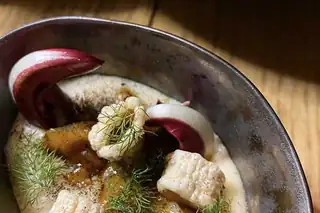
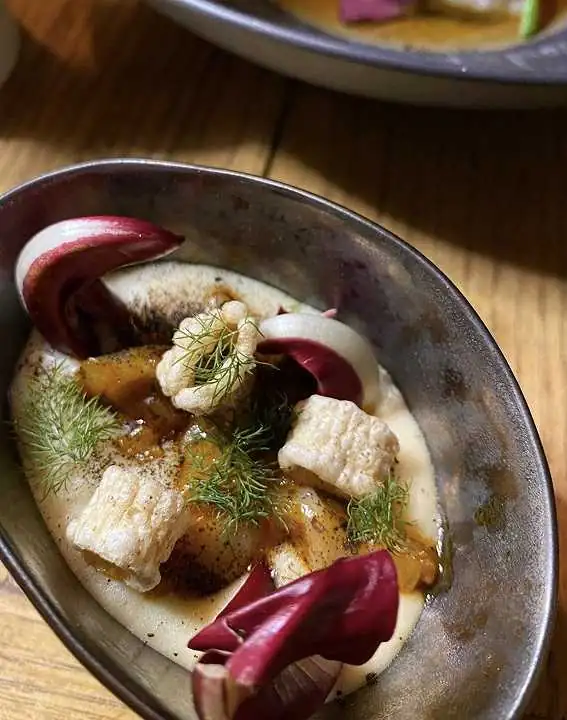
The culinary welcome multiplies into carefully crafted miniatures, announcing the identity the journey seeks: among them, the squid spaghetti, enhanced by the pairing with clams, pushes the marine notes, made even more vibrant by a reinterpretation of the classic sarda in saor, decidedly more dynamic and deliciously savory than the original version. However, it is with the first two courses, cuttlefish tagliatelle with ink mayonnaise, hibiscus gel, and lagoon herbs, followed by smoked amberjack with raw mantis shrimp, dashi broth, edamame, and ponzu sauce, that the journey really accelerates, focusing on technique (very well mastered, as the cuttlefish cut into tagliatelle demonstrates), contrasting textures, colors (the cuttlefish doubles in an optical black and white), mutually reinforcing temperatures, umami and sweetness (the broth and amberjack are a story unto themselves), not forgetting the lagoon, in its little-known version of the herbs, crucial here.
The spaghetti in sardine sauce with smoked volpina is a breath-taking treat, elevating the seductive character of the more famous bigoli to a whole new level, achieving an overall velvety texture, accentuated by the smokiness of the volpina and refreshed by citrus notes. Unexpectedly, panko is just around the corner, providing a final kick. The pluma with Teriaky sauce, almost lacquered, finds a lively twist on the palate thanks to the Treviso radicchio and, more importantly, the mustards (in sauce, whole grains, but more decisively, the vegetable version, with herbs adding spiciness). Meanwhile, the seared octopus with paprika returns to a softer tone, ennobled and enticed by the foie gras royale and accompanied by puntarelle and fried cardonelli. It's a roller coaster ride, but the chef knows what he's doing and is never reckless, nor, more importantly, does he propose combinations designed to surprise: every ingredient has a meaning in the overall composition of the dish.
Those who love sweets in their most reassuring tone and flavor (this writer) might harbor some prejudices when faced with a "walk in the lagoon woods," but the freshness of the sorbet and the buttery notes of the biscuit manage to transform, on the palate, the small tufts of porcini cream into a more placid toffee. The pre-dessert and the small pastries, playful as expected, bring the curtain down. Having left Venice, we've gone elsewhere.
Opinion
In an area traditionally geared toward tourism, Chat qui rit represents an exception and a challenge, offering cuisine that, while rooted in the lagoon, is decidedly oriented toward the East. A four-handed cuisine in which classical training and creativity not only communicate but also stimulate each other.
AGAINST
- The lack of a tablecloth detracts from the dishes. A white cloth would help enhance their character and identity.