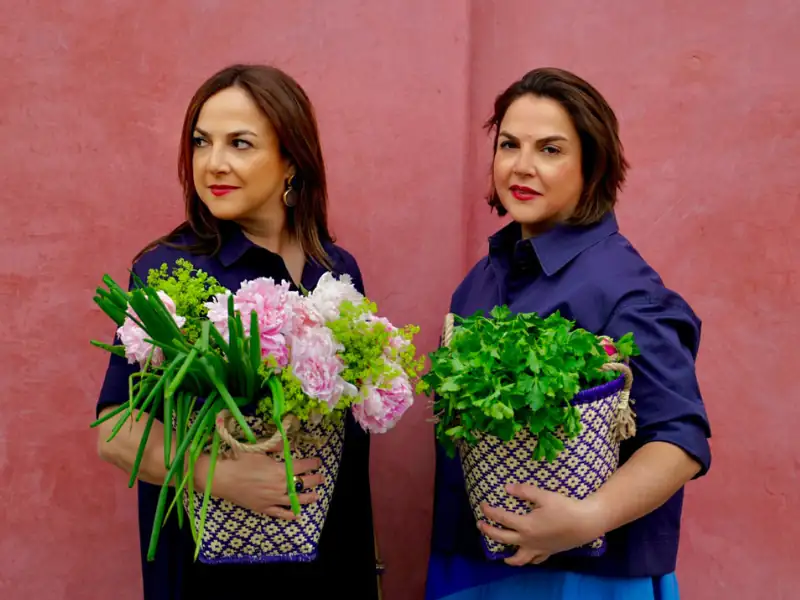
Persian cuisine in Berlin by the Soudoubi twins
Persian cuisine in Berlin: Here, love flows!
Berlin, Reichenberger Straße: graffiti-covered apartment blocks, cobblestones, daycare centers, cafés, pubs. People tinker with bikes in front of shops, flowerpots dot the sidewalk. A piece of laid-back, pre-reunification Kreuzberg has been preserved here. But a completely different world unfolds behind the gleaming white facade of number 116. Here, in the "Culture and Food Lab," pots and pans clatter, the air is filled with the scent of fairy tales and the Orient, and delicacies beckon from ornate brass and ceramic bowls. The turquoise and saffron-yellow tiles on the walls and kitchen counter are replicas of centuries-old originals from Tehran's magnificent Golestan Palace.
Private dining with a wow factor
“Some of our guests are completely beside themselves when they walk in,” says Forough. “They look around, beam, take photos, call friends: ‘Imagine, I’m right in the middle of Kreuzberg – what I’ve discovered here!’” Some come back again and again, even from Lübeck, Münster, Leipzig, and Hanover. Others book appointments a year in advance. There are no opening hours like in a restaurant, but there are cooking classes such as “Persian Mezzeh” or “Persian Festive Menu” and also “Private Cooking Classes.” On the “Private Dining” evenings, a festive table is set for ten to sixteen guests. And everything is shared. Anyone who wants to can mix modern Persian cocktails at the large kitchen counter or even sample food from the pots and pans. Like in one of the traditional houses in the Middle East, the magic unfolds inside, says Sahar, Forough’s sister, who is twelve minutes younger. Sahar means “early morning” in Farsi. Forough means “dawn.”
From Berlin brats to daughters of the revolution
She was born in Berlin. Her parents had come to Germany to study and met there. After finishing their studies, they returned to Tehran. That was in 1978. "We were five years old and wild Berlin kids; we even preferred to speak German with each other at school in Tehran," says Sahar. A year later, the Iranian Revolution took place. The Shah and his family fled into exile. "Everything was suddenly different; we girls had to wear the hijab and behave inconspicuously in public." In return, her family provided all the more warmth, love, enjoyment, and security at home: "Our grandmother told stories, we made jams, and dried orange peels on newspaper." Things became more difficult for them as young women. Dancing, flirting, everything Western was forbidden. They, too, were not spared arrests and interrogations by the police.
A new beginning with flavor
After completing their studies in meteorology and geophysics, and also at their parents' request, they moved back to Berlin in 2000 to pursue their doctorates. Dr. Forough Sodoudi became an expert on seismic changes in sensitive geological zones. Dr. Sahar Sodoudi taught urban climate and sustainability. However, the increasing coldness and exclusion of people, especially those from the Middle East, in Germany and within academia in recent years left their mark. "The privilege of education always meant giving something back to us," says Sahar. After a thirteen-hour, fruitless meeting, Forough was the first to pull the plug and resigned the next day. Sahar followed suit shortly after. They agreed that it was time to rekindle that comforting warmth, compassion, and the flavors of their childhood in Tehran—and share them with everyone in Berlin! The idea for the "Middle Eastern Culture and Food Lab" was born.
Persian recipes for the whole family
“Suddenly, we were surrounded by happy faces again,” says Sahar. With enthusiasm, energy, and meticulous attention to detail, they refined the concept and its execution. Recipes and cooking tips from family and friends were noted down, and cookbooks were studied. Persian cuisine can be traced back over 2,000 years. Among their favorite dishes is, for example, aromatic Mirza Ghasemi, made with eggplant grilled over an open fire and puréed with garlic, turmeric, and tomato. Sweet and earthy Khoresh Morgh o Aloo, chicken seared and then braised with pomegranate molasses, is served with apricots and Persian plums cooked in spices and saffron. Fesenjan, a sweet and sour stew of chicken, beef, or baby eggplant with pomegranate-walnut sauce, parsley, and Persian hogweed, originated in the 7th century in a mountainous region near the Caspian Sea.
Berlin catering with Persian flair
Fresh herbs and crisp vegetables are served with every dish. The preparation of Persia's famous crispy saffron rice, which Forough and Sahar still artfully garnish with caramelized barberries and pistachio slivers, just as they did back home in Tehran, is proudly demonstrated in front of the guests. For Kreuzberg kids who pop in after school, there might be a slice of North Iranian walnut cake with cardamom. A key pillar of their business is their now highly sought-after catering service, through which Berlin's most famous twins deliver good vibes – and every platter or bowl is a visual delight. Readings and musical evenings exploring the diverse Persian culture in the "Lab" further help to break down barriers. And it works!
Excellent hostesses with vision
Last November, the "Middle Eastern Culture and Food Lab" was named "Berlin Host 2024" by the "Berlin Master Chefs" jury. In July, the sisters will cook for the mayor and 500 guests at Berlin City Hall. Forough and Sahar's first cookbook and book, "Here Flows Love – Persian Cuisine" (Brandstätter Verlag), has also received medals. The foreword states that it is dedicated to all Iranian women – their strength, culinary skills, and devotion are what truly nourish the people of Iran. Photos of leading Iranian women also adorn the walls of the "Lab," including one of former Empress Farah Pahlavi, who still lives in exile in Paris. A letter dated March 8, 2025, now hangs next to her photograph: "Your path, your perseverance, and your extraordinary success show that dreams can truly come true. With warmest regards, Farah Pahlavi."