Wines and oils from the pasture
Olive groves and vineyards often go hand in hand, protected within the same farm. This is quite common, perhaps because, along with wheat, they form the three pillars of the Mediterranean diet: bread, olive oil, and wine.
In the case of these last two, both share many historical and cultural similarities and have been an irreplaceable part of the Iberian Peninsula's landscape for centuries. This is also true in terms of production: they adapt to poor soils, are drought-resistant, perfectly reflect the terroir, and showcase the characteristics of each variety, each farm, or each plot where they are cultivated in all their splendor.
Throughout the country, there are numerous examples of prestigious wineries that, in addition to wines, also produce extra virgin olive oils, involving different regions or designations of origin. In Madrid, for example, there's Bodegas Bernaveleva with a blend of Cornicabra and Picual olives; the Roda wine group (which produces wines in Rioja and Ribera del Duero) with its Aubocassa extra virgin olive oil in Mallorca; in Navarra, there's Bodegas Aroa (part of the Vintae group), which produces the rare Le Naturel extra virgin olive oil; and one of the first to venture into this dual world of vines and olives, Marqués de Griñón, at its Dominio de Valpusa estate in Toledo.
Muga, from La Rioja, is proud of its La Mariana olive oil, as are Arzuaga wineries in the Ribera del Duero region—which also produces extra virgin olive oil in Toledo—and Marqués de Valdueza in Extremadura. Many have chosen this path. Now, a new brand is joining the trend, which, in its case, begins in the olive oil sector before moving into winemaking, a path that is often the reverse.
The best extra virgin olive oil in the world
Dehesa El Molinillo has gained recognition among gourmet consumers by winning the award for best extra virgin olive oil at the prestigious international competition Evooleum 2025. Specifically, the award went to an EVOO produced with the Coratina variety (€13 for 250 ml), an Italian olive harvested early that yields fresh oils with aromas of herbs, green almond, and wildflowers, intense on the palate (slightly bitter and peppery). Furthermore, it has a high polyphenol content – over 1,000 mg/kg – which has also earned it recognition as one of the healthiest olive oils in the world. This award joins four other EVOOs produced at their mill, such as their magnificent Empeltre, Tradición, and Navalices (based on the Cornicabra variety), and their organic Reserva de la Familia.
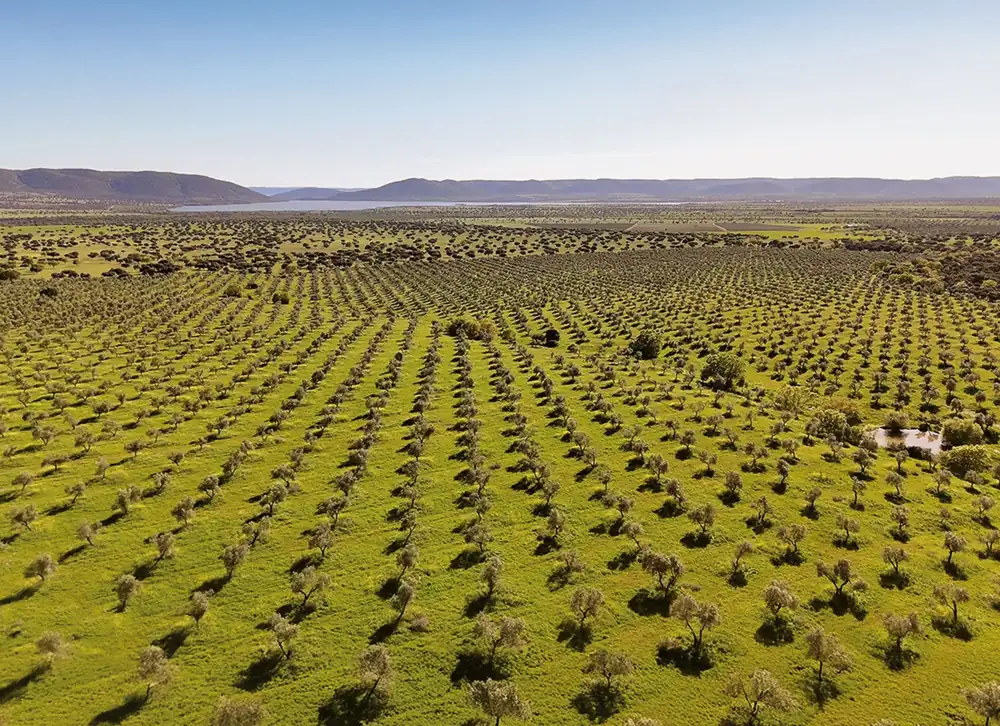
The olive grove covers 230 hectares of the Dehesa El Molinillo estate, a 4,200-hectare property located between the southernmost reaches of the Montes de Toledo mountain range and the Cabañeros National Park, within the municipality of Retuerta del Bullaque, in Ciudad Real province. Here, the olive trees coexist with the typical Mediterranean forest, full of holm oaks, cork oaks, and ash trees, as well as livestock, native species, and, of course, the vineyard. All of this is just 150 kilometers from Madrid and a little over 50 kilometers from Toledo. The olive mill and winery are located right there, in the heart of this natural setting.
Now, also wines
The owners of the estate, the Lao family, acquired it as a second home in 1983. They came from the arcade business, the well-known CIRSA, a company they sold in 2018. However, from the beginning, they were clear that the environment had to be respected as much as possible, and that their intervention would focus on cultivating the olive grove, although they didn't rule out working the vineyard either. They established the olive mill in 2019, and two years ago they built the winery. Until then, they sold their olive and grape harvests to third parties. And if first it was marketing their own oils, now it's the turn of the wines.
Pedro Belmar, an agricultural engineer and manager of Dehesa El Molinillo, has been at the helm of this farm for five years. In his opinion, “it’s not your typical farm, but a natural park with organic olive groves interspersed with vineyards. It’s located in the heart of the Montes de Toledo, an ecosystem of undeniable value that must be preserved.” He emphasizes that among the holm oaks, vineyards, and olive groves, there are cereal crops, game, and a privileged natural environment, all just an hour’s drive from Madrid.
The vines, certified organic, were planted in 2006; initially, they were of the Touriga Nacional variety (a rarity in this area), Cabernet Sauvignon, and Syrah, and later Graciano, Pinot Noir, and Chardonnay were added. In total, there are 10 hectares of vineyards cultivated at an altitude of around 700 meters, which contributes to the wines' freshness, along with shallow, poor, and rather acidic soils, geologically among the oldest in the Mediterranean.
To launch the wine project, they enlisted two consultants, Juan Antonio Leza and Jean Marc Sauboua. The former is an oenologist and expert in vines; the latter, from Bordeaux, is one of the most highly regarded winemakers internationally (he has worked at the legendary Château Haut-Brion, among many others).
Wines from the pasture
So far there are two wines on the market: a rosé and a red.
La Rous 2023 is a 100% Cabernet Sauvignon rosé, of which just over 3,500 bottles were produced. 70% was aged for 9 months in French oak barrels, while the remaining 30% was aged on its lees in tanks. The result is a fresh, luscious rosé with body and minerality, boasting a beautiful color—an undeniably attractive feature in a wine of this type. It retails for €20.
The red wine, Nacelcanto 2022, reflects the landscape and diversity of the estate. Made from 50% Cabernet Sauvignon, 24% Syrah, and 26% Touriga Nacional (the blend will vary depending on the vintage), it has aged in French oak barrels as well as 750-liter terracotta amphorae, for a total of 12-14 months. This red wine reflects the warm 2022 vintage: it is somewhat liqueur-like, yet approachable, with a very fruity nose and subtle spicy and balsamic notes. On the palate, it displays good freshness, rounded tannins, and a pleasant, youthful finish. This red wine will improve with bottle aging. 4,600 bottles were produced. The price is €25.
Their future plans include producing wines from Chardonnay, and they are currently experimenting with white and sparkling wines. Their ultimate goal is always to showcase the terroir without sacrificing finesse and complexity.