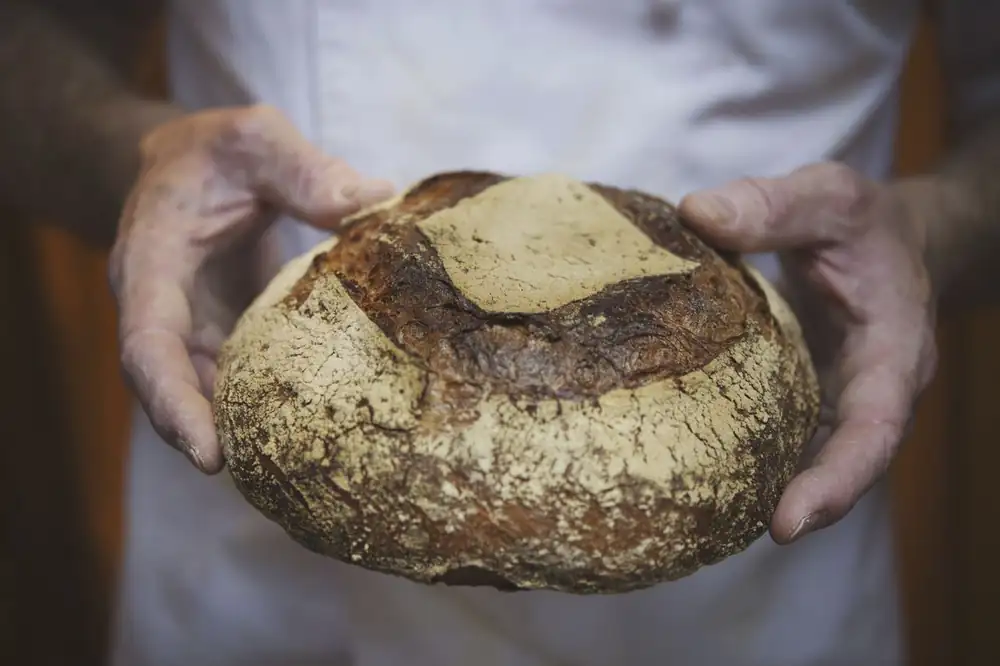
The best bakers in Stuttgart
Bakery and confectionery Karl-Heinz Weible
Southern district, Heusteigstr. 51, postal code 70180, Tel. 0711-60 21 01, Instagram.
The bakery's incredibly charming and authentic interior in the trendy Heusteig district still exudes the flair of the 1960s. However, the selection of goods in this traditional bakery with over a century of history showcases contemporary and exceptionally solid craftsmanship. We were particularly pleased to sample the Swiss farmhouse bread made with organic sourdough, which gives the impression that Swiss farmers clearly prefer a refined rather than rustic style, as well as the spelt-emmer ancient grain bread, which is subtly nutty, gently hearty, and boasts a pleasantly airy crumb.
Café Nast
Since 1902, "Nast" has been one of Stuttgart's premier bakeries. While the consultation and sales conversation during our visit was more typically Swabian and hearty than truly customer-focused, this traditional bakery still manages to impress with its classic baked goods. The house bread, sold by weight and baked according to a family recipe using equal parts wheat, rye, and spelt, is considered the benchmark. The Alsatian-style bread, with its airy texture and crispy crust, is also a standout. And the rye bread is quite good as well.
Port villages
Great-grandfather Wilhelm Hafendörfer was a royal court baker in London and, after returning from England in 1898, opened a bakery in Stuttgart's west end. In 1987, the current main location opened in the former court printing works in the Heusteig district. With five branches today, the bakery is considered medium-sized in the region, but remains committed to traditional, handcrafted production. The braided yeast bread is particularly popular with locals, but among the products we tested, the rustic wood-fired bread and the hearty rye star also impressed. The "Filione," likely a product of the current Italian trend, however, was rather bland.
Trölsch Bakery, Confectionery, Café
The bakery, now run by brothers Dirk and Falk Hafendörfer, is a long-established institution in the state capital. In 1987, they opened their current headquarters in the former court printing works in the Heusteig district. Their rustic wood-fired bread has long been their signature offering, and the Backhauslaib (a type of loaf) is quite similar, but with the addition of potatoes. The small after-work loaf is perfect for single households and beyond. If it's on sale, be sure to check out the eye-catching St. Gallen semi-white bread in its spiral shape. And a new discovery among their rolls: the fantastic potato dumplings.
This traditional bakery, with over a century of history, fits perfectly into the trendy Heusteig district with its beautiful old Gründerzeit-era buildings. The interior feels like it's straight out of the 1960s, yet it's wonderfully maintained. The finest craftsmanship is evident in the bakery itself. The Swiss farmhouse bread, a light mixed wheat bread with a touch of rye and organic sourdough, is a popular house specialty. We also particularly enjoyed the spelt-emmer loaf and the rustic spelt country bread. The subtly tangy little quark and potato crusty bread is a delicacy, even for single households. The whole-grain rye bread is especially hearty and nutty. The homemade butter rusks evoke fond childhood memories.
Were it not for the magnificent products of master baker Jürgen Frank, one would have to praise him already for his social awareness and sustainable business practices. Supporting local social projects is as much a commitment for him as ecological sustainability through an electric vehicle fleet and 100% climate-neutral energy in the bakery. His motto, "Whoever bakes bread bears responsibility," is also reflected in the high quality of his baked goods. We look forward to the beer bread, made with wheat, a touch of rye, and barley, on every visit, as well as the flavorful South Tyrolean flatbread (when it isn't, as is so often the case, already sold out due to its popularity), and the potato loaf is a feast for the eyes. We recently discovered the wonderfully moist, grainy ancient grain whole-grain bread with emmer and einkorn.
Since 1902, Nast has been one of Stuttgart's premier bakeries – a status that stands in striking contrast to the often lackluster customer service. But Stuttgart's clientele probably already knows what they want, and the legendary "Nast" loaf, with its signature floured crust, is a local icon made from Württemberg rye and wheat, using the bakery's own sourdough starter. It's sold whole in two-kilo loaves or by weight. The dark rye bread and the light, airy Alsatian bread are also popular classics. The Mühlenweckle (mill rolls) and Pfefferle (pepper rolls) are also highly recommended.
Francesco Ingrassia and his father Aurelio have moved a few doors down and created an additional attraction for their already widely renowned organic bakery: In their chic new shop, you can buy bread practically right next to the bakery! The "Grandpa's Bread," a mixed wheat bread with 30 percent rye, is the bakery's signature product and clearly one of the best breads in the state capital. The Ingrassias' heritage is evident in the remarkable "Etna Lava Crust," which combines rye sourdough with traditional Italian biga, a pre-ferment made from durum wheat. And yet, the two are also true Swabians: Their pretzels are considered a delicacy, enjoyed even by top chef Vincent Klink. Without a doubt, the Ingrassias' insistence on traditional baking methods and a particularly long fermentation process, under the hashtag motto "bake to the roots," is deliciously noticeable in each of their outstanding breads.
Iris and Dirk Voß are particularly proud of their family tradition, which dates back to 1904. A visible sign of this is the bread specialties dedicated to Grandma Waltraud and Grandpa Hermann, both considered classics of the bakery. Both mixed-grain breads are as beautiful to look at as they are delicious, with the "Grandpa Voß" bread being slightly darker and more robust, while the "Grandma Voß" has a heavenly light, almost delicate and airy crumb. The "Atlanta Crust," a five-grain bread with corn and peanuts created for the 1996 Olympic Games, has also become a modern classic. We recently discovered the "Rudi," a pretty little loaf that lives up to its name—a rustic spelt bread—in a delicious way.
The tiny Bosch bakery is a Stuttgart institution, not only because of its delicious pretzels, for which the bakery is also simply known as "the pretzel baker." The classic country breads are always a special treat here, such as the Frankenlaib (Franconian loaf), the Besenbrot (broom bread, which has nothing to do with the cleaning implement, but is named after the traditional Swabian wine tavern), or the Hirtenlaib (shepherd's loaf), a net-textured farmer's bread made with spelt flour, with a wonderfully airy texture and nutty touch. For a more cosmopolitan, but equally handcrafted, option, try the cornbread or the olive ciabatta. Those who prefer something more hearty should definitely try "Bochs Büxe," a distinctly nutty and spicy, coarsely ground whole-grain bread baked without added yeast in a tin.
The Dürrlewangen organic bakery is particularly proud of its in-house sprouted grains, which consist of long shoots of rye, wheat, and spelt. These so-called "golden sprouts" then refine, for example, the "Spelt Power Bread," which gets a pleasantly sweet and nutty touch from a little organic honey in the dough and sesame seeds. A classic is the Black Forest bread (80% wheat, 20% rye), which finds a beautiful counterpart in the darker Silesian bread (80% rye, 20% wheat). A particularly popular choice is the light, airy Dürrlewanger wheat-based bread. Those who prefer something more hearty should look for the spelt flake bread with sunflower seeds and flax seeds. It is somewhat surprising, however, that contrary to the otherwise high standards of this bakery, originally founded in Tübingen in 1968, the standardized "Bernd" brand bread is also included in their product range.
The friendly service alone makes shopping at this award-winning bakery near Möhringen train station so pleasant. It's worth checking the baking schedule published on their website so you don't miss out on the specialties offered alongside their already excellent standard classics like Black Forest farmer's bread. These specialties are often made with organic ingredients and their own sourdough starter. For us, Thursday and Saturday are ideal days, as they offer all three of our favorite breads: the moist organic mill loaf, a feast for the eyes; the "Orgellaible" made with spelt flour, boasting a wonderfully balanced flavor and a crispy crust; and the large-pored Ticino wheat bread with its fluffy, delicate crumb. Those who visit on Wednesdays or Fridays should look out for the organic Bündnerbrot made with whole wheat flour.
As one of the few bakeries of its size, Trölsch Bakery has once again earned this recommendation. For its 22 locations in northern Stuttgart, the bakery continues to use only regional flours and adheres to high artisanal standards. The large Black Forest flatbread from the bakery, founded in Gerlingen in 1958 and now run by brothers Peter, Jürgen, and Ulrich Trölsch, is particularly noteworthy. The Swabian potato bread and the more robust Alpine loaf are also very popular. The spicy caraway loaf pairs wonderfully with Münster cheese. The Vinschgau flatbread has a beautiful crust and good texture, but its spiced aroma is somewhat less pronounced than that of its South Tyrolean counterparts.