Spanish ham and larder conquer Munich
If the conclusions of Spain Fusion Munich had to be summarized in a slogan for a t-shirt, the phrase would undoubtedly be: "Germany loves Iberian ham." The event, which promotes Spanish gastronomy in strategic international markets and was organized by ICEX Foods and Wines of Spain, Alimentos de España, and Vocento Gastronomía, made a spectacular debut in the Bavarian capital.
If the conclusions of Spain Fusion Munich had to be summarized in a slogan for a t-shirt, the phrase would undoubtedly be: "Germany loves Iberian ham." The event, which promotes Spanish gastronomy in strategic international markets and was organized by ICEX Foods and Wines of Spain, Alimentos de España, and Vocento Gastronomía, made a spectacular debut in the Bavarian capital.
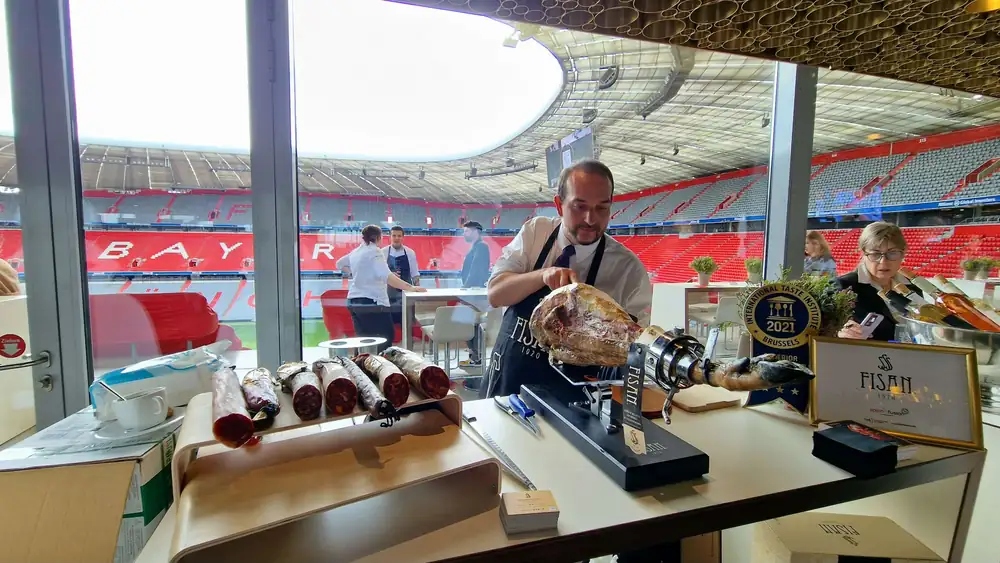
The VIP area of Bayern's stadium, the Allianz Arena, became a showcase for some twenty companies of Iberian hams, artisanal cheeses, fish preserves, sauces, extra virgin olive oil, truffles, fresh and dried fruit, wines and vermouths, where they presented their top quality products to distributors, retailers and restaurateurs, and where experts and great chefs showed the uniqueness of Spanish products and their applications.
The meeting coincided with the semi-final of the German Chef of the Year (Koch des Jahres) competition, an event that arouses the passion of the best sporting events, promoted by the Spanish resident in Germany, Nuria Roig de Puig.
In the area occupied by Spain Fusion, enormous statues of Las Meninas, their dresses decorated with motifs from Spanish gastronomy, served as eye-catching displays. Besides those specifically invited by the organizers (distributors, gourmet shop owners, and hospitality professionals), there was a constant flow of contestants and attendees, mostly chefs and front-of-house staff.
In this edition of Spain Fusion (the fourth, following two events in the United States and one in Bonn), Castilla-La Mancha played a prominent role with the participation of the Raíz Culinaria quality brand. Fran Martínez (Maralba, Almansa) and Iván Cerdeño (Iván Cerdeño Restaurant, Toledo) showcased the richness of game cuisine and the potential of pickles in contemporary haute cuisine.
Among the other ambassadors at Spain Fusion Munich was Lucía Freitas (A Tafona and Lume), who demonstrated how refined, and gastronomic, canned fish can be with an elegant touch. Luis Valls (El Poblet) offered a cooking demonstration on rice in haute cuisine, and Javi Abascal (Lalola, Seville), a specialist in Iberian pork cuisine, focused on showcasing the nuances of Iberian hams and cured meats in a joint tasting with Spanish Master of Wine Almudena Alberca.
Another tasting that the German public, passionate about Manchego cheese but unfamiliar with artisanal Manchego cheeses, followed with interest, was the one offered by Master of Wine and oenologist Fernando Mora, a veteran of the Spain Fusion team, who explained the possibilities of pairing between Spanish white wines and cheeses from different areas together with the Sevillian cheese affineur Vanessa Cruz (Quesería Queso-Queso, Seville).
Alfonso Fernández, international taster of extra virgin olive oils and vinegars, and master of ceremonies for Spain Fusion, introduced the audience to the world of Spanish vinegars, which are among the products with the greatest potential in the international market despite their limited awareness in Spain (did you know that three of the four European Protected Designations of Origin for vinegars are Spanish?). Expert Kerstin Barduhn focused on Spain's liquid gold: extra virgin olive oil.
“Germany loves Spanish gastronomy, particularly its traditional cuisine and products like Serrano ham and Manchego cheese, but it is still difficult to find these products in the German market, where lower quality versions are sold that are sometimes not even Spanish.” This quote belongs to Toni Amer, a Mallorcan who has lived in Germany for eight years and is the sous chef at the Facil restaurant (Berlin).
“My boss is a big fan of Spanish cuisine. We use Spanish olive oil, we’ve worked with products like bluefin tuna, and we serve gazpacho in the spring and summer; people love it. However, the ham we’ve been able to get so far has been a fairly common Serrano. Iberian ham is on another level. It’s what brought me here” he says.
Judging by the way the public crowded around the stands of the four producers of Iberian ham and sausages participating in Spain Fusion Munich during the nine hours of the event, Toni Amer was not the only enthusiast of the product.
The German chefs were particularly expressive, among them René Frank of Coda Dessert Dining (Berlin), a true star of German cuisine who gave an unforgettable presentation on the boundless possibilities of pastry. A proponent of using salty and umami contrasts to reduce sugar and offer new sensations in his desserts, Frank didn't hesitate to choose his favorite Spanish product: "Iberian ham. I think it's one of the best products in the world."
For Maximilian Oswald, Munich representative of Frische Paradies, Germany's leading gourmet food group, another noteworthy discovery was the Alalunga brand of canned fish. "We already have a wide selection of Italian and French products, and we came to Spain Fusion to complete our catalog of Spanish products. We love canned goods. In Spain, canned goods are a high-quality product, not the typical staple you keep in your pantry, but these cans offer both possibilities: enjoying a gastronomic experience and having a practical meal," he stated.
Alalunga is a company from Cantabria. "My brother and I wanted to take advantage of our experience in canning and apply it to products that are not usually seen canned," Pablo Huidobro explained to Oswald and his companion.
Another product that joined the Spain Fusion expedition for the first time, and which received an outstanding reception in its country of origin, was the rosé vermouth from the Reus-based company Miró. Also included was the almogrote from Argode and Fortaleza, producers of Canarian mojo sauces.
“I was convinced that the red mojo and avocado ranges would be the stars, but the almogrote has been more successful because people appreciate its potential as a spreadable cheese cream and also its resemblance to Italian pesto. More than one visitor has commented that they would like to try it with a pasta dish” said José Antonio Mederos, sales director.
Another surprise was that the Aragonese apples from Moncayo captivated the public in a country that produces the same fruit. "Apples are very mistreated in the market," explained Menchú Guerrero, farmer and founder of Orchard Fruit, "but when you work with unique varieties and take care of the product from the field until it reaches the consumer, it becomes a delicacy. Today I saw the same reaction hundreds of times: people would pick up a piece of apple as they walked by, and after tasting it, they would turn around and stop to talk to me."
The commercial and educational part of the day gave way to a more festive atmosphere at sunset, with the Spain Night Out event, where Manchego gastronomy shone with traditional versions of atascaburras and pisto, competing with the potato omelets of La Tasca Flamenca, a Munich restaurant affiliated with the ICEX Restaurants from Spain quality seal.
Ana Isabel Fernández Samper, Director General of Tourism for Castilla-La Mancha and head of Raíz Culinaria, highlighted the potential of gastronomy as a tourist attraction for regions and territories. "At Raíz Culinaria, in collaboration with leading restaurants in the region, we offer gastronomic experiences and routes that complement the stay of those who don't travel primarily for food and, above all, attract the increasingly important gastronomic tourist," she stated.
The organizers of Spain Fusion Munich left the Allianz Arena feeling they had held a successful event and further boosted their entry into the lucrative German market. "This was the first time we targeted the event at companies that don't yet have a presence in this market. We'll have to wait to see its true effectiveness, since the goal was for them to find distributors, but it's clear we can't spare any effort," explained María Naranjo, director of the agri-food sector at ICEX.
“Bavaria is an economic engine of Germany and a region that, due to its location near Switzerland and Austria and the fact that it is a tourist destination, has a very solid Horeca sector” he added.
For his part, José Miguel Herrero, Director General of the Food Industry at the Ministry of Agriculture, highlighted his satisfaction with the union between Alimentos de España, the institution he represents, and ICEX to continue and make these promotional activities more effective: “We must understand that together we are stronger, and we must also make those sectors that do not yet see it understand that gastronomy is an engine of wealth for the regions.”