Lele Usai and fish aging on Masterchef: intense flavors, biodiversity, and local development
Lele Usai and fish aging on Masterchef. We've been wanting to revisit Lele Usai for a while now, the chef who established his reign in Fiumicino with his restaurant Il Tino (one Michelin star), later joined by 4112.
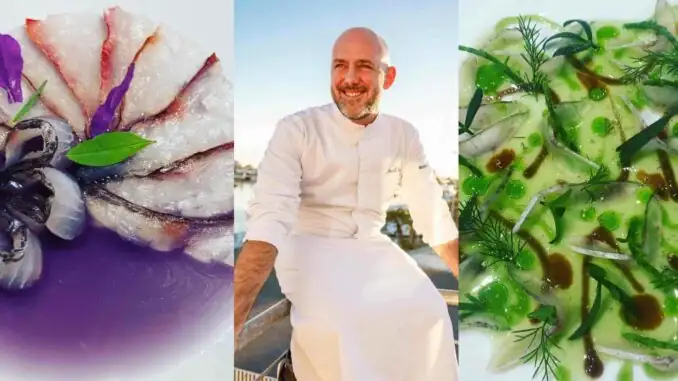
The two dishes brought to Masterchef: Nautilus and Rockfish
The chef was the guest of honor on the fifth episode of the renowned culinary talent show (which aired on January 27th; you can find our ratings here). He presented two recipes and a special fish-processing technique to the contestants. The topic of the invention test was dry-aging, Usai's subject and object of study in recent years. Indeed, the chef wasn't content with earning his first Michelin star, so in 2019 he decided to travel to Marseille to learn new fish-processing techniques from Gerald Passédat of Le Petit Nice (three Michelin stars), who has been working in the field for three generations.
"My idea was to understand how they used raw materials at such a high level with fish that were essentially similar to those found on our coasts. I began to learn about this technique they had been using for years, I became passionate about it, and I began to study it." An in-depth and constant study that led Usai to refine this technique, to the point where it became one of the many specialties served in his restaurants, both located inside the Nautilus Marina Yacht Club in Fiumicino. Here, there is a refrigerated aging room designed specifically for fish. "You can control humidity and ventilation. It emits ozone, a true health asset, a powerful bactericide that reduces bacterial growth. So, not only can you make salted fish, which becomes like cured meat, but it also works on raw meats."
Techniques that seem like science fiction, but they allow for a top-quality tasting of the raw material and new flavors on the palate. "Among the advantages of this process is the 23-30% reduction in liquid content and the elimination of connective tissue, giving the fish a more intense flavor, releasing all the aromas of the sea, and a different texture, almost crunchy yet yielding." It's a way to savor fish in a new light, discovering all its nuances. The difference between raw and aged fish "is a bit like the difference between young and aged champagne; it all depends on what you're eating at that moment and what kind of taste experience you're after."
Following the theme of matured fish, a Masterchef theme for the episode, Usai brings two of his original and spectacular recipes to the studio:
Nautilus: white fish matured and infused with mallow flowers.
Rock fish, seaweed, salicornia and fennel extract, arzilla garum.
"I have a strong emotional connection to Nautilus because it's the name of the shipyard that hosts us, and it's a dish dedicated to my members." Nautilus is also a special shell "that if you cut it in half, you can see the Fibonacci sequence, and in my dish, in fact, the fish fillets are arranged following this very principle." The Rockfish recipe, then, is based on an ethical choice as well as one of taste and aesthetics: "In the menu, I indicate a specific fish, the rockfish, but I don't say which rockfish it is. I go to the auction and take what I find." So one day it might be red mullet, another marble smelt, or maybe monkfish. But why this daily improvisation? "Simple, because I only follow the availability of the catch. I leave it up to the Fiumicino auction to suggest what to cook. If, however, you specify a specific fish and it's not available locally that day, you'll have to buy it, perhaps even giving away the location and availability. So I go by type, not by family."
Respect for the sea and the land
A choice that respects principles dear to Usai, who personally participates in the fish auction and wants to "change the supply and demand of the catch, in a way that respects the sustainability of fishing." Because the sea offers a significant variety of fish, but then at the time of purchase, the same "familiar" types are always requested and used. In the collective imagination, incorrectly, when people buy or cook fish, they think they're always using the same raw materials, considered more familiar. But the sea, as they say, is full of fish, and ours offers unparalleled biodiversity. "After so many years of going to the auction, I still see crates of fish I've never seen before!" The challenge, not only at Tino but also at 4112, is precisely to serve lesser-known products. “I also get advice from other buyers on how to use them, because I think that if I stop using overly sought-after products, like octopus, and offer, for example, octopus pulp, then maybe I can change the demand because people learn to know and appreciate different, more readily available products that don't harm our seas.”
The informed contribution of even a single person can make a difference in demand. "I try to always do something, consistently, even in my own small way. One idea, for example, would be to create brochures for fishmongers featuring recipes, written by me, for lesser-known fish. This would encourage them to sell them and customers to buy them, because they already have an idea of how to cook them at home."
In recent years, thanks in part to Chef Usai, a true virtuous cycle has been established, one that extends beyond sustainable fishing to promote the entire Fiumicino area. Usai, along with other local entrepreneurs, founded the nonprofit association Periferia Iodata: "The idea was born one evening when we were with other restaurateurs, and we decided to bring this project to fruition, helping to preserve and respect the characteristics of our region." Fiumicino is truly unique, not only thanks to the aforementioned fish auction, but also to its supply chain of small wine and cheese producers, and the extensive local vegetable cultivation in Maccarese and Isola Sacra. "The challenge is to create interesting things for the area, for sustainability and quality, but also to encourage people to visit its beautiful villas, parks, archaeological sites, and castles." A mission that hinges on promoting not only the local excellence, but also the producers and restaurateurs who are committed to ensuring quality and sustainability. A sense of belonging to the periphery and pride in its characteristics shines through in Usai's dishes and in his very concept of cuisine, of which he brought only a taste to MasterChef.
Il Tino. Via Monte Cadria 127, Fiumicino (RM). Tel. 06 5622778. Website. Facebook. Instagram 4112. Via Monte Cadria 127, Fiumicino (RM). Tel. 06 6581179. Website. Facebook. Instagram.