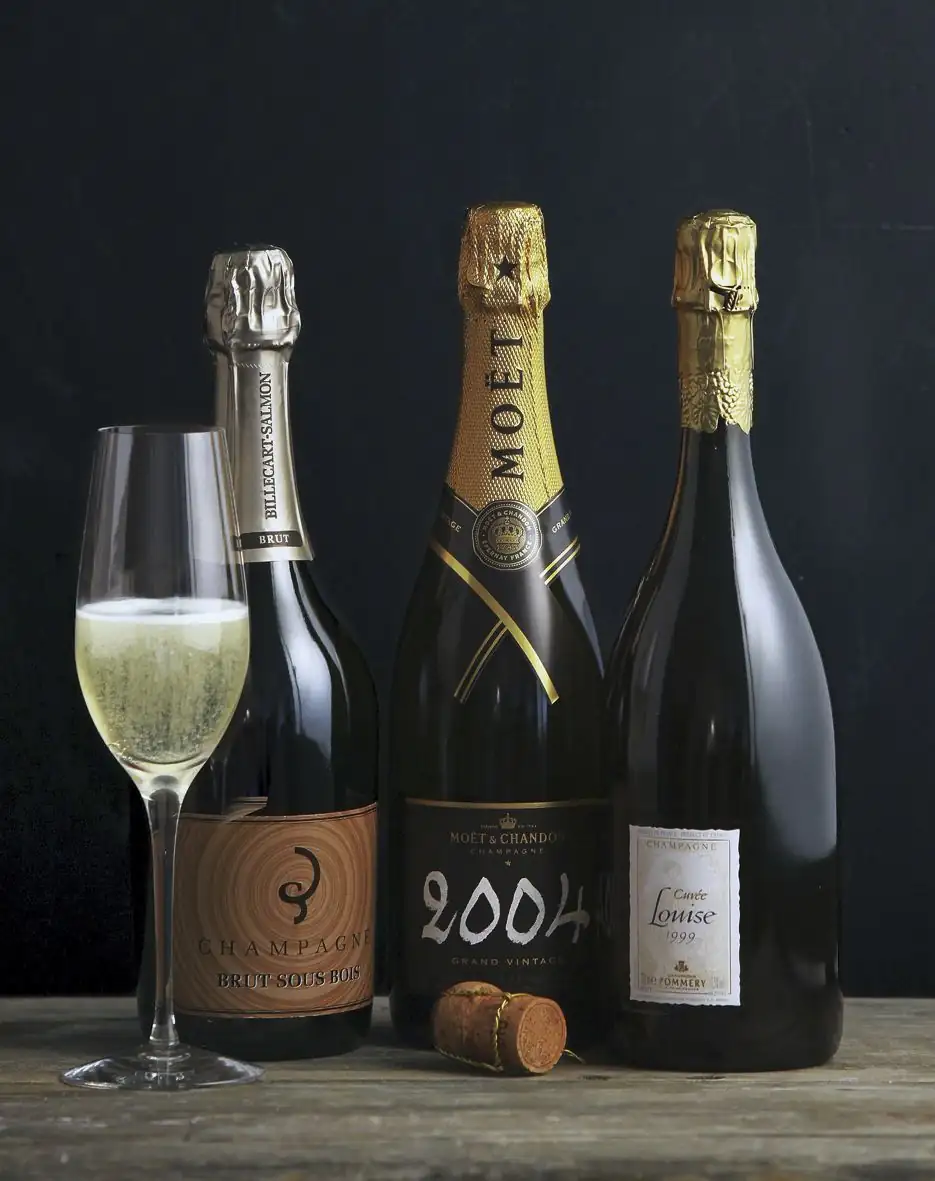
Champagne production: How the noble sparkling wine is made
Where does champagne come from?
So who invented it? No, not Dom Pérignon (1638–1715), the cellar master of the Abbey of Hautvillers. It was an Englishman who first described the basics of Champagne production. In 1662—six years before Dom Pérignon—Christopher Merret invented the so-called méthode champenoise, the second fermentation of bottled wine through the addition of sugar. The process should therefore actually be called the méthode anglaise. But true Champagne requires a bit more. Dom Pérignon can at least be considered the originator of the classic Champagne blend, the assemblage. The art lies in creating a cuvée from different vineyards and grape varieties (Chardonnay, Pinot Noir, Pinot Meunier) that is superior to all other sparkling wines and retains the same character year after year. For non-vintage bottlings, called non-vintage (NV), wines from other vintages are also included. All wines must be influenced by the cool climate and chalky soil of Champagne. Only wines produced there may be called Champagne.
How is champagne made?
How does wine become the highly sought-after Champagne? Here we show you the various steps of the production process, the so-called méthode champenoise.
Vintage
The start of the grape harvest depends primarily on the weather and the ripeness of the grapes. In warm summer months, the harvest can begin as early as the beginning of September. However, it takes place no later than the beginning of October. The harvest then lasts approximately two weeks.
To maintain high grape quality, a certain maximum number of hectares is not exceeded. For wine and sparkling wine production, the general rule is: the lower the yield per vine, the better the grapes.
The grape harvest for champagne production is still mostly done by hand. This ensures that only the best and ripest grapes are selected during picking.
grape press
As with the harvest, the greatest possible care is taken during the pressing of the grapes to ensure that the red pigment from the skin of red grapes (Pinot Meunier and Pinot Noir) does not escape (in white Champagne) and that the bitter substances do not get into the must.
The grapes are pressed twice. The first pressing, Première Taille, is of very high quality. The second pressing, Deuxième Taille, extracts slightly more bitter substances into the must.
First fermentation
As with other sparkling wines, the first alcoholic fermentation takes place after pressing. This occurs in separate barrels for each grape variety and vineyard site. The first fermentation initially produces a still wine.
Die Assemblage
The art lies in creating a cuvée from different vineyard sites and grape varieties that is superior to all other sparkling wines and retains the same character year after year.
The winemakers closely monitor their wines during maturation. As the process unfolds, they blend the various still wines (without carbonation) for the secondary fermentation. The following grape varieties are typically used:
- Chardonnay
- Pinot Noir
- Pinot Meunier
Chardonnay grapes provide elegance and finesse. Pinot Noir lends the champagne structure and strength, while Pinot Meunier contributes fruitiness and smoothness.
Second fermentation / bottle fermentation
However sophisticated the final result of Champagne production may be, the base wine is rather mild in aroma. Champagne only becomes complex through the second fermentation, also known as bottle fermentation, and the subsequent aging. For the second fermentation, the liqueur de tirage is added, a mixture of wine, sugar, and yeast. Then everything is bottled, sealed with crown caps, and the yeast gets to work. It produces a little more alcohol and the so-called mousseux, the tiny bubbles of carbon dioxide that later rise in the glass. The typical flavor then develops through aging, through autolysis. In this process, which lasts at least 15 months—but for some Champagnes even years—the dead yeast cells are broken down by enzymes. This creates delicate notes of toast, nuts, biscuit, and acacia.
Disgorging
For production, after the second fermentation in the bottle, the remaining yeast is shaken into the neck of the bottle, followed by the so-called disgorging process: The bottle is immersed upside down for several minutes in a freezing solution at minus 27 degrees Celsius. Then the crown cap is removed, and an ice plug surrounding the yeast shoots out.
The dosage
At the end of the production process (except for the extremely dry Brut Zéro), the dosage is added: sugar dissolved in wine, which is intended to counterbalance the acidity. Cork it on, voilà!
What is the difference compared to other sparkling wines?
One might think that if the production process using the "traditional bottle fermentation" method is done exactly the same way as in Champagne, then sparkling wines everywhere should ultimately taste the same. But that's not the case. Besides the climate, the soil, and the long aging on the lees, it is primarily the grape varieties that shape the flavor. For example, other appellations outside of Champagne often use regional grapes for their sparkling wines called Crémant; Chenin Blanc is common in the Loire Valley, and Sauvignon Blanc in Bordeaux. Pinot Bianco is used in the Italian Franciacorta, Macabeo, Parellada, and Xarel-lo are used in Cava, and Riesling is, of course, the dominant grape in German Sekt.
Sparkling wine vs. Champagne: an exciting duel
With a per capita consumption of 3.9 liters in 2011, Germans are considered the world champions of sparkling wine. Domestic sparkling wine producers supply a large portion of this demand. However, the term "Sekt" (sparkling wine) doesn't specify the region of origin, grape varieties, or production method. The base wines for producing inexpensive sparkling wines usually come from Italy or Spain. This type of sparkling wine is mass-produced using the cuve close or Charmat method: the wine is placed in a large, closed tank, yeast is added, and then the tank is heated and stirred to ensure the yeast does its work as quickly as possible – according to the law, 30 days is sufficient. During production, there is no riddling; the wine is simply filtered, and a large amount of sugar is added to the dosage. The result is meager in aroma and, above all, sweet; there is no trace of autolysis. This is only noticeable in the compromise method, the transfer process, where fermentation in the bottle is followed by the removal of the yeast through filtration in a pressure tank instead of the elaborate disgorging. However, this negatively affects the effervescence.
But there are also winemakers in Germany who ferment sparkling wines in the bottle using traditional methods, employing the best grape varieties of their region: Pinot Noir in Baden, Lemberger in Württemberg, Silvaner in Franconia, and Pinot Gris and Pinot Blanc in the Palatinate. The ultimate challenge, however, remains the production of sparkling wine from Riesling, whose notes of apple and peach leave little room for autolytic aromas. These wines don't aim to imitate Champagne, but rather have their own distinct style: fruitier, more floral, yet no less elegant than their major competitors. Who knows what the world of sparkling wine would look like today if Pierre Pérignon had entered a Rheingau monastery as the monk Peter?