¡Trufa negra, por favor no te vayas!
Para los amantes de la trufa negra (Tuber melanosporum), la variedad más aromática de este preciado hongo, su temporada es demasiado corta.
For lovers of the black truffle (Truffle melanosporum), the most aromatic variety of this prized fungus, its season, from late January to February, is far too short. They are all passionate about this seasonal product that grows 30 to 40 centimeters below the surface, rooted in trees brimming with character, and uses its aroma as a powerful weapon of seduction.
The ritual of cultivating and harvesting truffles, they are rarely found wild in the market, continues to captivate those who observe it. As Paco Coduras, the truffle grower in charge of the family farm San Babil, in the Aragonese town of Santa Engracia, says: “If there’s no dog, there’s no truffle.” But first and foremost, without a tree, there is no truffle.
I travel with nurseryman Javier López Hijos through the San Salvador ravine, the Baros road and the bed of the Aragón River as it passes through Villanua to try to understand, “within the chaos that reigns over order, the prodigious nature of the holm oaks (quercus ilex), which is what the trees are called in Aragón under whose roots this type of fungus is born and grows” explains Javier as we approach the base of a specimen over 50 years old.
“In holm oak plantations inoculated with black truffles, the ground sometimes looks scorched” he points out, gesturing to the sandy soil and small stones surrounding the tree. “It’s as if the truffle doesn’t allow anything else to grow nearby. The opposite is true in its relationship with the holm oaks. The truffle will never harm the tree it’s inhabiting for a very simple reason: it can’t harm the one it knows gives it life.”
“Holm oaks” he adds, “also called chaparros in Aragon and encinas in Castile and León, are associated with the Mediterranean landscape. They thrive in dry, windy areas and have leathery, evergreen leaves with a white underside to prevent sun damage, and extraordinarily hard wood that was used to make charcoal.”
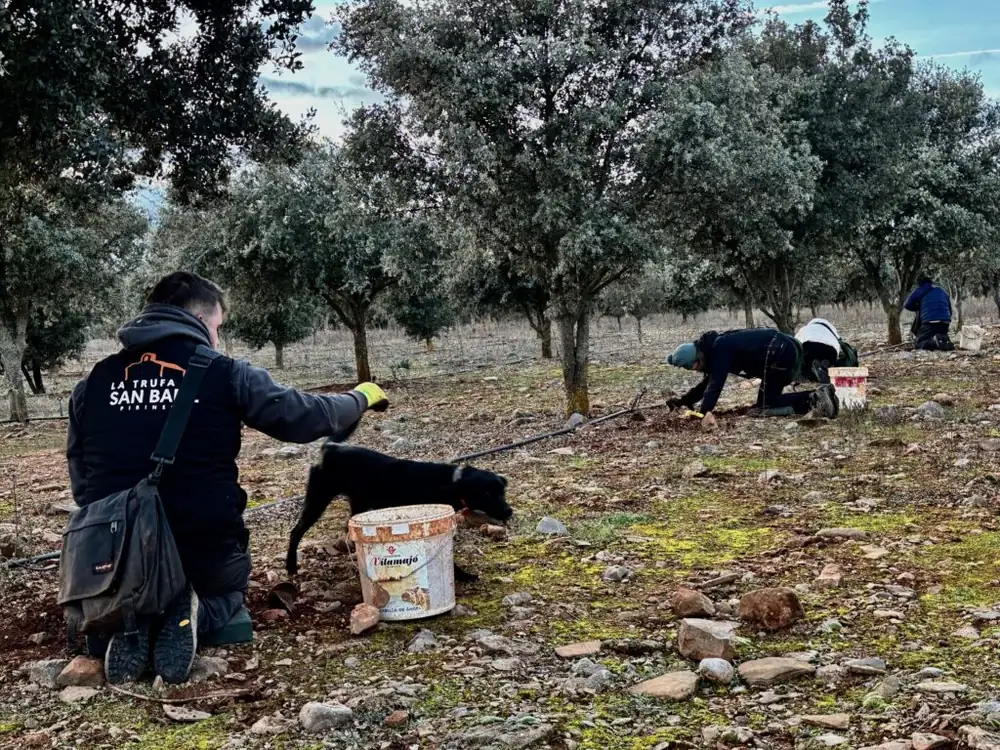
We're now heading to Santa Engracia to visit San Babil. Every morning, accompanied by one of the seven dogs currently on staff, Paco Coduras and his team walk along rows of holm oaks planted 17 to 20 years ago. They walk slowly, waiting for a sign that will soon arrive. Today, the fastest was Mulan, a beautiful 3-year-old springer spaniel. After scratching a specific spot, she sits down to savor her reward while letting the humans do their part.
On his knees, with a bag across his body, gloves, and a machete, Paco delicately moves the earth until he finds what Mulan has indicated and extracts a piece weighing between 80 and 100 grams. Half a meter away, his wife Begoña performs the same action and extracts a second piece.
In a few hours, thin slices of these and other freshly harvested aromatic bombs will travel in portions from a pizzeria in Bearn that consumes a kilo a week; on the truffled eggs of La Cocina, Casa de Comidas and the tapas of Jaizquibel in Jaca or in the proposals of the winter menu of Vidoq in Formigal.
“You have to be generous with truffles”
Pepe Pérez, owner of La Cocina, Casa de Comidas (11 Zocotín Street, Jaca), remembers the first black truffle he ever held as if it were yesterday. “It was in 2000. Back then, they weren't cultivated, and the best wild specimens were in Graus. We traveled in groups, at night, after closing our restaurants. They would meet us at gas stations, and it always seemed like we were dealing. They would weigh them on the hood of the car, tell us the grams, and we would confirm and give them the cash.”
He admits he's tried everything to extend the shelf life of those truffles that were so difficult to obtain. "I've experimented with semi-drying and freezing, fermentation, and vacuum sealing, and I always come to the same conclusion: truffles must be eaten fresh. They're a seasonal product; you have to enjoy them in January and February and look forward to them the rest of the year."
I ask him about the truffles that began to be cultivated in the Jacetania region two decades ago, and he confirms that “they have an extraordinary quality and aroma. There’s hardly any difference between them and the wild ones gathered in the mountains.” He likes to grate them directly onto the plate, and if he has to choose, he prefers truffled eggs.
Before offering them to his customers, Pepe keeps black truffle specimens with several dozen eggs for two to three days so the aroma permeates the yolks and whites. After this time, he fries the eggs in extra virgin olive oil at a temperature that never exceeds 70 or 80 degrees Celsius. “If we subject them to a high temperature, the aromas that have taken so much effort to capture will evaporate. After frying them, we present them at the table and grate truffle on top, more or less generously, depending on how friendly we are with our customers” he confesses, laughing.
Also in desserts
What pastry chef Jairo Vincelle loves most about this product is everything that happens before the truffle reaches the table. “Whenever I go out on my bike, I always end up noticing the crops, the fences, the irrigation, and how the trees grow year after year. And when I see the truffles they harvest, I understand that it's a priceless gift that nature offers us in return for nothing.”
Jairo works in his pastry shop Vincelle (Plaza Biscós 2, Jaca) with seasonal products and until now he had used black truffle in winter as a secondary ingredient in a beetroot tart with goat cheese and in a chocolate mousse.
This year he has gone further and, after a month of testing, is offering a dessert to share that faithfully recreates the appearance of a black truffle. “We wanted to pay homage to it, to reproduce the real appearance of a truffle because in the end, when you see it whole, freshly brought from the field, that's when you understand its true value” he explains while molding each piece with a mesh to reproduce the roughness of the skin.
The 90-100 gram format is filled with a creamy Marcona almond filling and coated with 70% chocolate mixed with grated dark truffle and cocoa powder. Smooth on the bite, it delivers powerful flavors of nuts, praline, and truffle, all those flavors we love to enjoy in winter.