Reinventing the wines of Malaga
In 1924, the Málaga winemakers' guild registered the Málaga brand to combat the imitations that were undermining the business upon which the wealth and fame of this Andalusian port had been built: the export of wines and raisins.
The Regulatory Council of the Malaga DO, Sierras de Malaga and Malaga Raisins celebrates the centenary of the brand by recalling its history and showing how a new generation of winegrowers is reviving a mythical terroir with a minority production focused on high-quality signature wines.
Hopeful future
“The most hopeful thing for the future of Málaga is that, while its old wines were easily imitated, what is being done now is inimitable,” said wine expert, consultant, and lecturer Juancho Asenjo in 2021 during a masterclass on the Axarquía and the Montes de Málaga regions. He also noted that, however legendary they may have been in their time, “no terroir from antiquity is still alive.”
Francisco Pérez Hidalgo, a professor at the University of Malaga and a winemaker who has studied the reasons for the crisis of Malaga's historic wines, states, however, that "the fact that a world-renowned wine region is relegated to a token presence is unparalleled."
At the beginning of the 19th century, vineyards in Malaga covered one-seventh of the province, especially the mountainous areas. “The soils were poor, unsuitable for other crops, and perfect for vines,” recalls Pérez Hidalgo. Numerous archaeological remains show that wine was made there as far back as the Neolithic period, and Andalusian texts confirm that Malaga wine and raisins were already famous in the Middle Ages. However, it was two exceptional areas that cemented the legend and commercial success: the Axarquía and the Montes de Málaga. These areas have mineral soils with steep slopes of up to 70 degrees, where even today the grapes can only be harvested with the help of donkeys. The soils in the Axarquía are slate, while those in the Montes de Málaga are extremely complex, containing slate, limestone, sandstone, silica, magma, and other materials.
The soils and climate are perfect for the two main varieties of the area, which take root in bedrock. Pedro Ximénez, with genetics dating back to the Andalusian era, and Muscat of Alexandria, one of the oldest grape varieties preserved without genetic modification.
The lucrative raisins
Muscatel raisins became a more lucrative business than winemaking in La Axarquía. Achieving excellence required meticulous care. Imperfections were removed from the vines; then the bunches were cut and placed in ten-kilo boxes, without being trampled. Finally, they were laid out on south-facing drying racks.
This meticulous production system, declared a World Agricultural Heritage System in 2017, was also used for winemaking. They knew no other method. Hence the purity, smoothness, and complexity of sweet wines from Málaga.
The same technique benefits the quality of the musts today, although their main destination today is not dessert wines, but dry, still or sparkling white wines, and naturally sweet wines that are in no way inferior to Tokajis and Sauternes.
The renowned winemaker Michel Rolland says there is no such thing as poor wine country. This maxim did not hold true in the Axarquía and the Montes de Málaga, because the rule, established by the 1932 regulations of the Málaga Designation of Origin, was that winegrowers, owners of small plots of land, had to sell their grapes to producers and merchants, whose wineries had to be located in the city of Málaga.
To cultivate the land, farmers received exorbitant loans from their supposed customers. When phylloxera devastated the province's vineyards in 1878, a famine ensued. Many small landowners were forced to emigrate, and the large ones changed their line of work. At the dawn of the 20th century, part of the Montes de Málaga became a pine forest, while the rest was planted with almond trees or reclaimed by Mediterranean scrubland.
Mountain wines, wines of legend
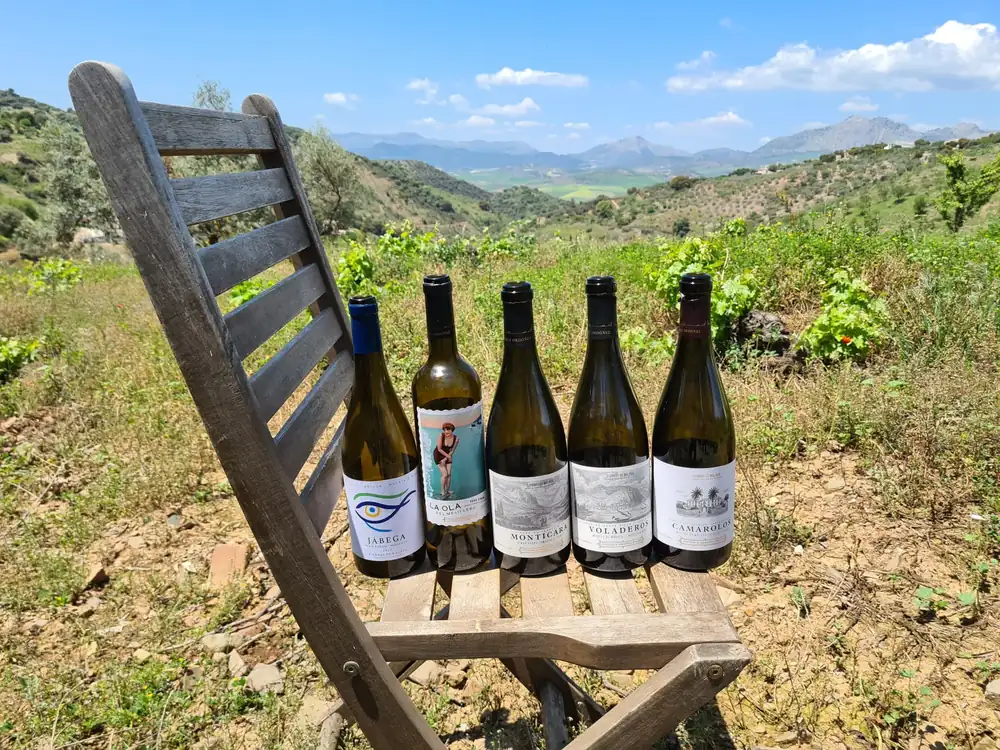
Of the legendary mountain wines of the Montes de Málaga, celebrated by travelers and chroniclers, nothing remained until Victoria Ordóñez, a doctor turned winemaker, began her winemaking project in 2015, focusing on the Pedro Ximénez grape variety after painstaking work recovering vineyards in the best historical areas of the Montes de Málaga. Her white wine, Voladeros, is undoubtedly one of the great Andalusian whites.
In the Axarquía region, the vineyards and their cultivation continued to be passed down from parents to children, until, in the last quarter of the 20th century, avocado and mango trees began to climb the black slate slopes.
There were and are still those who resisted, like Pepe Ávila, a winemaker from Cómpeta whom Telmo Rodríguez turned to when he arrived in Málaga. Enthused by the fact that the prestigious Hugh Johnson had placed an old Málaga among the best wines in the world, Rodríguez launched his first sweet Muscat wines in the mid-nineties, among them the now legendary Molino Real, while Ávila debuted with Jarel, a splendid naturally sweet wine with an unbeatable price-quality ratio.
Reinventing Muscatel
Jorge Ordóñez, from Málaga, who had opened the doors of the US to quality Spanish wines, wanted to start a project in his homeland. In 2004, he founded Bodegas Jorge Ordóñez and introduced the Axarquía region to one of the world's great masters of sweet wine, Alois Kracher. In addition to a collection of signature sweet wines, he launched Botani, the first dry Muscat still wine on the international market.
Muscatel reinvents itself
In 2006, Lagar de Cabrera dry muscatel, from Bodegas Dimobe, was launched. It was the brainchild of Juan Muñoz, then a young winemaker in charge of the winery opened by his grandfather in the Axarquía village of Moclinejo in 1927. Unlike Ordóñez, who entered a market free of prejudice, Muñoz had to contend with the skepticism of his fellow villagers, who couldn't imagine a modern-style dry muscatel.
Incidentally, Muñoz, author of Tartratos, the first dry sparkling Muscat wine made using the traditional method, is also a master of traditional sweet and dry wines, and in recent years he has embarked with Vicente Inat, winemaker and author of some of the most interesting red wines from Ronda, on the Vertical Vineyards project, which explores new possibilities for vinifying Muscat and other Axarque varieties.
These modern-style wines, along with the non-native varieties planted in Ronda since it emerged as a wine-producing region in the late 1980s, fall under the Sierras de Málaga PDO, established in 2001. Before that, apart from the iconic Moscatel and Pedro Ximénez, the historic Málaga PDO recognized few other varieties. One of them was the red Romé grape, formerly used to color wines, and now used for interesting single-varietal wines and blends, including Ariyanas rosé and red from Bodegas Bentomiz, founded by the Dutchmen Clara Verheij and André Both, or those produced by Lauren Rosillo at Sedella Wines, a winery whose name pays homage to the village in the Upper Axarquía region that stole the heart of the talented winemaker from Albacete.
Pleiad of dreamers
The latest romantic to join the ranks of dreamers striving to preserve the winemaking heritage of the Axarquía region is Fabio Coullet, who has achieved excellence with his dry Muscat Villazo, aged in French oak barrels. A commitment to quality and uniqueness defines the new direction for wines from Málaga's legendary wine regions, but some wineries still offer the opportunity to savor the oenological heritage represented by their historic wines. Among them, Pajarete is one of the most popular today.
Wineries like Quitapenas, Antigua Casa de Guardia (which also serves its wine in its century-old tavern in the center of Málaga), Dimobe, and Diecisiete Filas continue their production. Another gem is the fortified dry wines; aged wines (3 to 5 years old), such as Verdiales from Antigua Casa de Guardia, Trajinero from Málaga Virgen, or Don Pepe from Cortijo la Fuente (both in the northern part of the region), and aged wines (5 years and older), both dry and sweet, such as the award-winning Arcos de Moclinejo from Dimobe, the Seco Trasañejo from the same winery, Carpe Diem from Bodegas Carpe Diem, or the Trasañejos from Málaga Virgen. Centuries-old soleras and testaments to a past that serve as a reference point for the new, all that takes root and blossoms from the fertile ground of centuries of winemaking culture.