Wines in Galicia
Monterrei: La godello cambia la historia.
Located in the southeast of the province of Ourense, it is the youngest and smallest designation of origin in Galicia. Due to its geographical location, it belongs to the Duero River Basin, so it is not surprising that it has historically focused on the production of red wines.
We say historically because, currently, the production of these wines is gradually decreasing, giving way to white wines made from Godello grapes, which in the last two decades have seen their markets grow exponentially, thanks to their pleasantness, with luscious fruity and tropical notes, a pleasant minerality and a measured and balanced acidity.
For a wine to be classified as Godello in Monterrei, it must contain at least 60 percent of this variety, while the remaining 40 percent can be one of the other varieties authorized by the regulatory board, such as Blanca de Monterrei, Albariño, Loureira or Caíño.
The red wines, with Mencía and Merenzao as the main varieties, and Araúxa (the name given here to Tempranillo), Caíño Tinto and Sousón as secondary varieties, are fruity, light, with some structure and moderate tannins, very easy to drink.
Featured wineries: Ladairo, Gargalo, Triay Adegas do Oimbra, Terras do Cigarrón.
Rías Baixas: The empire of Albariño.
The Albariño variety is the undisputed star of what is perhaps the most internationally renowned Spanish designation of origin specializing in white wines. Such is the prestige of this grape that, in a misguided metonymy of the part for the whole, there is a general tendency to call all wines produced in this region Albariños rather than Rías Baixas, when in fact not all of them are.
In any case, considering that over 95 percent of total production is Albariño, it's not exactly cause for alarm. The other white grape varieties used, almost all of them indigenous, are Loureiro, Treixadura, Caíño, Godello, Torrontés, and the recently accepted (in August) Ratiño Gallego. They generally serve as complements to Albariño, but several wineries are developing some very interesting single-varietal projects.
The wines from this DO are marked by the almost dictatorial influence of the Atlantic Ocean and the local climate. The result is very fresh wines that exude acidity, with pronounced citrus notes. Although the general trend is to drink them young, they usually benefit from some time in the bottle, and in fact, almost all the major wineries already have what we might call "reserves" on the market.
As for the red wines, made with the also native grape varieties Caíño Blanco, Castañal, Espadeiro, Loureira Tinta, Sousón, Mencía, Brancellao, and Pedral, they stand out for their lightness and very moderate alcohol content. Production is quite limited, but they are becoming increasingly popular.
Rías Baixas is located mostly in the province of Pontevedra, although it also touches A Coruña, and is divided into five subzones, from south to north, O Rosal, Condado del Tea, Soutomaior, Valle del Salnés and Ribera del Ulla.
Notable wineries: Terras Gauda, Pazo de Señorans, La Comtesse, Attis, Santiago Ruiz, Zárate.
Ribeira Sacra: The heroism of making wine.
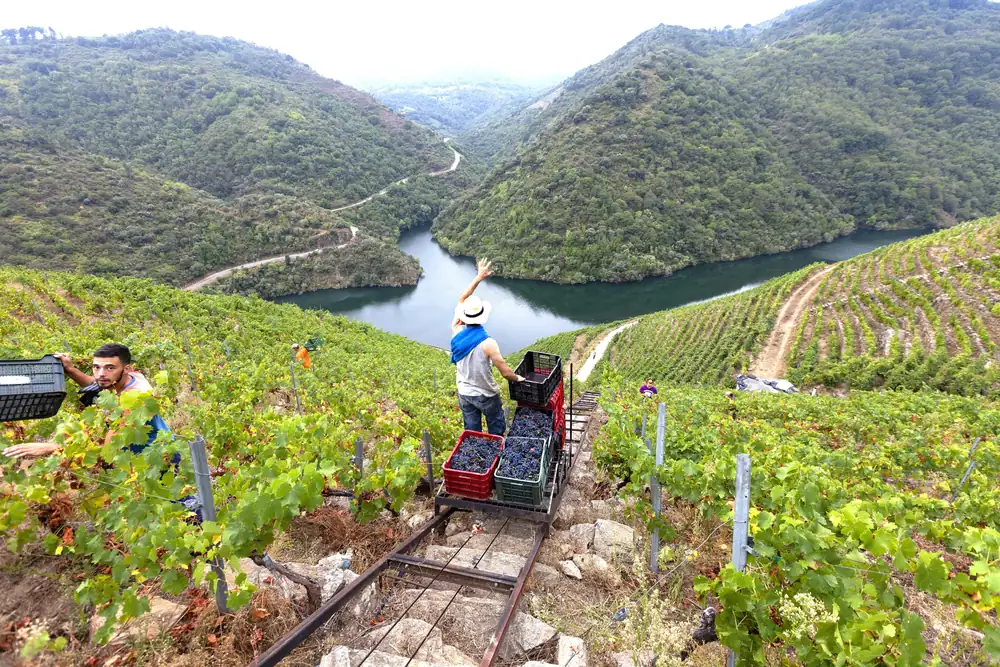
Between the south of the province of Lugo and the north of Ourense, on the banks of the Cabe, Sil and Miño rivers, Ribeira Sacra is characterized by its impressive and rugged landscapes, which have led to this region being on the path to being declared a World Heritage Site.
These landscapes, which have transformed the area into one of the most dynamic wine tourism destinations, translate, in winemaking terms, into what has been termed heroic viticulture, due to the enormous difficulties involved in harvesting grapes by hand on steep, rugged slopes. All the while, the rewards include privileged views of the Sil River canyons.
And at the same time, these are what give the wines their special and somewhat rugged character, wines that have been produced for over 2,000 years on the smallholdings that comprise the region. The red wines, generally young, fruity, very aromatic, and low in alcohol, have always been the most popular, with Mencía as the star grape, accompanied by indigenous varieties such as Brancellao, Merenzao, Sousón, Caíño Tinto, and Mouratón.
In recent times, due to the unstoppable increase in demand for white wines, both nationally and internationally, this type of wine is proliferating and labels bearing the word godello are the most popular, because it is the fashionable variety.
Featured wineries: Algueira, Dominio do Bibei, Abadía da Cova, Ronsel do Sil.
Ribeiro: Treixadura between three rivers
There was a time, not so long ago, when Ribeiro wine was identified with an indecipherable cloudy liquid that was served in bulk in taverns, in ceramic cups (cuncas) that did not allow one to appreciate the color or, much less, to see the sediment.
Today, things have changed radically and Ribeiro, with eight millennia of history behind it, which is quite something, is a designation of origin that boasts a well-deserved prestige, especially when it comes to white wines, both in Spain and beyond its borders.
The heart and soul of these white wines is Treixadura, a highly aromatic, expressive, glyceric, and versatile grape with great aging potential and a remarkable balance between acidity and alcohol. Whether as a single varietal or blended with other varieties (Albariño, Loureiro, Godello, Lado…), to paraphrase Louis XIV, Ribeiro is it.
The DO is divided into three sub-zones, based on the rivers that run through them: the Miño and its tributaries, the Avia and Arnoia. Each valley has a very distinct character. The wines from the Miño are the most aromatic and have a long finish. Those from the Avia (my personal favorites) have more structure and vibrancy and age best. The wines from the Arnoia are the lightest and have the highest acidity.
While red wines are barely present, we mustn't forget the toasted wines of Ribeiro, a rarity and a jewel, with limited production. These naturally sweet wines are obtained from the drying of native grape varieties in covered cellars and matured in oak barrels, and they can compete with the best sweet wines in the world.
Featured wineries: Viña Costeira, Casal de Armán, Lagar do Meréns, Bodegas Campante, Adegas Celme.
Valdeorras: Paving the way
Where there's smoke, there's fire. And when renowned winemakers like Rafael Palacios or Telmo Rodríguez champion a particular region, it's because that region has enormous potential. However, in the case of Valdeorras, it's more of a reality than a potential.
It is the easternmost of the five Galician appellations, located in the southeast of the province of Ourense, bordered by León and Portugal and situated along the Camino de Santiago. With a wide variety of soils (slate, granite, pebbles, etc.) and altitudes, an extreme, almost continental climate, and the influence of the Miño, Sil, and Bibei rivers, with the ocean looming in the distance, its wines have a distinctly Atlantic character: fresh and light. And, importantly, they pair beautifully with food.
Godello, in terms of white wines, and Mencía, in red wines, are the two predominant varieties, although in the area for some years now there has been a commitment to other recovered native grapes, namely Dona Branca, in the first case, and Sousón or Brancellao, in the second. If Godello has become the fashionable white grape, much of the responsibility lies with this designation of origin, which knew how to see its potential before others and only certifies as monovarietal those that are made one hundred percent with this grape, without mixtures.
Featured wineries: Godeval, Bodegas Joaquín Rebolledo, Guitián y Blanco, Bodegas Rafael Palacios, Ladeiras do Xil.