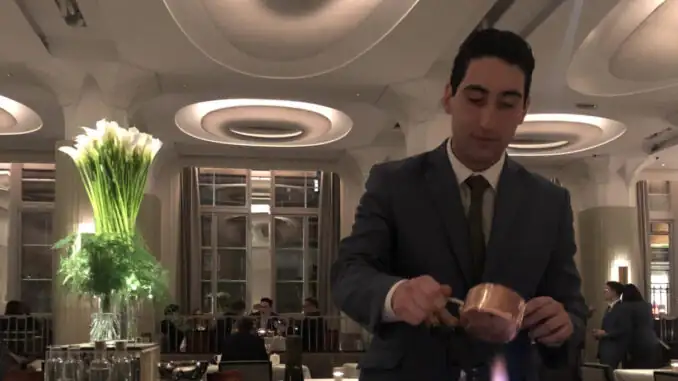
A London sommelier, Alessandro Gallo, says, “We drink internationally here: lots of French and little Italian, apart from Prosecco.”
A sommelier in London, Alessandro Gallo. Our ancient favorite drink has always been culturally determined. Each country has not only its own wines, but above all its own customers with their own tastes.
What's it like being a professional taster in the world's most multicultural city? "In a city like London, especially in a sector like hospitality, there are professionals from all over the world. We Italians, along with the French, have an advantage in terms of wine knowledge. But due to our clientele, the limited local winemaking tradition, and the commercial vocation that England has always had, we need to know grape varieties and producers from all over the world. In short, in Italy we're rightly very focused on ourselves and on something French, and that's enough. Here in London, however, we expand our horizons to the global scene. In Italy, if you mention Australian wine, the sommelier looks at you a bit askance; it's mostly a historical-cultural issue."
How do you approach dining room service in a city like London? "Here, meal times are much shorter, so the service style also changes. Very often, they're business meetings, so we sommeliers have to be more dynamic and flexible. If you compare Michelin-starred restaurants, here they have far more seating than in Italy. Consequently, the social aspect of meals is seen in a more concrete and convivial way."
What are the English's tastes? "The Empire has always imported Bordeaux and Port, in particular. They have a real fetish for the latter, but French wines are also essential; here, the menus are built around France. But that's not all; we're used to being asked for American, South African, Australian, and New Zealand products. Customers' approach to wine here is different: if an American is on holiday in Italy or France, they'll tend to ask for a product with strong regional roots, whereas in London, they'll look for international varieties that they're more or less already familiar with."
This influences the construction of your wine list. "Exactly, the structure of our list is unique among restaurants. We offer nearly 2,000 different products and are organized in a rather unusual way. In fact, very few people actually build it.
based on the grape variety, from the lightest to the most structured. While the backbone is usually the differentiation between sparkling wines, white wines, and red wines, we organize them by blend and, consequently, by structure. We favor the classics, therefore, the area of origin of the main variety. For example, if we start with Rieslings, we'll find Germany, Austria, and then Alsace. It's perhaps a little more difficult to interpret, but it's very interesting because customers with less knowledge on the subject will more easily know where to look if they want to drink an international blend. This approach was conceived at Eleven Madison Park in New York, owned by the same company, and brought back to London.
And what about Italian wine? For the type of clientele we serve, paradoxically, the American selection is broader than the Italian one. Besides, it's easier for our customers to approach an international grape they're familiar with (a French Bordeaux or an American Pinot) than to opt for a native Italian wine that's still little-known and more difficult to interpret from a taste perspective. We naturally have a lot of Tuscan and Piedmont wines on the menu, but I like to steer customers towards the Etna area, which I believe deserves attention. Among my favorite producers are Franck Cornelissen, who works with Nerello in a very unique way, Monterosso, I Vigneri, and Tenuta delle Terre Nere. Here in London, Prosecco is very popular and appreciated, having a very international vocation and a product that closely resembles English tastes. But the extraordinary variety of native Italian grapes too often still lacks the prestige it deserves. Our products need to be presented in a certain way to fully appreciate their unique characteristics and their close relationship with each other. with the territory. It is therefore up to us Italian sommeliers to bridge the image gap that still exists with France, but we are on the right track."