From Bompiani to Pasticceria Walter Musco: cakes as canvases, drippings, and Banksy-style shortcrust pastry in Rome
Walter Musco Bompiani Pastry Shop. To speak to Walter Musco, you have to emerge from the depths of his workshop, where there's no phone service. It's located beneath the pastry shop on Largo Bompiani in Tor Marancia, where he'll be celebrating 10 years of running it in 2021.
The next step was to fuse the offering with inspiration from her own passions: art first and foremost. "We're passionate about cinema in my family; art has always been present in my home and in my life." Musco, with a career as a gallery owner behind him, began working with Easter eggs, with tributes to Alighiero Boetti, Piero Manzoni, and Jackson Pollock. And then to the world of cinema: Fellini, Antonioni, and Pasolini. These still tentative approaches found greater expression in later cakes, such as the Bauhaus, a tribute to Walter Gropius.
From this world, she translates the dripping technique, using cakes as canvases and giving her creations a strong visual impact. This is particularly true in a now iconic cake, the Action Painting, a tribute to Jackson Pollock, where the white icing on the surface highlights the lines of color created by the dripping. Inside, a layering of three chocolates: 70% Guanaya chocolate mousse, 40% Jivara chocolate mousse, and 30% Ivoire chocolate mousse.
In 2013, Musco participated in an event with a tribute to Piero Manzoni's Acromi, white compositions made with chalk or kaolin, where lines and stripes are rendered without any pre-established artistic form. At the event, he met Massimo Bottura, also an art enthusiast, who was struck by the cake and asked what was inside. "I replied that there was mango and passion fruit. I saw him frown. According to him, the cake should be white inside and out; he invited me to play with one color and a single ingredient. I reworked the cake, searching for something white and monochrome: the almond. From there, it wasn't just an aesthetic form, but a content that justified it."
Experiments followed, increasingly veering toward an artistic conception of pastry making. Such was the homage to Joseph Beuys, the controversial German artist and mystic. "He was an aviator during World War II when his plane was hit. He managed to survive and was treated by Tartar shamans with fat. From that moment on, fat became an obsession for him, with which he constructed installations that even looked like marble. My homage was a foie gras cake, a block of foie gras inserted into a cake. It might have been unsightly, but it immediately evoked an emotion—either repulsion or curiosity. Imagine this thing in the display case among all the other cakes."
From there comes the desire to share ideas with clients that can also be transformed into starting points for discussion, unlocking memories, or even serving an educational purpose. "We wanted to share a different kind of knowledge, not a technical one. Technique is just the means, it doesn't interest any of our clients. It's as if a writer were to introduce his book by prefacing it with his knowledge of grammar. He'll talk about it in a context of experts, at most. His skill, however, will be in having good content. Technique is like grammar. And it's not just aesthetics, either; it's a highly subjective element. My cakes are very cold, minimalist, which is why not everyone likes them. I know it's not an easy path, the one I've taken, but now I see with clients that we're going much further. Some, yes, still look at us as if to say: 'You're stupid!'"
In addition to his artistic background, Musco's background is in cooking, rather than pastry making: "I've never worked for a pastry chef, but looking back, I would have liked to intern with an architect." He attended Gambero Rosso, then moved on to Acquolina, then Angelo Troiani's pastry shop, and then Colonna's. "I learned by getting angry, throwing away a lot of stuff, and reading a myriad of books. When I opened, only Cristalli di Zucchero had popularized the concept of fine pastry making in the city." With the founding of Bompiani, he pushed himself to realize a very personal vision of his profession as a pastry chef: "The pastry shop should be the place dedicated to talking about desserts: but no, let's dismantle that. It's a bit like Duchamp's concept of decontextualizing art. If I put a toilet in a museum, it becomes a work of art. That's what I want to do with my desserts."
From this awareness, limited-edition products like the Banksy tart are born, a single-serving tart reminiscent of the painting "Girl with a Balloon." Reflecting the young protagonist's Syrian origins, the dessert is made with dates, shortcrust pastry, and rose sponge cake. "I went with my children to see the Banksy exhibition at the Chiostro del Bramante. I had picked up the book, drank a bottle of champagne, and tried it."
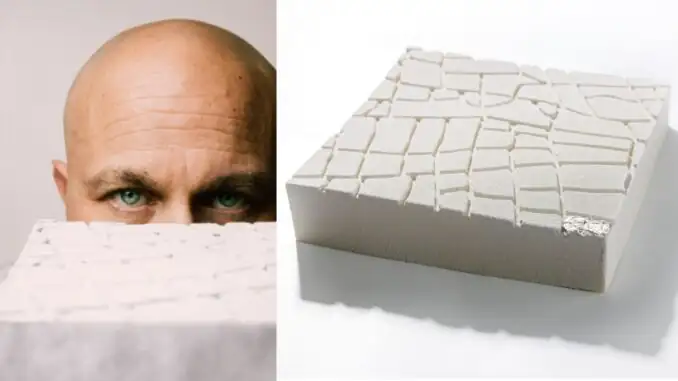
We arrive at today with the Gran Cretto, a tribute to Alberto Burri and Sicily. "The first cake I made with my own mold. The aesthetic recalls the content, with absolutely Sicilian ingredients: mulberry and almond. It's not just aesthetics for aesthetics' sake. There's a very profound work behind it." Burri's Cretto is a majestic work of land art created in Sicily, on and with the rubble of the town of Gibellina, completely destroyed by the 1968 Belice earthquake. The rubble is compacted and shaped to reconstruct furrows in the earth, alleys, and original streets, which are also replicated on the surface of the cake, which can finally be scratched while enjoying the inside. Here—surprise—the white of the almond contrasts with the bright color of the mulberry. The first cake of 2021, the launch of a series dedicated to the artists who have most influenced Musco's pastry making.
Alongside these certainly curious experiments, tradition is not lacking. Indeed, the two extremes seem to strike a good balance in this case: "As if to say: chefs can do everything well, but trust me, they have to know how to make spaghetti with tomato sauce. So here for Father's Day we have to have cream puffs, and they have to be very well made." The counter also features maritozzi, shortcrust pastry, millefeuille, and zuppa inglese. There's no gastro-artistic snobbery. In a city that, in terms of pastry making, not only has no tradition but hasn't even built one, Musco's work seems twofold. "On the other hand, I have to say that Rome can give me enormous satisfaction: those who achieve success here certainly deserve it and have worked hard for it. And I assure you, at first I was completely out of the loop."
2021 also brings a name change: no longer Bompiani, but Pasticceria Walter Musco. "We need it to give a much stronger brand recognition, not to the place or the venue, but to the conception of this process. This is now a large and complex company, with 17 people with whom I hope, despite the difficulties, to have established a bond." This change corresponds to a revision of the logo: from Bompiani's spiral, a shape with a continuous and confusing movement, to Musco's triangle, a more solid, defined, almost perfect structure. At the center is the person, but also the character. "And yes, I also think I deserve it a little."
Walter Musco Pastry Shop. Largo Bompiani 8, Rome. Tel. 06 5124103. Website. Facebook page.