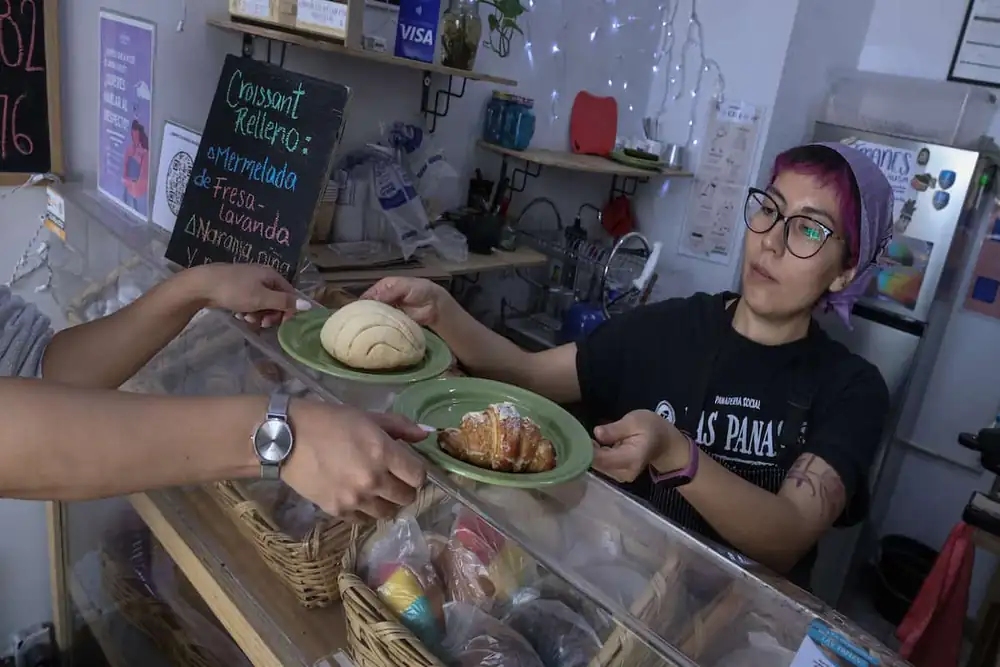
Las Panas: A bakery that empowers women who are victims of gender-based violence
Las Panas is a social bakery that seeks to be a space of empowerment for women, through the making of artisanal bread, which was founded by Rosalía Trujano Ortega in 2016 when she lived in La Merced, one of the neighborhoods of Mexico City with a high rate of gender violence.
Together we build a stronger and more prosperous future
Rosalía created a methodology to support women in vulnerable situations. At Las Panas, the time it takes for bread to ferment and bake is used to give talks on gender violence to the participants.
“Something I’ve realized throughout my life is that I get involved in projects that align with my own needs, but I think it stems from my own struggle and resilience. I’ve encountered people who fight and resist.”
Las Panas offers baking workshops and gender violence awareness programs. They also have a café selling sweet and savory bread. Recently, their products have also been made available at Tienda UNAM and Huerto Tlatelolco.
The word "panas" is a colloquial expression used in several Latin American countries to refer to close friends or trusted companions.
This community bakery has transformed over its eight years of existence. It began in La Merced with women experiencing economic dependency and high levels of violence. The project grew, so they had to move to the Santa Maria la Ribera neighborhood, a place where Rosalía realized that the women attending the workshops had other needs but were ultimately affected by gender-based violence.
The Las Panas team aims to enable all women participating in their workshops to identify and name the violence they experience, so that they can then heal collectively.
When a woman finishes her time at Las Panas, she's never the same again; something inside her has changed. "The women definitely leave here stronger, I'd even say with a little bit of hope," Rosalía acknowledges.
Domestic violence during COVID-19
The pandemic brought death, economic hardship, and mental illness that thousands of people around the world continue to grapple with. Another consequence of the coronavirus was the increase in domestic violence. Women and girls were confined with their abusers and isolated from support people and resources.
In Mexico, during the more than 100-day lockdown due to the COVID-19 pandemic, calls to 911 for violence against women increased by around 20%, according to figures from UN Women.
Regardless of social class or context, gender violence is something that affects us all, which is why Las Panas stopped being a separatist feminist organization since they assert that the responsibility lies with everyone.
Rosalía and her team have worked with women from the State of Mexico, with functional diversity (blind and visually impaired women), migrant women and women in situations of deprivation of their liberty in prisons.
What is meant by gender violence?
Gender-based violence can be sexual, physical, psychological, and economic; moreover, it can occur both in public spaces and in private settings, according to the UN Refugee Agency.
According to the Executive Secretariat of the National Public Security System (SESNSP), the crime of domestic violence increased in 2024 compared to the month of February, going from 21,603 cases to 23,941 cases in March.
In the case of gender violence, 566 cases were registered during March, giving a total of 1,557 so far this year; the State of Mexico leads the list with 646 cases.
Gender-based violence puts women's lives at risk; femicides are the most extreme manifestation of systematic acts of violence against women and girls simply for being women. A constant in these murders is the impunity that accompanies them, reflecting the lack of sensitivity and education among authorities.
Learning about economic independence
Las Panas is a respite for women who are and have been victims of gender violence; for them, the "long-term workshops" were created, lasting five months, with 100% scholarships thanks to donations and what was raised in "One paid workshop, one donated workshop," which I will tell you about later.
In the "long-term workshops" women not only learn to bake bread, they leave with tools to start their own business, since one of the most silent forms of violence is economic violence, described as a form of control against women; it is shown through aggression by the person who holds economic power, manipulation to manage expenses, or deprivation of resources.
Around 13.4 million Mexican women have suffered from it at some point in their lives, that is, 29% of the total number of women aged 15 or over, according to the National Survey on the Dynamics of Relationships in Households 2016.
“We primarily support them in learning the basics of baking. We give them knowledge of baking techniques and, above all, how to make breads that they can easily sell, and we teach them the processes,” says Rosalía Trujano, director and founder of Las Panas.
Talent and dedication at Las Panas
Las Panas has a network of affiliated bakeries where these women can do internships and, if successful, even get a job as bakers.
Alma Palomec, a baker at Las Panas, assists the women during the workshops. She started as a volunteer but gradually became more involved in Las Panas' activities, eventually becoming one of them.
“I learned about a bakery project in another country that helped women with social reintegration and provided them with bakery training. It was a huge coincidence, and I thought, 'a project like this here in Mexico would be amazing,' and I found one of those project incubators, and suddenly Las Panas appeared,” Alma recalls.
Her work is extremely important within this social bakery. Alma guides and trains the participants in all aspects of bread making, and she also produces the bread that is sold to the public to cover the expenses of the civil association.
Methodology of Las Panas
The workshops have several stages. At the beginning, the group introduces themselves to break the ice, and then they start mixing and kneading an easy-to-make bread, such as sandwich bread. The Panas choose recipes that the participants can make at home, even without an oven.
In the next stage, during the resting time of the mass, psychologists intervene to help the participants identify their emotions and the violence to which they are exposed.
After this time, the bread-making process resumes, and during its second resting period, before baking, the experts return to delve deeper into the topic discussed earlier. While the bread is baking, the second activity concludes with a closing discussion, and at the end of the session, everyone gathers to taste what they have prepared.
Each session addresses a different topic. If any participant needs individual psychological help, she is provided access to therapy.
In 2020, Las Panas were awarded the Kering Foundation Awards 2020 for having an innovative methodology to combat violence against women.
“Most of the women who come here don’t have any prior experience, so at the beginning there’s always this fear; most of them have that resistance. I’ve seen that it changes as we progress through the sessions. I like seeing that change in someone who is no longer afraid to hold the dough or manipulate it,” Alma points out.
#WeAreMoreThanBread The impact of Las Panas
Rosalía, founder of Las Panas, affirms that a true alchemy takes place within the organization's facilities. She has witnessed women with suicidal thoughts find a renewed will to live. Furthermore, women eager to start their own businesses receive support and guidance, while older women learn from younger ones about topics such as their children's sexuality and how to recognize the violence their daughters may be experiencing.
“A really beautiful alchemy happens; I always say that we are facilitators. We facilitate the space, the context, but they are the networks of the group.”
Through the ongoing campaign "One Paid Workshop, One Donated Workshop," you can help a woman in a vulnerable situation receive long-term training. These workshops are offered monthly, where participants learn to prepare recipes such as pan de muerto (Day of the Dead bread) or sourdough bread. With your payment, you are donating a space for a woman who needs to participate in this extended workshop. The approximate cost is 700 pesos.
Until 2023, Las Panas had the assistance of 606 people, during the period from 2016 to 2023, 780 women had been attended and accompanied through the workshops with methodology.