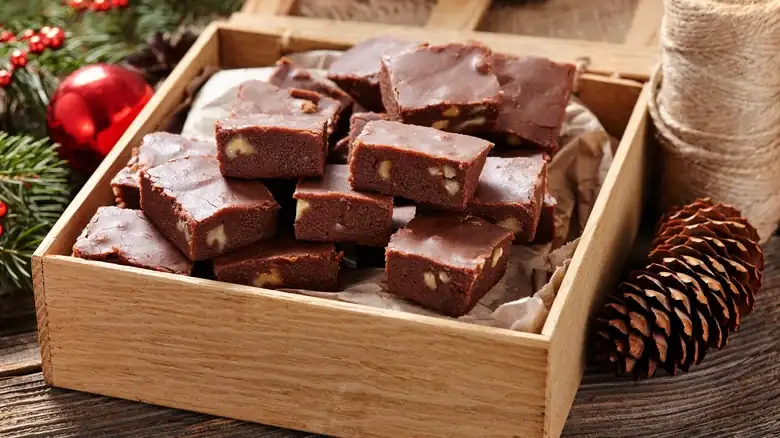
Here's Why Your Fudge Turned Out Grainy And How To Fix It
Though it's typically enjoyed during the holiday season, there is no bad time to eat homemade fudge. Candy making can be difficult, but when you create a batch of well-made fudge, not only will you be patting yourself on the back, your friends and family will, too.
Before letting all that effort (and chocolate) go to waste, return the gritty fudge back to the pot with 1½ cups of water and a little bit of cream. Over low heat, slowly stir the mixture until the fudge melts, and adjust the flavors as needed. Some experts suggest adding a pinch of cream of tartar, an acid which breaks down sucrose molecules into small, simple sugars like fructose, and interferes with large crystalline formation, i.e. grittiness. Once the fudge melts, increase the heat to medium and bring the mixture to a boil without stirring until it reaches the soft ball stage (234 to 240 degrees Fahrenheit). Then proceed with the remaining steps in your recipe.
Preventing fudge-making catastrophes
Unlike the quick fudge recipes involving marshmallow cream, sweetened condensed milk, or even Velveeta, old fashioned fudge making, or candy making in general, requires patience, precise measurements, and, unless you know how to manage without one, a reliable candy thermometer. There are only a few degrees difference between one candy making stage and another, and without a reliable thermometer, inordinate amounts of time and ingredients will be wasted. It's easy to test the accuracy of your thermometer by measuring a pan of rapidly boiling water. If it reads 212 degrees Fahrenheit (if you live at sea level), you're all set.
Another tip to ensure a perfectly melt-in-your-mouth batch or old-fashioned fudge is to remember not to stir once the sugar has dissolved and your mixture has come to a boil. Why? As you stir, you're introducing what's called nucleation sites, or favorable conditions for transformation. If you stir the mixture during this phase, minute particles of dust or larger sugar crystals from the side of the pan can act as seed crystals, encouraging larger crystals to form, crystals that make for gritty fudge. Also, at the end of cooking, get your mixture into your prepared pan as soon as it begins to lose its glossy sheen so that it sets up nicely.