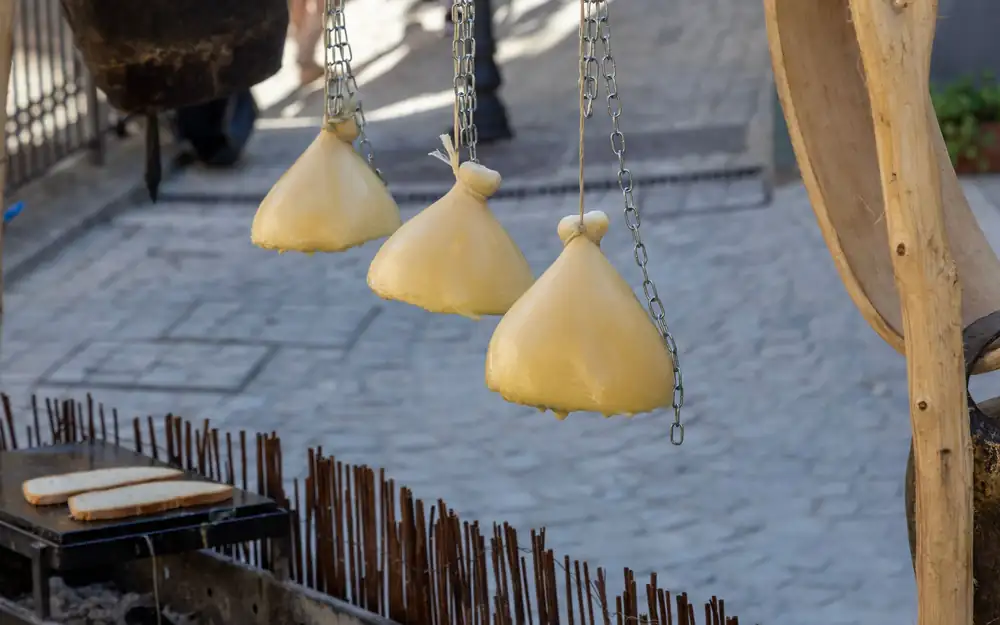
Caciocavallo impiccato, a fever that's inflaming the grills of Southern Italy
Flaming embers, glistening blades, swaying and "weeping" cheeses: hanging caciocavallo is one of the most evocative Italian street foods. In summer, in many villages, especially in the South, crowds gather around this truly unique and delicious gastronomic spectacle.
What is caciocavallo?
Caciocavallo is one of the most famous stretched-curd cheeses in Southern Italy. It is pear-shaped, composed of two hand-molded spheres of cheese. It weighs between 3 and 5 kilograms. It ages for three to six months in a dry cellar, where the caciocavallo is periodically brushed and oiled. It has a smooth, pale yellow rind or a wrinkled, ochre-colored rind. Its aroma can also veer toward a slight rancid scent. It is very hard to the touch, while its flavor tends to be spicy, becoming more intense with the length of aging.
The origins of caciocavallo (hanged)
Caciocavallo was known to the ancient Greeks and Romans. According to Pierre Androuet, in his Le dictionnaire des fromages du monde, this cheese's origins date back to the time of the barbarian invasions. It is believed, in fact, that it was originally made with mare's milk (hence the name). Nomads, not having sedentary livestock, consumed the milk of their pack animals. The raw material, transported in leather bags on horseback, transformed into cheese due to the movement of the containers against the animal's body, in contact with its heat.
Androuet also advances another hypothesis: the name could derive from a horse-shaped tax stamp, imprinted on the tolls of the Kingdom of Naples affixed to cheeses. The Neapolitan connection seems to be further supported by the saying "fare la fine del caciocavallo" (to end up like a caciocavallo), meaning "to be hanged by debts," a reference to the theatrical consumption of this cheese.
A third hypothesis suggests that the caciocavallo cheeses were left to dry in pairs, passed from one side of the horse's rump to the other.
Variations of caciocavallo
In Puglia, where this cheese is called "cazzecavadde," there are two recognized and certified types of caciocavallo. Caciocavallo Silano, which obtained DOP status in 1996, is widespread in the provinces of Foggia, Bari, Taranto, and Brindisi, as well as in Campania, Calabria, Molise, and Basilicata.
Then there's the Caciocavallo Podolico del Gargano, a Slow Food Presidium. It's made with the milk of Podolica cows, animals known for producing very little raw material, and only at certain times of the year. However, this milk yields cheeses with exceptional flavors. The Caciocavallo Podolico del Gargano undergoes a long maturation process in a natural cave, a technique that Slow Food is working to preserve with a dedicated Presidium.
In Italy, especially in the South, there are other variations, such as the caciocavallo from Ragusa, Ciminà, Godrano, and Agnone.
The hanging technique
The technique of hanging caciocavallo is mostly from Irpinia, but, given the shifting boundaries of this area of southern Italy, the northern part of Basilicata, the province of Foggia and the northernmost reaches of the Murgia, up to the borders of the province of Bari, have also adopted this tradition.
Many believe that it was shepherds who "hung" the first caciocavallo cheeses during the transhumance. It's also thought that this technique was discovered by chance by these men. During nighttime stops, the caciocavallo was hung from tree branches to keep it away from the animals. The heat from the campfire, reaching the crusts, would have given the shepherds the idea of melting the cheese.
But according to Simone Pizza, that cheese was too precious to "waste" by melting it over a fire. A devotee of hanging caciocavallo and a member of the Metamorfosi association, he and other members of the group helped popularize the hanging technique in Campania. "It all started at the beginning of this new millennium. During our bivouacs, we would cut slices of caciocavallo, which we would grill. The cheese would always melt and fall into the fire, disappearing. From there, we moved on to hanging. Around the same time, we introduced this technique to the Chestnut Festival in Montella (Av)." A couple of years after that first appearance, other neighboring festivals copied the technique. So, no more shepherds: hanging caciocavallo is a child of the new millennium.
How to hang a caciocavallo
The color, type of milk used, rennet, or maturation don't matter, but the aging process does. The caciocavallo to be hung must be young (and therefore less salty). Once purchased, ask for the string it's hung with to mature: you'll need it for hanging. Attach it to a chain and attach it to a tripod. "This way, the iron won't affect the cheese's healthiness or break the caciocavallo's head," explains Pizza.
The cheese should be placed about 10 centimeters from the heat and should never touch the grill, unlike the slice of bread, which can be passed over the heat for a few seconds to toast it. You can choose a homemade loaf, known as "pane ammassato," to serve as a bed for the caciocavallo cream. When the crust begins to melt, you can remove it and taste it. The soft part of the caciocavallo will then be free to drain better.
To portion the cheese, simply use a spatula or the back of a knife. As the caciocavallo burns, lower it gradually towards the heat.
Then, there are those who have decided to export the tradition of hanging caciocavallo beyond the borders of Southern Italy. Saverio Mancino has created a ready-to-use kit, available in three packages (basic, luxury, and gourmet), with the corresponding refills. Inside, in addition to the caciocavallo and the tripod needed to hang it, you'll also find Matera bread, the ingredients to season it with the cheese, wine, and even a knife. Mancino suggests a truly delicious combination: bread, melted caciocavallo, Lucanian truffle sauce, Pollino honey, and crusco peppers.
Bread and caciocavallo cheese, anything else?
The slice of bread topped with warm caciocavallo cheese should be enjoyed hot. So whoever prepares this special bruschetta must be very quick when adding the toppings. For pizza, the caciocavallo impiccato should be enjoyed pure, without any additives. "For an aperitif, use a slightly fresher cheese, where the milky flavor is evident, aged no more than three months. Those who prefer a stronger flavor can use cheeses aged up to six months: here, the salt and fat of the cheese are clearly noticeable."
For experimenters, we suggest enjoying the young caciocavallo impiccato with truffle, crumbled crusco pepper, sliced lard, but also with meat or seasoned sausages.
Festivals, celebrations, and events dedicated to the hanging caciocavallo cheese
Especially in summer, the embers flare up and the caciocavallo begins to "weep." The highlight for all lovers of this street food is the Caciocavallo Impiccato Festival in Apice, held at the end of June. Also not to be missed are the events of the same name in San Marco ai Monti (late July) and Sant'Agata dei Goti (September), in the province of Benevento. Naturally, purists should head to the Chestnut Festival (November) in Montella, in the province of Avellino, where it all began.
Monteleone di Puglia, in the province of Foggia, hosts the Caciocavallo, Cicatielli, and Acc' Festival, an event that has enlivened the town's summer for over twenty years. On this occasion, caciocavallo, handmade in local factories, is accompanied by cicatiell e acc', or cavatelli pasta with celery. The festival takes place in August in Monteleone's Piazza Municipio.
Caciocavallo cheese hanged outside the festivals
But hanging caciocavallo isn't just a staple at village festivals. In Taranto, Andrea Marangi, 35, managed to "cage" fire and cheese in the central Piazza Giovanni XXIII. This led to the creation of Santo Ripieno, the first restaurant to serve hanging caciocavallo every day, all year round, spread on fragrant pucce.
The challenge wasn't just commercial, but also technical: the live fire typical of festivals is difficult to manage in an enclosed space. Marangi and his team therefore patented a device capable of melting caciocavallo cheese at temperatures of 400°C (842°F). This is still a prototype, handcrafted by a blacksmith based on an architect's design. It also features smoke-proof glass windows, a hood to recirculate air, and the necessary permits from the local health authority (ASL). Customers walk in, see the cheese hanging, stop, and take a photo: "It's an experience that always gives a sense of authenticity," says Marangi.
Melted caciocavallo is served in puccia, the signature bread of the people of Taranto. The ingredients come from local farms, like Amodio's in Mottola. After Taranto, Marangi's goal is to bring the format to Bari, Rome, and Milan: a piece of Puglia ready to travel across Italy, one puccia at a time.