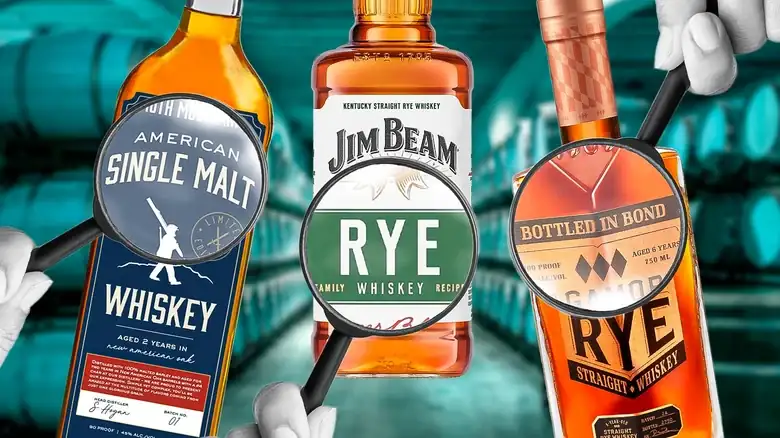
12 Terms You'll Want To Know Before Buying Whiskey
Having taken whiskey-tasting classes myself, I have learned that, simply put, whiskey is a distilled, brown liquor made from grain varieties that can include barley, corn, rye, or wheat . It can be aged for varying lengths of time, typically in wooden barrels. Finished whiskey must be at least 40% alcohol by volume.
“refers to pretty much the same thing, but with a historical distinction: American and Irish producers prefer to label their products”
The alternate spelling, "whisky," refers to pretty much the same thing, but with a historical distinction: American and Irish producers prefer to label their products "whiskey," while Scottish, Canadian, and Japanese producers prefer to call their products "whisky." In this article, I will use "whiskey" throughout, unless otherwise noted. Mark Tumarkin, a former liquor distributor who now teaches live and virtual whiskey-tasting classes in north Florida, will also share some whiskey history and knowledge about the terms you may find on bottle labels.
Single malt
The term "single malt" sounds familiar to most casual drinkers, even if they can't quite define it. What most people do know is that the term confers a patina of prestige and exclusivity to a bottle. Somehow, we've been conditioned to assume single malt whiskeys are more refined than other types and many drinkers believe that the term refers to a single type of malt, but this is a common misconception. "Single refers to one distillery," Mark Tumarkin explained. Thus, single malt whiskeys are those made exclusively from malt and produced in a single distillery. The term single malt has traditionally been associated with whiskeys from Scotland, where the term is regulated and whiskeys adopting that label must adhere to rigid guidelines. For instance, they must be distilled in pot stills — a slower and less efficient process than distilling in modern column s
Age statement
When you shop for whiskey, you will often see an age statement — something like "10 years old," for instance. This figure refers to the time the whiskey has spent aging in a wooden barrel, an essential step for developing its flavor. And because whiskeys are almost always a mixture from different barrels, the age statement refers to the youngest whiskey in the mix, so a 10-year-old bottle of whiskey may in fact contain 12- or 18-year-old whiskey as well. (Note, however, that the clock stops once the whiskey leaves the barrel, so a bottle of 10-year-old whiskey that's been sitting in a closet for 50 years is still 10 years old.) But as is the case with wine, older is not always better. "Young whiskey can be bright and brash and powerful, and the older whiskey is more refined and quieter and calmed down and mellow," Mark Tumarkin said. "So there's good things abou
Blended whiskies
"Blended whiskey" is another term that sounds vaguely familiar to most casual drinkers, but is easily misunderstood. The term blended refers not to the whiskey types, but to distilleries. A blended whiskey is one made from whiskeys produced at multiple distilleries. "A blended malt would be a malt whiskey made from 100% malted barley, but made from two or more different distilleries that have been blended together," Mark Tumarkin explained. (He cites Johnny Walker Green as an example of a blended malt whiskey.) Thus, in the context of whiskey, blended is the opposite of single, as in single malt. What makes the term confusing is that almost all whiskeys are a mix of different batches, whether from the same or different distilleries. "They're trying, generally speaking, to get a consistent product," Tumarkin said. "So they're blending it together, trying to get a
Mash bill
In whiskey-making, the mash is the mixture of crushed grains and water that is cooked together to convert the grain's starches into sugars, which ferment and ultimately form the base of the whiskey. The term "mash bill," which you'll see on many whiskey bottles and in whiskey reviews, simply refers to the grain contents of the mash. Since each grain lends its own flavor and character to the finished whiskey, this is important information for whiskey shoppers, especially if you have a certain flavor profile you enjoy (or are trying to avoid.) Malted barley (that is, barley that has been allowed to germinate, then heated to stop the process) is the central — and often only — grain in Scotch whiskey. "I'm convinced barley is the best thing to make whiskey," Mark Tumarkin said. "It gives you caramelly, bready kinds of notes. But through the fermentatio
Peat
Yes, this is the same peat that plant lovers use to line terrariums. It's compressed, partly decomposed plant matter that forms thick layers over much of the landscape of Scotland and other locales. Because it's so common in Scotland, it has traditionally been dug from the ground, dried, and used as a heating and cooking fuel, especially in areas where trees were scarce. And this is where its role in whiskey comes in. When malting barley for whiskey, maltmasters must heat and dry the germinated barley to stop the germination process, and in Scotland, historically the most easily accessible fuel for this process was peat. "But it has a very smoky character, and so that would cling to the barley," Mark Tumarkin said. "And then it would be carried on into the fermentation and distillation process, and you end up with peated, smoky whiskey." With the rise of
Rye whiskey
Rye whiskey boasts not only a spicy flavor, but a spicy history. When Scottish and Irish immigrants came to the U.S., they brought their love of whiskey and their distilling knowledge with them. But barley didn't grow well in many of the areas in which they settled. "Rye is a very hardy grass," Mark Tumarkin said. "It will grow in a lot of places and do well in a lot of places that barley won't. And so in Pennsylvania and some of those states, the farmers were growing rye." With limited markets for rye, many of these immigrants began to distill it to produce a more profitable and portable product — and the first rye whiskey was born. Today, the rye whiskeys with the most rye in their mash bills — and the most distinctive rye flavor — are still made in Pennsylvania. Rye whiskey even caused a military skirmish. "Wars are expensive, and George Washington and the gov
Tennessee whiskey
While bourbon is strongly associated with Kentucky, it's also made in other parts of the U.S. including Tennessee, which boasts its own special variation on the legendary drink. "Tennessee whiskey is basically bourbon," Mark Tumarkin explained. "But they add two things. One is, it's got to be made in Tennessee and two, it's got to be charcoal aged in maple charcoal. It's called the Lincoln County process." And if you want to try some, it's easy to find. "The two biggies are Jack Daniels and George Dickel," Tumarkin said. "And Jack Daniels wants you to believe that this is their process, but that's not true." Tennessee whiskey — and bourbon in general — are by-products of the Whiskey Rebellion. After the successful suppression of the rebellion, George Washington offered incentives to encourage the still-fuming Pennsylvania distillers to move to Kentucky. Once t
Straight bourbon
"Straight bourbon" is another term you'll see on labels when choosing a bottle. It refers to bourbon that not only meets all the legal requirements for the drink (at least 51% corn, aged in new oak barrels, with an ABV of at least 40%), but additional requirements as well. The Department of the Treasury Alcohol and Tobacco Tax and Trade Bureau defines straight bourbon as that which is "stored in charred new oak containers for two years or more" and "may include mixtures or two or more straight bourbon whiskies provided all of the whiskies are produced in the same state." It also may not include added coloring. So what does this mean for you as a shopper and drinker? "It's going to be good quality," Mark Tumarkin said. In contrast, however, he warned that the term straight whiskey doesn't offer the same guarantee. "It gets really loose," he said, explaining that stra
Bottled in bond
If the term "bottled in bond" sounds like a bit of legalese, it's because it is. But when you see it on a whiskey bottle, it's an ironclad guarantee that the whiskey was produced with integrity, with no undesirable additives, and a clear chain of custody through every step of its production. "Basically what that says is, you take your whiskey, you make it at the distillery. It has to be made at a single distillery in a single year," Tumarkin said. "It's got to be aged in new oak, just like [other] bourbon, right? But aged for four years." Most importantly, he said, "It has to be aged in a bonded warehouse." This ensures no one can tamper with the barrels or their contents during the aging process. Adherence to bottled in bond standards is voluntary, and today, only bourbon producers seek the bottled in bond designation. However, Tumarkin explained, the stan
Cask strength
By law, whiskey must have an ABV of at least 40%, or 80 proof, and shoppers can find whiskeys in a variety of strengths. However, whiskey that comes out of the still is always significantly stronger because to get it down to lower proofs, distillers dilute it with water. But not all whiskeys are adjusted to lower proofs. If you see the terms "cask strength" or "barrel strength" on a label, this means you're getting whiskey at its original strength straight from the still. And this can be potent stuff with 50% alcohol or more. This doesn't mean, however, that it's all alcohol burn and little else. "Yes, cask strength is typically a little higher, but if you took the same whiskey, a lower-proof and a higher-proof version, the cask strength [with the] higher proof is going to be much more flavorful," Mark Tumarkin said. "It's going to be hotter alcohol heat, but it's
Scotch
Scotch is, quite simply, whiskey made in Scotland. The label covers a lot of territory, from well-known supermarket mass-market brands such as Johnny Walker to rare handcrafted single malts. Their flavor profiles can range from light cocktail mixers to deeply smoky expressions meant for slow sipping. By Scottish law, all scotch must be distilled, aged, and bottled in Scotland. It also must be aged for at least three years in oak. (Unlike bourbon, however, it need not be aged in new barrels and many distillers add distinctive flavors by aging their scotch in barrels formerly used for bourbon, sherry, or other drinks.) Tumarkin explained that scotch varieties can have varied mash bills as well. Malt whiskeys are those whose mash bills only contain malt, while grain whiskeys are those that employ other grains, such as corn, wheat, or rye. (Usually, however, grain w
Sour mash
The term sour mash can sound a bit off-putting — who wants sour whiskey? But be assured this does not refer to the flavor of the whiskey. Instead, it refers to the process of taking some of the leftover mash from a previous fermentation and distillation and adding it to fresh mash when making a new batch of whiskey. And if anything, this technique of recycling old mash actually reduces the chance of sourness in a whiskey. "Usually they just feed it to cattle, right? But if you take part of that, roughly a third of it, and mix it into your next batch, it, it lowers the acidity," Mark Tumarkin explained. The sour mash technique, however, does not contribute any distinctive flavors to whiskey. And while some producers advertise their use of sour mash (which is why you'll sometimes see the term on labels), many don't. "You'll see a lot of whiskeys that don't advertis