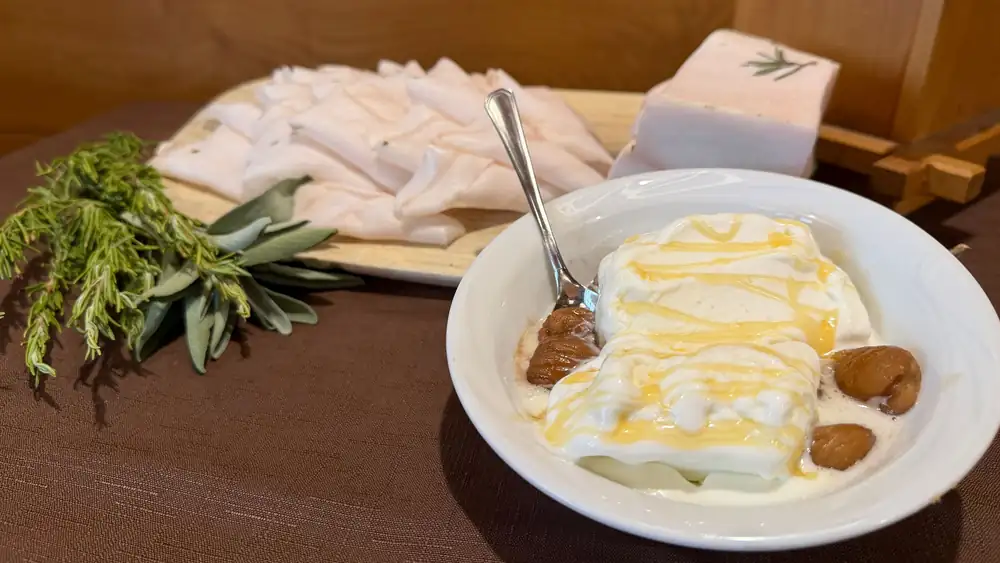
Would you like to try Arnad lard ice cream? At its festival in the Aosta Valley, you can
An Arnad lard ice cream with honey and chestnuts. On paper, it might seem like one of those pairings designed to spark controversy, but instead it draws on flavors that have been familiar in Arnad for centuries.
It's "Gelardo," the most unusual new addition to the 53rd Valle d'Aosta Lard d'Arnad DOP Festival, scheduled for August 27-30, 2026, in the small town in the lower Aosta Valley. After a two-year hiatus, the "Féhta dou lar" returns to celebrate what they call "White Gold" here, attempting to take it beyond the more predictable confines of platters, polenta, and mountain recipes.
Lard ice cream that plays with tradition
Local chefs created Arnad lard gelato, starting with a combination that's not unusual in these parts. Traditionally, the lard is sliced very thinly, left at room temperature, and served on warm black rye bread, often with honey or boiled chestnuts. In "Gelardo," these ingredients vary in temperature and consistency.
More than a provocation, the idea is to demonstrate the versatility of a product typically associated with appetizers. "A more modern and innovative proposal, illustrating how lard can be used in the world of food," says Ivo Joly, president of the Lo Doil Committee, which organizes the event.
And gelato won't be the only experiment at the 2026 edition. The festival will also feature reinterpretations of other recipes that are "very popular and internationally iconic," as Joly calls them, using Lard d'Arnad in less usual contexts. "It's not about provocation, but rather a desire to demonstrate the incredible versatility of this product," explains the president. In short, lard will continue to be a wonderful addition to a slice of bread, but for four days it will also have the opportunity to demonstrate its ability to perform elsewhere.
Four days of celebration in Arnad
The Valle d'Aosta Lard d'Arnad DOP Festival was founded in the 1970s by a group of young locals who wanted to promote one of the region's most distinctive specialties. More than half a century later, it is now in its 53rd year and, according to the organizers, attracts over 50,000 visitors—a remarkable number for a town of approximately 1,200 inhabitants.
From August 27th to 30th, with free admission, the festival will return to the clearing in Pied de Ville, historically known as "La Keya." Here, wooden huts decorated with flowers and embroidered hemp cloths will host tastings and producers, while the program will include food and wine markets, artisan workshops, themed lunches and dinners, performances by the Arnad Philharmonic, and evening entertainment.
Nearly 400 local volunteers will be running the show. "They offer visitors lard, wine, cured meats, and all the local products you can taste here in Arnad," says Joly. A village festival, then, but with numbers that have long surpassed those of the town itself.
A product to be celebrated also because there is less and less of it
Behind the festive atmosphere lies a less trivial issue. According to Joly, the availability of raw materials is declining because in recent years, pigs have tended to be less fatty. This transformation, for a product that depends on the thickness of the fat layer, has quite tangible consequences.
"This is a delicate moment for our lard, which is destined to be produced in increasingly limited quantities," explains the president of the Lo Doil Committee. Hence the desire to promote it, share its story, and even experiment with new ways to bring it to the table.
Gelardo thus becomes something more than a curiosity to be tasted once to be able to say you've done it. It combines the same ingredients that have long accompanied lard in Arnad and moves them to a new setting. Brown bread aside, honey and chestnuts are still there. Only this time the lard arrives cold, creamy, and spoonfuls.