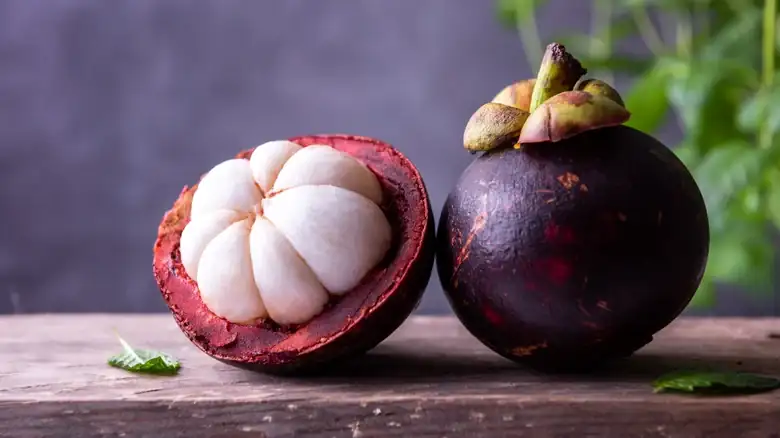
Why Mangosteen Was Once Banned In America
You may know how to tell if a mango is ripe, but you may not be as experienced with a mangosteen, as this elusive Southeast Asia fruit was banned by the USDA until 2007, due to fears it would bring the Asian fruit fly into the country.
Even with cultivation outside of Southeast Asia spreading to Mexico and Puerto Rico, mangosteens can usually only be found during the summer months and with a pretty hefty price tag. Expect to pay a premium for this exotic fruit, especially if you don't want it to be irradiated. For instance, retailer Miami Fruit sells a single mangosteen for $27 and a 3- to 5-pound box for $177. That said, all mangosteens from Southeast Asia need to be irradiated to prevent Asian fruit fly infestations in the United States, which also increases costs.
How fruit flies got mangosteens banned in America
Unlike the banning of haggis in America due to health concerns, mangosteens were banned in America because they could harbor the Asian fruit fly and its larvae. Also called the oriental fruit fly, this pest exists in Hawaii since 1946, originating from mainland Southeast Asia and surrounding islands. Although the ban helped mitigate the spread, the damage was already done.
Since being introduced to Hawaii, the larvae managed to find its way into over 125 fruits and vegetables, which spread to California due to the importation of infested Hawaiian produce. According to the California Department of Food and Agriculture, the Asian fruit fly was first discovered there in 1960. While an eradication program was designed, a female fruit fly can lay over 1,000 eggs, which turn into larvae that burrow into fruits and eat the pulp. This can lead to irrevocable crop destruction, which can be challenging to remedy.
For this reason, mangosteens and other susceptible fruits from Southeast Asia must be irradiated before being imported to the United States. In this process, the fruits are hit with electrons similar to X-rays, which raise their temperature by one degree. This kills off pests and sterilizes the fruit, but it increases costs and concerns some mangosteen enthusiasts. Although the American Medical Association and the World Health Organization approve the process, groups such as Public Citizen, founded by Ralph Nader, have spoken out against the practice. Fortunately, mangosteens from Mexico and Puerto Rico do not need to be irradiated because they pose no threat of introducing the Asian fruit fly.