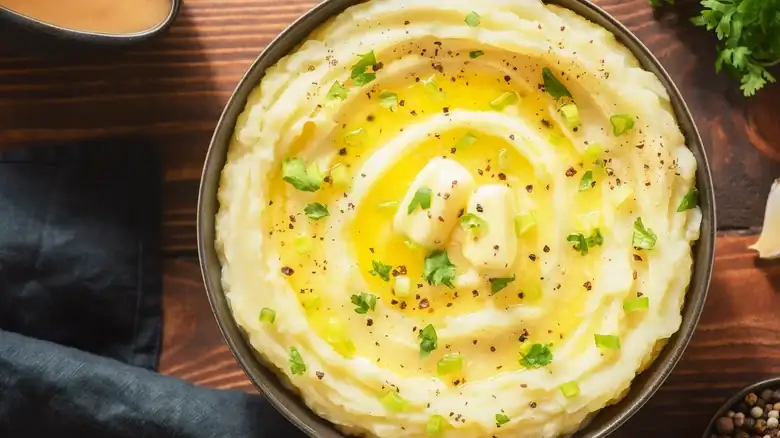
For Low-Labor Creamy Mashed Potatoes, Opt For The Electric Mixer
Is there anything better than mashed potatoes? The starchy side dish can be served with everything from fried chicken at your local fast food chain to a fancy steak at an expensive restaurant and be well received in both locations.
If you're making mashed potatoes at home, however, you've probably realized that the dish is a bit labor-intensive and unpredictable in terms of whether you'll end up with a fluffy treat or a lumpy mess when you're done. Chef J. Kenji López-Alt, author of "The Food Lab: Better Cooking Through Science," notes that you can achieve fluffy mashed potatoes every time — just look to your electric mixer.
Is there a right way to make mashed potatoes?
Unsurprisingly, the key to good mashed potatoes is to first start with the right potatoes. The dish is typically made with starchier russet potatoes. According to food chemist Shirley Corriher in "CookWise: The Hows & Whys of Successful Cooking," these potatoes have larger starch cells which absorb more water when they're being cooked, causing the cells to separate and you to end up with a fluffier mashed potato than you might from low-starch red potatoes.
For your basic mashed potato, all you need is butter, milk, and a little salt; however, you can also add things like cheese or bacon to make those potatoes a little more interesting. Garlic mashed potatoes, in particular, are an easy way to kick the mealtime staple up a notch. If you're feeling fancy, adding a bit of truffle salt, truffle oil, truffle butter, or even actual truffles can elevate your standard mashed potatoes to something you wouldn't be surprised to see on a fancy steakhouse's menu.
Traditionally, to make mashed potatoes you would slice and cook your potatoes and then mash them up by hand. You could use a potato masher, specifically designed for the task, a fork, or even a wooden spoon to get the job done. Mashing your potatoes manually, however, can be a bit labor intensive, and can also sometimes result in a lumpy end product — we aren't all perfect, are we? That's where the electric mixer comes in.
Why you should use an electric mixer to make mashed potatoes
If your goal is a fluffy mashed potato, J. Kenji López-Alt likes to use an electric mixer to blend things up. The reason, again, has to do with the starch in the potatoes. The more vigorously you mash your potatoes, the more starch will form from those cooked potatoes and the denser and stickier your potatoes will be.
To achieve this, López-Alt advocates for handling your cooked spuds with a light touch. Specifically, he suggests using a ricer or food mill to cut the potatoes into smaller pieces and then using an electric mixer to blend them up, a method (minus the ricer) also endorsed by "The Silver Palate Cookbook." Unlike the excess starch present in potatoes made using a masher or food processor, an electric mixer will only produce a minimal amount of the carbohydrate, leaving you with an ethereal side dish. It's an easy trick, but one that should save you some time and ensure you get perfect mashed potatoes without fail.