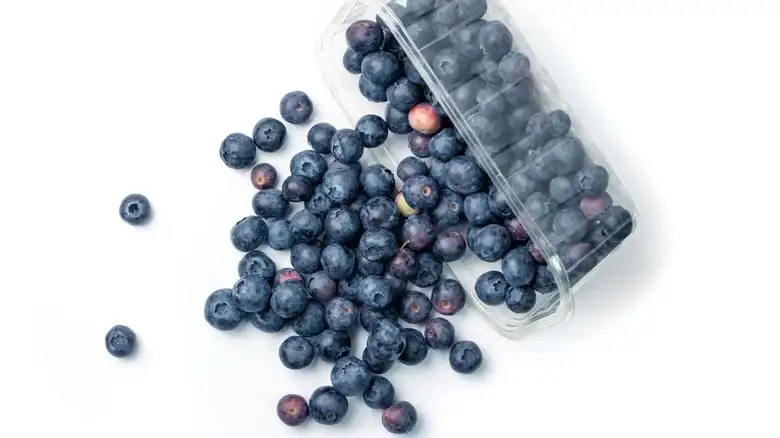
Huckleberry Vs Blueberry: Is There A Difference Between The Fruit Look-Alikes?
You've heard of Huckleberry Finn and Huckleberry "Huck" Hound. Perhaps you can even recall the phrases, "I'm your huckleberry" and "a huckleberry over my persimmon." But do you actually know what a huckleberry is, or better yet, how it differs from its fruity look-alike, the blueberry?
“can be also used in casual conversation to inaccurately refer to blueberries. The cause behind this trend may be the fact that”
Both huckleberries and blueberries belong to the taxonomic family Ericaceae. But so do thousands of other evergreen trees and flowery shrubs — such as azaleas, mountain laurel, and rhododendrons — which range from the tropics to the subarctic. More specifically, these two plants are berry bushes native to the Americas. Thankfully, however, there are still a handful of ways to tell them apart.
Huckleberries almost always need to be foraged, whereas blueberries can obviously be bought at the store no problem. In the wild, huckleberries spread out on branches while blueberries naturally cluster together nearer to the ground. On the insides, huckleberries are a bluish purple color, but blueberries actually appear a greenish white. Huckleberries also have large, tough seeds, yet blueberries contain soft, little ones. Last but not least, huckleberries range from tart to sweet, while blueberries are almost always pretty sugary.
Huckleberries often go overlooked
There are really several species of huckleberry. Quite confusingly, the term "huckleberry" can be also used in casual conversation to inaccurately refer to blueberries. The cause behind this trend may be the fact that "huckleberry," originating in the 17th century, is derived from "hurtleberry" and "whortleberry," two old-timey monikers for blueberries. It seems that English speakers exploring the New World also confused these two berries when first naming the huckle kind.
True huckleberries, however, are found in Idaho (where they are the state fruit), Montana, and the Pacific Northwest, and they have a history in Indigenous American medicine. These little, acidic fruits can appear dark blue, but they can also be red, purple, or even black. The versatile berries often end up in huckleberry pies or jams and sometimes even huckleberry cocktails. It's a shame that they don't enjoy the popularity of blueberries, but it's understandable. Unlike blueberries, huckleberries haven't yet been domesticated.
Blueberries are big business
Like "huckleberry," the term "blueberry" can actually refer to several different species. They're a bit farther spread than huckleberries, native as far as South America up to Alaska. (There's even a European cousin of these little, sugary, dark blue fruits dubbed "bilberries," but those are their own thing.) Hot or cold, lowbush or highbush, as long as there's acidic soil, at least some type of blueberry will likely be able to grow. As such, blueberries are even more common than huckleberries in jams and pies.
That's not all, though. For over a century now, blueberries have been cultivated in the field (as opposed to the wild), so in the modern day, the United States is now the biggest producer of blueberries worldwide. This also allows for dried, frozen, juiced, and other processed blueberry products to become widely available in stores. So, ultimately, if you're at the shop, it's likely to be a blueberry (and marked as such). If you the consumer are the one foraging for it, it just might be a huckleberry. And if there's any doubt left, you now know how to tell the two apart!