Milan's sweet parlor turns ninety
Pasticceria Cucchi: the origin of the myth
Even before its 1950s decor, illustrious clients, and reputation as a historic venue, Cucchi's entered Milan's memory through its sweets and music. Its official history begins in 1936, when Luigi and Vittorina Cucchi opened a café concert on Corso Genova. Not yet a pastry shop in the current sense, but a place where food and socializing coexisted until late at night. A small Spanish orchestra also accompanied the new dances arriving from the United States, beautifully capturing the atmosphere of a Milan already receptive to foreign trends and languages. That initial period was interrupted by the war. In August 1943, during the bombings that hit the city hard, the shop was destroyed. The reconstruction also marked the transition to a true pastry shop and the identity that Cucchi would maintain in the decades to come.
Illustrious clients
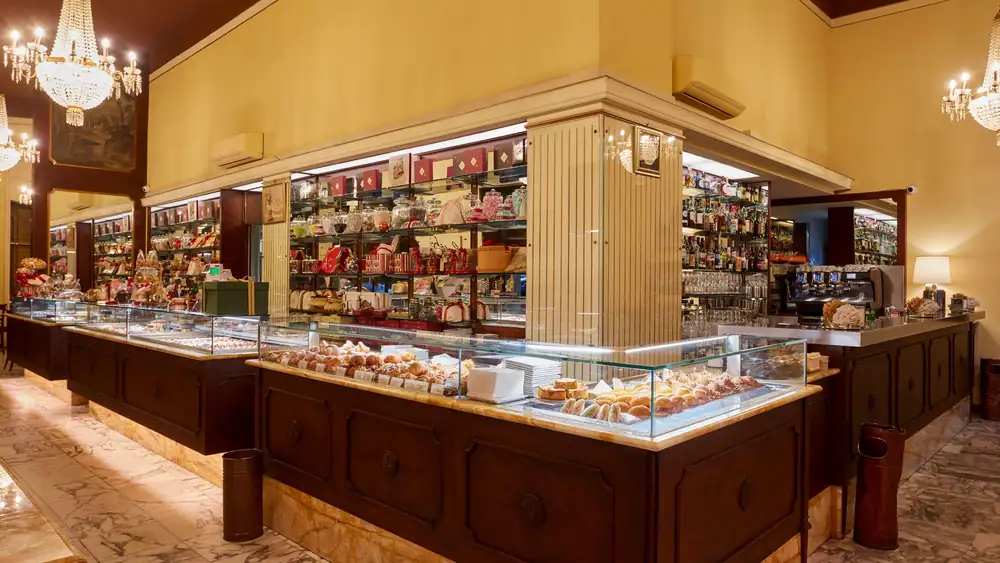
The interior was renovated in 1954. Dark woods, mirrors, chandeliers, velvet, and that typically Milanese bourgeois elegance remain a substantial part of the shop's charm today. Not a retro décor constructed after the fact, but spaces that truly belong to the pastry shop's history. Over the years, Cucchi's also became a meeting place. Artists, writers, professors, managers, actors, and directors passed through its tables. Giuseppe Ungaretti is remembered among the regulars; later, figures from Milanese cinema and culture would arrive, including Gabriele Salvatores. In 2017, the story of the shop and the family was also made into a documentary, Cesare Cucchi. Story of a Milanese Pastry Shop, which interweaves family memories, neighborhood transformations, and the city's history. That the shop has become something more than a simple commercial sign over time is also demonstrated by an episode in 2018. A few days before the opening of the first Italian Starbucks in Piazza Cordusio, architect Cino Zucchi posted on social media a retouched photograph of the shop with the American chain's logo on the sign. Many took it seriously, and protests and phone calls to the shop erupted. The joke was quickly cleared up, but the reaction clearly demonstrated how Pasticceria Cucchi was perceived as an integral part of the city's landscape.
The symbolic sweets
The history of a pastry shop, of course, is shaped primarily by what it continues to produce. Cucchi has maintained a significant part of the house's classic repertoire over time. Among the most recognizable preparations are the tart with cream and raspberries and rice pudding. Panettone holds a special place: here, it is prepared by hand throughout the year, with regularly refreshed sourdough starter. Long before the grand Christmas leavened cake began appearing out of season in many contemporary pastry shops, it had already become a permanent fixture at Cucchi. Alongside the products, the rituals have also survived. Breakfast, coffee at the counter, afternoon tea, the tray of pastries, the aperitif: different moments of the day that have changed audiences and language, but have not disappeared.
Changing of the baton
The most significant milestone in its recent history came in 2023. After Cesare Cucchi's death in 2018 and the subsequent management of his daughters Laura and Vittoria, the business passed to the Monti family, who had been active in Milan's restaurant business for over fifty years. With the change of ownership, the stated goal was to preserve the restaurant's identity while expanding its offerings and appealing to its clientele. In recent years, Cucchi has thus strengthened its presence beyond its pastry shop and café. Lunch, wine bar, and aperitivo have become distinct moments of the day; these have been joined by brunch, bistro, and, more recently, convivial dinner options. At the same time, its digital presence and e-commerce have also grown. The relationship with design, on the other hand, is not new. During Milan Design Week 2019, Cristina Celestino designed Caffè Concerto Cucchi, a temporary project inspired by the restaurant's origins. The interiors, windows, and outdoor seating were reinterpreted, along with the staff uniforms, packaging, table settings, and some desserts. This intervention already demonstrated one of the possibilities offered by a historic location: not rebuilding it from scratch, but working within its traditions without erasing them.
The anniversary menu
For its 90th birthday, starting September 17th and lasting a month, Cucchi is offering a special menu designed to span different moments of the day. The dessert created for the occasion is called L'eredità (The Legacy) and features a white chocolate and puffed rice crisp, sponge cake, white chocolate cream, strawberry jelly, and vanilla mousse. This cake is built more on contemporary textures and techniques than a replica of a historic dessert. The savory offerings include La brioche di stagione (Seasonal Brioche), filled with grilled vegetables, cream cheese, and arugula, and Il morbide di Cucchi, a milk roll with turkey breast, cocktail sauce, and tomatoes. The most direct reference to Milan, however, comes with La meneghina a modo nostro (Our Way): a Milanese ossobuco arancini, served on a parmesan fondue and topped with saffron pistils and fried sage. A deliberately unsettling encounter between two regional traditions, built around one of Milanese cuisine's most recognizable dishes. Two drinks have been created for aperitivo. The Rubino Spritz combines raspberry, prosecco, Select, lime, and orange; the non-alcoholic Virgin Blush is made with 0.0 gin, lime, raspberry puree, and tonic. The new offerings will complement the classics that have characterized the pastry shop's history. And this is perhaps the most interesting aspect of Cucchi's ninety-year history: continuity does not mean immobility. The historic desserts remain, as does the décor, but around them, the ways of frequenting the shop, the hours, the consumption patterns, even the language with which a pastry shop enters into the life of the city, have changed. Ninety years later, Cucchi continues to tell the story of Milan above all else: through what endures, what changes, and what continues to be served.