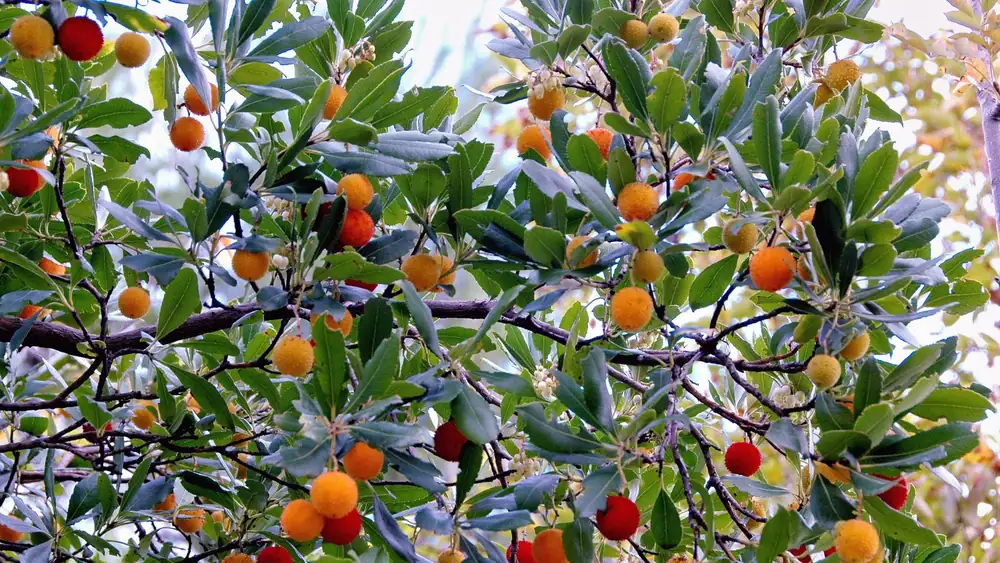
Strawberry trees: properties and benefits of an ancient fruit that contains more vitamin C than oranges
Red and sweet-tart, the strawberry tree is one of the most interesting forgotten fruits of the Mediterranean autumn. But what are the properties and benefits of strawberry trees?
Strawberry Trees: What They Are and When to Find Them
The strawberry tree (Arbutus unedo) is a shrub or small evergreen tree in the Ericaceae family, typical of the Mediterranean scrub and especially widespread in the milder regions of Italy. Its fruit, called arbutus or corbezzole, are small, rounded berries with a rough surface and characteristic protuberances: initially green, then yellow-orange, they turn a deep red when fully ripe. The pulp is soft and contains numerous small seeds.
One of the peculiarities of the strawberry tree is its unusual timing: both ripe fruit and new flowers can appear on the same tree at the same time. Flowering occurs in the autumn months, while the fruits we see ripening at the same time stem from the previous year's flowering. The strawberry tree harvest generally takes place between October and December, with variations depending on the climate and growing area.
The perfect time to eat them is when they've reached a uniform red color and the flesh begins to soften. When unripe, they can be tart and tart, while when fully ripe, they become sweeter and more aromatic. Ripening occurs gradually, so not all fruits on the same bush reach the ideal level of ripeness at the same time.
Why is it called strawberry tree?
The strawberry tree's scientific name, Arbutus unedo, dates back to Pliny the Elder: unedo literally means "I eat only one," a reference to the fact that, as beautiful and inviting as the fruit is, it's certainly not suited to large feasts. Popular Italian etymology, however, links the word "arbutus" to corbitium, meaning "basket," recalling the fruit's compact, globular shape, although some prefer the connection with corbus, meaning crow, an animal that is particularly fond of them.
In the 19th century, it even became a political and cultural emblem: with its white flowers, green leaves, and red fruits, this Mediterranean plant was adopted as a symbol of the Italian Risorgimento, a living flag of nature. And, between magic and superstition, its branches were hung in front of houses and stables as a protection from negative influences. And let's not forget its linguistic aspect: the exclamation "Arbutus!" continues to color everyday speech.
Strawberry Trees: Properties and Benefits: An Interview with Fabio Bortesi
What are strawberry trees, and what are their main nutrients? The strawberry tree (Arbutus unedo) is an evergreen Mediterranean shrub that produces spherical fruits, typically 1 to 2 centimeters in diameter. They are red-orange when ripe, with grainy, sweet-tart flesh. Nutritionally, strawberry trees are rich in water (about 80%), low in calories (40–50 kcal per 100 g), and contain natural sugars, dietary fiber, organic acids, and vitamins.
Are they rich in vitamins and minerals? "Yes. Their vitamin C content is particularly high, often higher than that of oranges and lemons (up to 200 mg/100 g in some studies). Strawberry trees also contain polyphenols, carotenoids, and tannins, which have antioxidant properties. Minerals include potassium, magnesium, and calcium, albeit in moderate quantities."
Do they have bioactive compounds that benefit our bodies? "Molecules such as flavonoids and phenolic acids have been identified, which contribute to antioxidant, antimicrobial, and anti-inflammatory properties. Some preliminary studies have suggested a potential protective effect on the cardiovascular system and glycemic control, but further clinical research is needed."
Are there nutritional differences between fresh fruit and dried or processed fruit (jams, liqueurs)? "Fresh fruit retains the maximum amount of vitamin C and antioxidant compounds, while cooking or fermenting jams and liqueurs partially reduce their content. Drying concentrates sugars and calories, making them more energy-dense, but less rich in vitamin C."
Can they have antioxidant or anti-inflammatory effects? Are there any studies on their role in preventing chronic diseases? "In vitro and animal model data show antioxidant, anti-inflammatory, and antimicrobial effects. Some studies have linked the intake of strawberry tree extracts to a reduction in oxidative stress and an improved lipid profile. However, there are no large clinical studies in humans yet, so we're talking about potential, not consolidated evidence."
Who should avoid them or consume them with caution? "They are generally well tolerated. However, those with sensitive guts should consume them in moderation, as the fiber and tannins can have an astringent or irritating effect. People with severe kidney disease should limit their intake of fruits that are very high in potassium. Furthermore, excessive consumption of strawberry tree liqueurs, which contain alcohol, should be avoided."
Can they have laxative or irritant effects if consumed in excess? "Yes. Consumed in large quantities, they can cause mild diarrhea or gastrointestinal discomfort, linked to the fiber and organic acid content. This isn't a question of toxicity, but rather of a mechanical and digestive effect."
Can they interact with medications or supplements? "There are no documented significant drug interactions. However, given the presence of tannins, it is prudent not to take them with medications or iron supplements, as they may reduce iron absorption. Otherwise, there are no significant clinical reports."
Are there any risks associated with consuming the seeds or unripe parts of the fruit? "The seeds are edible and non-toxic. Unripe fruit, rich in tannins, can be astringent and difficult to digest. There are no known serious risks, but it is recommended to consume very ripe fruit."
Is it better to consume them fresh or processed? "Fresh is preferable for those seeking vitamins and antioxidants. Processed foods (jams, desserts, liqueurs) offer other qualities: intense flavor, energy, but fewer micronutrients."
Does cooking or making jams change their nutritional properties? "Yes. Vitamin C is thermolabile and is largely degraded during cooking. However, sugars, fiber, aromatic compounds, and some polyphenols remain, which still provide nutritional value."
Can the leaves or other parts of the plant also be used in cooking or as herbal teas? "The leaves and bark contain arbutin and tannins, with astringent and antimicrobial effects. In herbal medicine, they are used in decoctions or herbal teas for urinary or intestinal disorders. Caution: high doses can irritate the gastric mucosa. They are not commonly used in cooking, but only in phytotherapy."
What food pairings enhance their benefits? "Arbutus berries pair well with fresh cheeses, yogurt, and whole grains, which balance their acidity. They're also excellent with white meats and game, as a side dish in a sauce. Pairing them with honey or dried fruit enhances their energy potential."
How often is it advisable to eat them? "They can be eaten like any other seasonal fruit. One or two servings a week, when available, is a reasonable amount."
What daily amounts are considered healthy? "Around 100 to 150 grams per day is a balanced portion, providing fiber and vitamin C without digestive problems."
How do you recognize ripe, high-quality strawberry trees? "They should have a uniform, bright red color, a soft but not mushy texture, and a sweet aroma. Fruits that are too hard are unripe and astringent; those that are too soft risk fermentation."