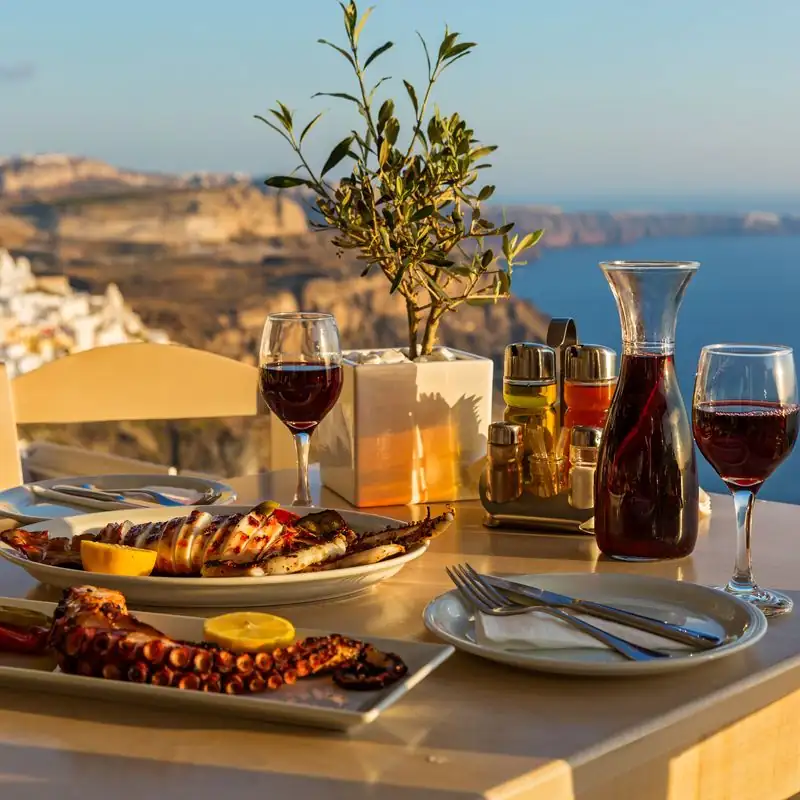
All the goodness of Greece
Kalí órexi, bon appetit, is the best wish you can receive in Greece, a land rich in flavors, all waiting to be discovered.
The islands, the beaches, the sun, the sea, the white houses, and cascades of colorful flowers. Anyone who has vacationed in Greece treasures photos and memories of picturesque landscapes, capable of capturing the true soul of the Mediterranean like few others. But the country also has so much to offer at the table, with aromas and flavors capable of captivating even the most seasoned gourmet. Suffice it to say that the Mediterranean diet was born here, where the sun provides not only the perfect tan, but also ripe, flavorful fruits and vegetables, authentic olive oil, and wines that conquer ever-increasing markets worldwide year after year. Nearly every island and every village has its own specialty, born from the use of wild-growing ingredients, brought by colonizers from distant lands, or invented by cooks to comply with the strict precepts of the Orthodox Church. Are you ready to join us? All you need is a napkin.
The Secrets of Crete
It's said that the Mediterranean diet originated here, but what is certain is that some of the island's specialties are so delicious they've spread throughout the country. The best-known is dakos, reminiscent of Apulian frisella; it's a crust of hard bread topped with pieces of tomato and feta, generously drizzled with olive oil, salt, and oregano, making it the perfect snack on hot summer days. But if you want to discover the island's true gastronomic heart, plan a trip to Chania, the northwest region of Crete, rich in olive groves and vineyards. The first experience not to be missed is a visit to a winery: wine has been produced here for 4,000 years, and the island boasts over ten native grape varieties, including Vilana, which produces a white wine, and Mantilari, which produces a red. These must be paired with exquisite local cheeses, such as the yellow and spicy graviera, Myzithra, made from sheep's or goat's milk, and Anthotiro, a semi-hard, very white and very savory cheese. Also worth visiting are a rakokazano, a distillery producing raki, a pomace distillate similar to Italian grappa, known as "Cretan firewater," and an olive oil mill, as olives are often still processed in traditional stone mills here. Have you been won over by Chania's food? There's nothing better than signing up for a cooking class to learn how to prepare a five-course meal and even smoke meat like a true Cretan.
Santorini and the volcanic wines
Some of the world's finest wines are born on volcanic soils, and Santorini is no exception. Grapevines have been cultivated here for over 3,000 years, and there are over 50 grape varieties, including the celebrated Assyrtiko, used to produce a highly acclaimed dry white wine and passito wines protected by the DOP (Protected Designation of Origin). Many of the vineyards are ancient and still cultivated with an ancient pruning system that curls the plants around themselves, forming kouloures (baskets), protecting them from harsh winds and the sun. Equally fascinating are the arched underground cellars, known as kanaves. There are about a dozen wineries on the island, starting with the renowned Domaine Sigalas in Oia and the Koutsoyannopoulos Winery and Wine Museum, set in a cave eight meters underground, with a labyrinth of tunnels stretching 300 meters. The wineries in the Caldera, with their terraced vineyards, are also very scenic, such as the Santo Wines Cooperative or the Venetsanos, Boutaris, and Gavalas wineries. After the tour, there's nothing better than ending the day with a dinner of grilled octopus accompanied by a glass of Assyrtiko.
The Treasure of Chios
Protected by the PDO (Protected Designation of Origin) for 25 years, Chios mastic is the island's most distinctive product, and its cultivation was inscribed on UNESCO's Intangible Cultural Heritage List in 2014. This resin, obtained from mastic trees, is used to make characteristic liqueurs, sweets, and even chewing gum. However, mastic's fame risks overshadowing the island's other excellent products, such as its mandarins, among the world's most prized varieties for their intensely sweet pulp; the Ariousios Oinos red wine; the unpasteurized and unfiltered lager beer produced in Kampos; fig liqueur; and ouzo flavored with anise, coriander, fennel, lemon blossom, or mastic. In autumn, it's best paired with the exquisite amanita mushrooms, which are enjoyed fried or grilled here. Also worth trying are the soft cheese of Chios, which has a characteristic flavour due to its preservation in brine, and the various types of pasta produced on the island, such as tagliatelle ricce with a flavour of the inevitable mastic tree.
In Syros the recipes smell good
Syros is the administrative capital of the Cyclades: much-visited by Greeks, it is still little-known to tourists from other countries, but it is a discovery worth making, especially for those with a passion for gastronomy. Certain dishes can only be tasted here, such as kaparosalata, a caper salad; maindanosalata, a parsley salad with lemon, onions, and capers; marathopita, a wild fennel pie; and aetopita, a fish and vegetable pie. Also worth trying are atherinopita, small floured and fried fish, flavored with mint and parsley and served with chopped tomatoes, onions, or eggs; kokkinista karavola, snails in a rich tomato and sage sauce; or melomenes melitzanes, eggplants served in a very sweet, slow-cooked tomato sauce. But even recipes common to other parts of Greece are enlivened here with a touch of spice, wild fennel, or the intense flavor of local capers, which grow in the Apano Meria area in the north of the island. And for a sweet finish, there are loukomia covered in powdered sugar: they're among the best in all of Greece!
Tinos, where food is a celebration
In Tinos, food is a serious matter, so much so that it becomes the focus of culinary festivals that attract tourists from around the world; there are festivals dedicated to artichokes, honey, wine, raki, and oregano. Each season has its own peculiarities, and while early summer brings the harvest of capers to pickle, in autumn it's time to forage for mushrooms to be fried or stewed. Those who venture into the island's interior will be captivated by the scents of mint, sage, dittany, thyme, and chamomile, which are enjoyed in infusions and purchased in local shops, as well as by the distinctive architecture of the dovecotes (there are over a thousand), where doves and pigeons are raised and then used in delicious recipes.
The Venetian soul of Corfu
The most famous of the Ionian islands is also one where its Italian past is most evident, clearly visible not only in the palaces and historic monuments left by the Venetians, but also at the table, where many traditional recipes resemble Venetian dishes, but with an irresistible Greek twist. Strolling the pedestrian streets of the Old Town, you'll find quaint tavernas serving sofrito, a pan-fried veal dish with a wine sauce; pastitsada, a beef or rooster stew served with pasta; bianco, a succulent fish dish; and bourdeto, a spicy fish dish whose red color comes mostly from peppers. You'll also hear the phrase, "Italians, same face, same race": welcome to Greece, a country where you feel at home, even at the table.