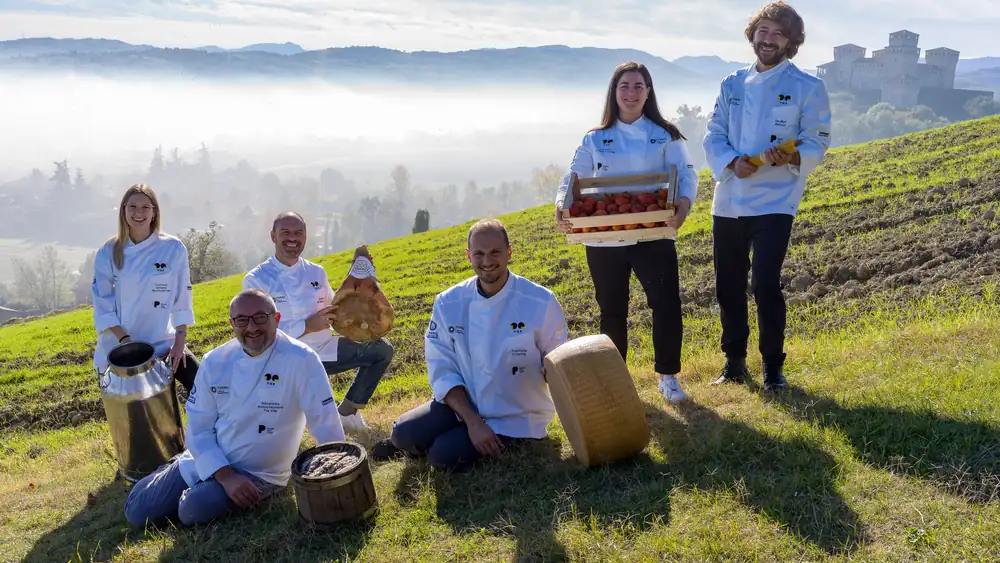
Six supply chains for a territory of excellence
Parma Food Valley is the brand created by the Parma UNESCO Creative City of Gastronomy Foundation after Parma became a UNESCO Creative City of Gastronomy in 2015.
All the taste of the territory
The six supply chains of the Parma Food Valley—Parma Prosciutto DOP, Parmigiano Reggiano DOP, milk, anchovies, pasta, and tomatoes—are a veritable treasure trove of history, tradition, and flavor.
Prosciutto di Parma DOP has a thousand-year history and can only be produced in a limited area of the province of Parma, up to an altitude of 900 meters: only here, in fact, are all the ideal conditions for the natural curing that gives it its unmistakable flavor.
Parmigiano Reggiano DOP is made with just three ingredients: milk, salt, and rennet. The milk, used raw, comes exclusively from the areas of Parma, Reggio Emilia, Modena, and parts of the provinces of Bologna and Mantua, where environmental factors influence the quality of the forage fed to the cows used in production.
A highly specialized sector in the production of milk and its derivatives has developed in Parma thanks to the founding of Dietalat in 1961, which later became Parmalat, a company that has always been oriented towards innovation and very attentive to sustainability.
Despite being remote from the sea, the Parma Food Valley also produces 70% of Italy's anchovies in oil, a tradition with ancient origins, tied to religious, logistical, and technological issues. The three leading companies in the national market are headquartered in the area: Delicius, Rizzoli Emanuelli, and Zarotti.
As for pasta, the two Parma engineers Mario and Giuseppe Braibanti, sons of engineer Ennio Braibanti, owner of the eponymous pasta factory founded in 1870, were credited with automating its production. Pietro Barilla later purchased the machinery and thus took the first steps toward making his company a world leader in production.
The tomato arrived in Parma in the second half of the 19th century and its cultivation soon spread across the fertile, flat lands of the province, which today exports its “Red Gold” all over the world, thanks to leading companies such as Mutti and Rodolfi Mansueto.
A driving sector that looks to the future
Over the past six years, the turnover of the six Parma Food Valley supply chains has grown by 22%, from €9.3 billion in 2019 to €11.5 billion in 2024, thanks in part to the boom in exports, which increased by 67% over the period. More generally, exports have grown steadily since 2015, reaching nearly 100% in 10 years. The sector, which combines innovation, respect, and a focus on sustainability, involves over 1,500 food and food processing companies and employs 25,000 people. The six local supply chains are also accelerating the transition to virtuous models, with projects spanning all fronts: from sustainable fishing to animal welfare, from renewable energy to plastic-free packaging, and even the use of recycled materials. The use of photovoltaic systems is also increasing, drastically reducing carbon dioxide emissions throughout all stages of production. On the social front, the region stands out with gender equality policies and programs to empower people. Because the Parma Food Valley produces products that are good in every sense of the word.