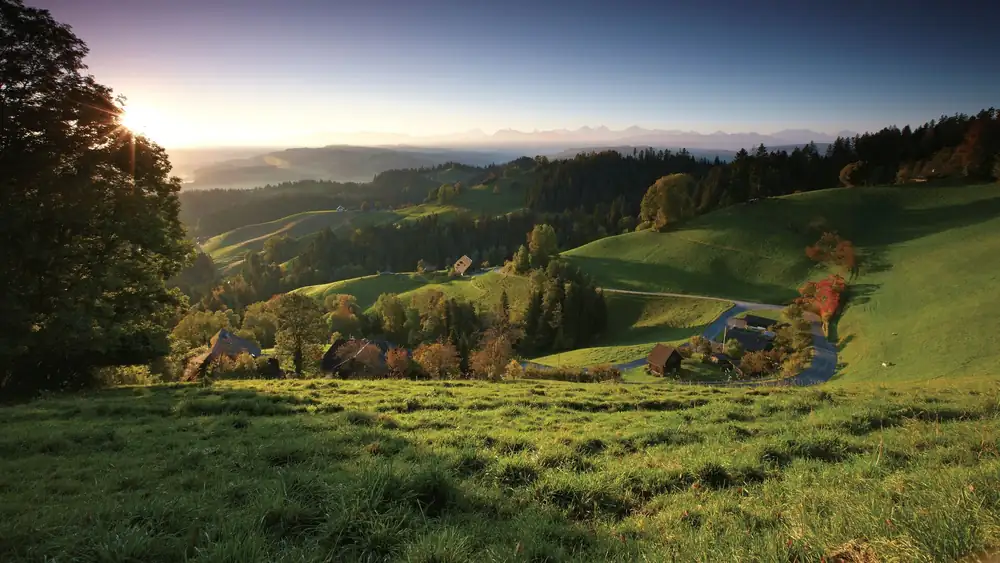
A taste of nature
Swiss cheesemaking has an ancient tradition, built on artisanal expertise passed down from generation to generation by master cheesemakers, and on respect for a special land: Switzerland, in fact, is a vast expanse of green meadows, as approximately 80% of its agricultural land is used as pasture to produce fodder for livestock. Light, temperature, precipitation, winds, and snow cover shape the mo
To each territory its own cheese
Although Switzerland is a small country, it boasts many traditions and a wide variety of cheeses, depending on the canton. The French-speaking Alpine regions are home to specialties such as Le Gruyère AOP, Tête de Moine AOP, and Raclette Suisse®, while the German-speaking Alpine regions are home to Emmentaler Suisse AOP and Appenzeller®.
Gruyère PDO, produced since 1115, is made with top-quality raw milk and aged for between 5 and 18 months. Available in sweet, semi-salted, salted, or surchoix varieties, it has a delicate, fruity aroma, with scents reminiscent of roasted chestnuts or peanuts, and a flavor reminiscent of fine salt crystals.
Tête de Moine PDO was created 800 years ago in the Bellelay Abbey, giving it its name, meaning "monk's head." The characteristic that makes this cheese unique and unmistakable is the ritual with which it is cut and served: it is not sliced, but scraped with a tool called a Girolle® or Pirouette®, which presents it in elegant and refined rosettes; this process modifies the structure of the cheese and fully releases its intense aroma. It seems that in 1291, the year Switzerland was founded, "Bratchäs" (roasted cheese), as Raclette Suisse® was then called, was already known, a name derived from the French "racler," meaning to scrape. Made with a semi-hard, fatty paste and aged for at least three months, it is now heated on a special stove directly at the table and, once melted, is enjoyed with boiled potatoes, spices and side dishes such as salad, gherkins and corn on the cob, mustard and dried fruit.
Swiss Emmentaler PDO originated almost 700 years ago in the Emme River Valley in the canton of Bern. Known as the "king of cheeses," it is placed in special warm fermentation cellars—where the characteristic holes form in the cheese—and then transferred to cooler cellars for the actual maturation.
Appenzeller® is characterized by a soft texture with small holes and a unique, distinctive flavor, created by the herb brine it's soaked in. The brine recipe is a top secret, and every cheesemaker guards it carefully!