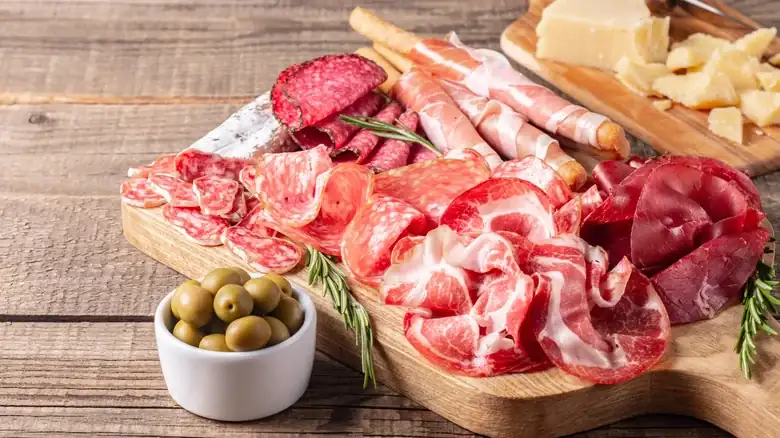
Is It Ever Okay To Use A Charcuterie Board As A Cutting Board?
Cutting boards and charcuterie boards can look like twins — both large wooden boards kept in the kitchen that can be a nuisance to clean. But that doesn't mean they're equal. The main difference between the boards lies in their function — one is for cutting, and one is for serving.
Charcuterie boards are designed to display and serve assorted cured meats, cheeses, fruits, and nuts. These are typically lighter, thinner, more decorative, and made from a softer wood than cutting boards. On the flip side, cutting boards are built to hold up against repeated chopping and are usually heavier, thicker, and sturdier –- like Ina Garten's luxurious favorite one made from maple wood.
If you're in a pinch and are debating chopping up some veggies on your charcuterie board, think twice before you do. Because it's not made for cutting, the wood on charcuterie boards can be more prone to scratches. You theoretically can double up and use it if you need to – just don't be surprised to see knife marks on the surface next time you pull it out of the kitchen cupboard.
How are charcuterie and cutting boards made differently?
The reason cutting boards won't scratch but charcuterie boards will is that they are made differently. Charcuterie boards are typically made of face-grain wood, which is more delicate. When you look at a piece of lumber, the face grain is the widest and smoothest portion.
On a face grain board, you are cutting against the wood's fibers, which is why face grain is more prone to scratching. In that case, you'd be better off using a cutting board in place of a charcuterie board — if you need to.
Cutting boards are generally made from edge grain or end grain wood, which is more durable. Edge grain refers to the grain on the long edge of the lumber — whereas end grain refers to the short end. Every piece of lumber has a face grain, edge grain, or end grain, but what matters is how the pieces are glued together and which grain is on top of the board.