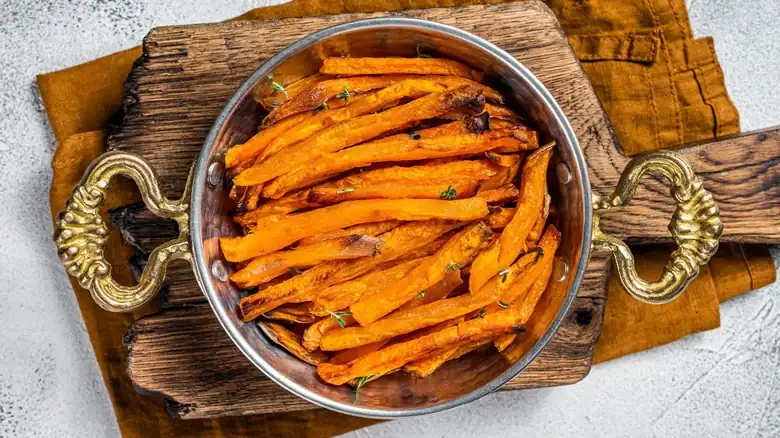
Las sartenes son estupendas para recalentar patatas fritas, con una excepción
Recalentar las patatas fritas puede resultar en unas crujientes como recién hechas o en unas empapadas, y la diferencia es mínima. Por suerte, la sartén es una herramienta fácil y eficaz para esta tarea. Este método funciona con casi todas las variedades de patatas fritas, que son sorprendentemente numerosas.
Reheating fries can either result in crispy, as-good-as-new food or soggy messes, and the line between them is finer than you'd think. Luckily, your skillet is an easy and effective tool for the task. This method works for almost all of the surprisingly numerous varieties of fries. The only downside? Curly fries don't make the cut.
To successfully reheat fries in your skillet, heat your pan up to medium-high heat and add in a couple of teaspoons of oil. Don't overthink this step. Many people continuously make the mistake with oil of not understanding smoke points — olive oil has a relatively low smoke point, making it a great choice for medium-high heat. Two teaspoons may not sound like a lot, but remember that you're just reheating, not refrying them. You need just enough to lightly coat the fries without oversaturating them. Anyone who has reheated fries in a microwave can attest to the fact that they are already super moist and retain a lot of oil.
Stir your fries around the skillet frequently for three to five minutes. Larger cut fries may take a minute or two extra, and you can also keep them in longer if you want to really solidify that crunch. Just be sure to keep an eye on them at all times, as they can burn even over medium-high heat. Once they're to your liking, dust on a little more seasoning to compensate what they've lost, serve hot, and enjoy.
Tips and limitations
Unfortunately, not all fries are cut from the same cloth. Curly fries are creative, but this also makes them harder to work with than other types. The issue you'll run into trying to reheat curly fries in a skillet is that they have wonky surface area. It's hard to get the oil to fully coat their shape, and they won't heat evenly in the pan. Trying to flatten them out as you reheat won't work entirely, either, as they are cooked in such a way to retain their curl. Plus, you'll ruin the fun! Some parts of the fry will cook, or even burn, while other parts will remain un-heated.
Still, this is one drawback among many pros. There are also ways to enhance reheating in the skillet. Pre-salting or seasoning your oil in the pan will add a great flavor to your fries, which, in any case, lose some of their taste as they age. Some skillets, such as those made of cast iron, are known for retaining flavor thanks to their porous material, and this can be a big upside in reheating fries that were a little lackluster to start with. Keep in mind, your skillet can easily be cleaned using just lemon juice, soap, and water, so don't mistake flavor retention for a lack of cleanliness. That's simply the mark of a well-loved skillet that has provided many a yummy home-cooked meal.