¿Qué significa la clasificación numérica del atún?
Los aficionados a este pescado de carne firme saben que el atún abarca una amplia gama de sabores y texturas. Si se tienen en cuenta la especie, el corte y la calidad del animal, existen muchos sabores y texturas posibles.
Fans of the meaty fish know that tuna covers a broad range. When you consider the species and cut, as well as quality of the animal, there are many possible tastes and textures. So, to help navigate the options, many vendors employ a tuna rating system. Inspired by traditional Japanese categorization, the process assesses the fat content and appearance of each fish in a move akin to top beef grades.
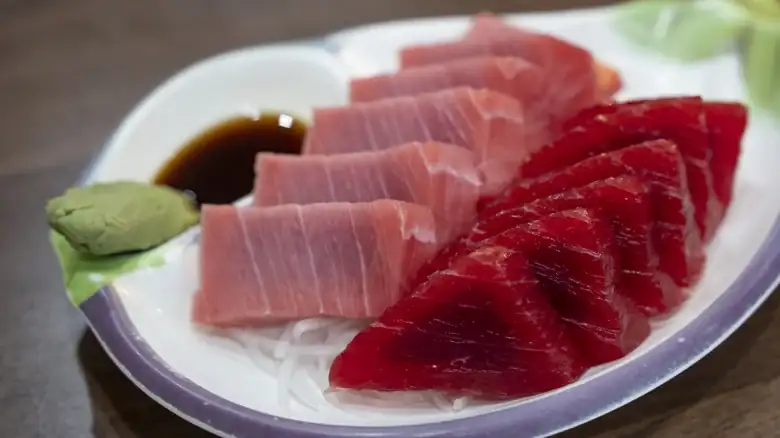
The tuna is delineated into four grades: 1, 2+, 2, as well as 3. The higher the number, the more vibrant red the appearance, and the greater density of fat marbling. The top two grades, 1 and 2+, are the ones suitable for raw consumption, making them fit for tender sushi or sashimi. Meanwhile, 2 typically has some off-coloring and blotches of less-vibrant flesh, as well as a lower quantity of fat but still makes for a delicious tuna steak. And the 3-grade packs in a lean texture and an unappealing brown color, making it best reserved for high-heat cooking methods like smoking or poaching. So, to best pinpoint your tuna application, ask your fishmonger regarding the rating.
The number rating system categorizes tuna appearance and fat content
It's important to note that the number rating system is applied differently per tuna species. The quantity and density of fat are most prominently considered with bluefin, the largest tuna species. However, the marbling is also considered with bigeye fish larger than 100 pounds. Yellowfin is examined almost exclusively on color, and albacore doesn't receive a grade. Furthermore, note that such ratings are conducted by private enterprises, which can be third party experts or the fish retailers themselves.
In the U.S, regulation concerning sushi-grade is indefinite. The U.S. Food and Drug Administration offers guidelines for deep-freezing tuna, but doesn't inspect the fish's appearance and quality. Note that the rating system involves a degree of subjectivity, and can vary between purveyors. As with other purchases in the seafood industry, there's a level of trust between the consumer and fishmonger, so only credit ratings from a reputable source. It's a good sign if the seller offers the full range of ratings, and avoids selling exclusively top-graded tuna for marketing purposes. Nevertheless, when you do buy a genuinely well marbled and fresh tuna cut, you'll certainly taste the quality.