Eslava transforms Legatum into a journey through wine-related heritage
The day brought together archaeology, tasting, Roman recipes and music in different spaces of the municipality.
Monday, September 7, 2026
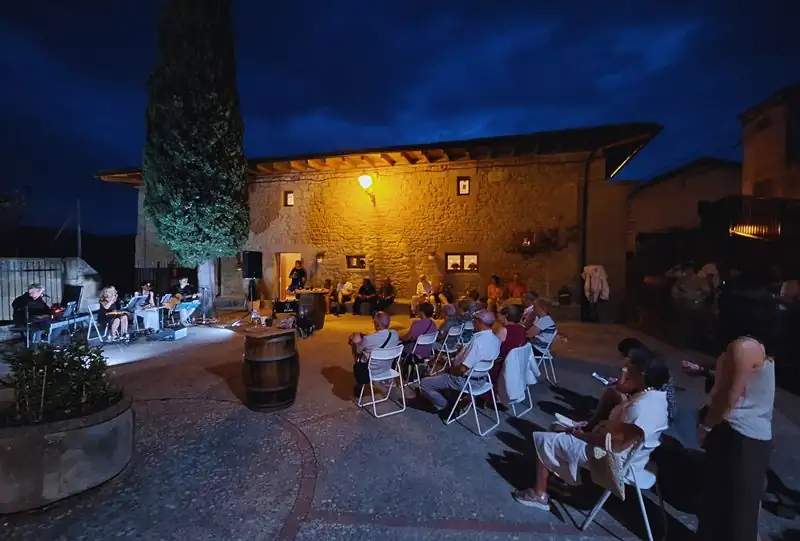
Eslava hosted around fifty people on September 5th for the second edition of Legatum: Heritage, Culture, and Wine, a day organized by the Town Hall to explore various locations in the town and connect archaeology, vineyards, gastronomy, and music. The event took place in the Núcleo Building, the medieval passageway, and the atrium of the Church of San Miguel, with a central theme: to link the past being researched, the heritage that forms part of daily life, and the knowledge that, in the opinion of the organizers and participants, should be preserved for the future.
The program opened with a round table discussion entitled “What did Roman Navarre taste like?”, moderated by journalist Elena Arraiza. Participants included researcher Javier Larequi Fontaneda, Félix Cibrián, head of the Viticulture Department at EVENA, Julián Palacios, from Viticultura Viva, and Francesca Mariani, a technician from the Eslava Town Hall.
During the meeting, the relationship between the archaeological investigation of Santa Criz, the history of the vineyard, and the knowledge linked to the land was discussed. Participants connected this work with the role that heritage can play in small municipalities like Eslava. They also reviewed the material traces left by the passage of time, from wine presses and Roman-era production structures to grape varieties preserved in archives and old vines that still hold agricultural information.
The discussion revolved around a shared idea among the participants: heritage is not limited to preserving remnants of the past, but also helps interpret ways of life, crops, and practices that can provide useful knowledge in the present. This perspective linked archaeological work with viticulture and the collective memory of communities.
Following the roundtable discussion, Javier Larequi presented the progress of the excavation campaign underway at the Vascon hill fort of Santa Criz. The researcher explained that this work continues to expand the available information about the settlement and about life in this territory before and during Romanization. His presentation connected with one of the day's central themes: demonstrating how field research allows for a deeper understanding of local history.
The tour continued through the medieval passageway, where Francesca Mariani explained the origin and function of the space. This was followed by a tasting of a wine made with Berués grapes, a red variety documented in 1620 in the municipal archives of Sada and Eslava. The organizers noted that this variety was nearly extinct and has been able to return to the vineyards thanks to the work of locating, identifying, conserving, and recovering it, carried out by EVENA.
The final part of the day moved to the atrium of San Miguel, where Bodega Eslava Rosé 2025, from Bodega Eslava, and Arbayún Tinto 2021, from Baja Montaña Viñedos y Bodegas, were served. The wines were paired with three tapas inspired by Roman recipes: moretum, lucanica, and isicia omentata. The culinary offering aimed to connect the wine experience with historical references and locally produced goods.
The musical finale was provided by Legatum Ensemble with their concert “Rome Through Cinema.” With this performance, the City Council completed a program designed to bring a bygone era closer to the public through a contemporary lens and to connect research, heritage, and cultural activity in various locations throughout the Navarrese municipality.