FIVIN explains why a study on wine alone does not prove health effects
The organization calls for a review of the design, sample, biases, and type of evidence before drawing conclusions.
Thursday, September 10, 2026
The Foundation for Wine and Nutrition Research (FIVIN) explained this Thursday, September 10, what criteria should be reviewed before interpreting a scientific study on wine, nutrition, and health. The organization maintains that it is not enough to read a headline or an isolated conclusion: to evaluate research, one must consider the quality of the design, the sample size, the methodology used, potential biases, and the consistency of its results with the body of existing evidence.
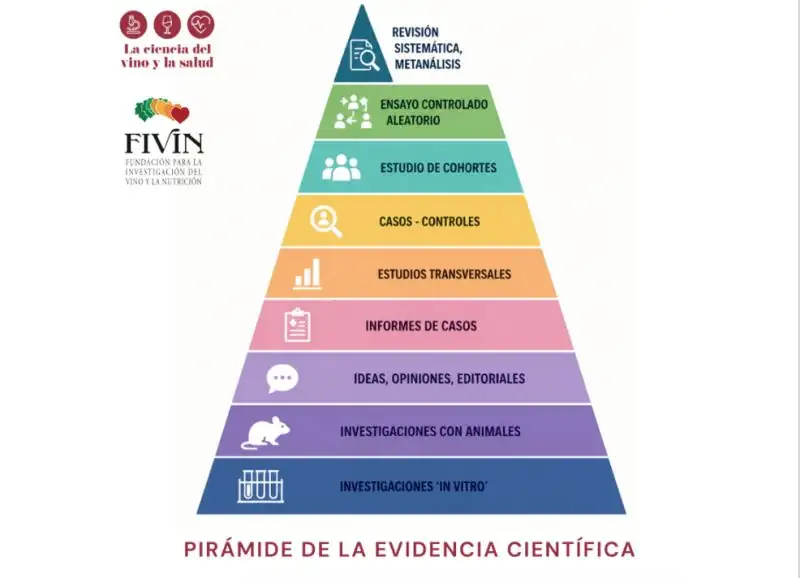
The foundation argues that each type of study addresses different questions and provides a different level of information. Therefore, its scientific committee reviews not only the final results of each study, but also the methodology used. This analysis, FIVIN states, allows them to distinguish between studies useful for formulating hypotheses and those more capable of verifying whether an intervention produces a specific effect.
At the base of this classification are in vitro studies, conducted with cells, tissues, or molecules under laboratory conditions. FIVIN explains that these studies are useful for examining biological mechanisms and opening new lines of research, but notes that they do not allow for a direct transfer of their conclusions to the behavior of the human organism.
Animal studies go a step further. The foundation indicates that these are useful for observing these mechanisms in whole organisms and for assessing certain effects before moving on to human research. Even so, it cautions that their results cannot always be applied to humans without further verification.
Also included at initial levels are reports or case series, focusing on one or more patients. FIVIN believes these can help detect rare phenomena or raise research questions, although they do not, on their own, prove a specific cause behind what is observed. Similarly, the organization includes editorials, opinion pieces, and reflective articles, which can contribute to scientific debate but do not constitute experimental evidence.
When the analysis shifts to populations, observational studies come into play. The foundation emphasizes that these studies provide useful information about what happens in real-world practice, but stresses a basic principle: finding an association between two factors does not mean that one causes the other. Within this group, cross-sectional studies observe a population at a specific point in time and allow researchers to measure the frequency of behaviors, characteristics, or health problems, as well as identify potential links between variables.
The level of evidence increases with randomized controlled trials. In this type of research, participants are randomly assigned to several groups to compare different interventions. According to FIVIN, this assignment helps reduce bias and allows for a more precise measurement of whether an intervention produces a specific effect. When neither the participants nor the researchers know which intervention each group receives, the trial is considered double-blind, a method the foundation considers among the most reliable for studying causality.
FIVIN prioritizes systematic reviews and meta-analyses over individual studies. Systematic reviews gather and organize the available research on a single question in a structured way. Meta-analyses, in addition, apply statistical techniques to combine results from different studies when they are comparable. According to the foundation, these tools provide a broader view of the state of evidence, especially when they incorporate well-designed randomized controlled trials.
The organization emphasizes that this classification does not automatically divide studies into “good” and “bad.” A trial can be poorly designed, and an observational study can provide invaluable information if it is well-conducted. Therefore, FIVIN recommends always asking what question each study attempts to answer, how it was carried out, what limitations it presents, and how it aligns with previous research on the same topic.
This same criterion is applied in The Science of Wine, the educational platform where FIVIN compiles research on wine, nutrition, and health. FIVIN reports that all scientific content in this initiative is reviewed by its Scientific Advisory Board before being made available to readers.