Franciacorta speakers warn the wine region’s future hinges on protecting its wider landscape
Experts at Festival Franciacorta cited planning gaps, climate stress and the Torbiere del Sebino wetlands as key tests.
Tuesday, September 22, 2026
The future of Franciacorta will depend not only on what is planted in its vineyards, but also on how the region decides to protect and reshape the broader landscape around them, speakers said at a public discussion held during this year’s Festival Franciacorta in Cantina in Rodengo Saiano, in northern Italy.
The conversation took place at an old Franciscan convent that houses the Academy Symposium, a higher technical institute focused on professional training in food, wine, marketing and tourism. It brought together wine writer and art historian Armando Castagno, Fiona Colucci of the Archaeology, Fine Arts and Landscape Superintendency for the provinces of Bergamo and Brescia, Marco Pilotti, president of the Torbiere del Sebino nature reserve and a hydraulic engineering professor at the University of Brescia, and agronomist Pierluigi Donna, co-founder of the consulting firm Studio Agronomico Sata.
The event was organized as Franciacorta, one of Italy’s best-known sparkling wine regions, faces growing pressure to balance economic activity, tourism, environmental protection, historical preservation and climate adaptation. The Franciacorta Consortium, which protects the denomination for the Lombardy region’s traditional-method sparkling wines and is led by Emanuele Rabotti, made landscape one of the central themes of the festival.
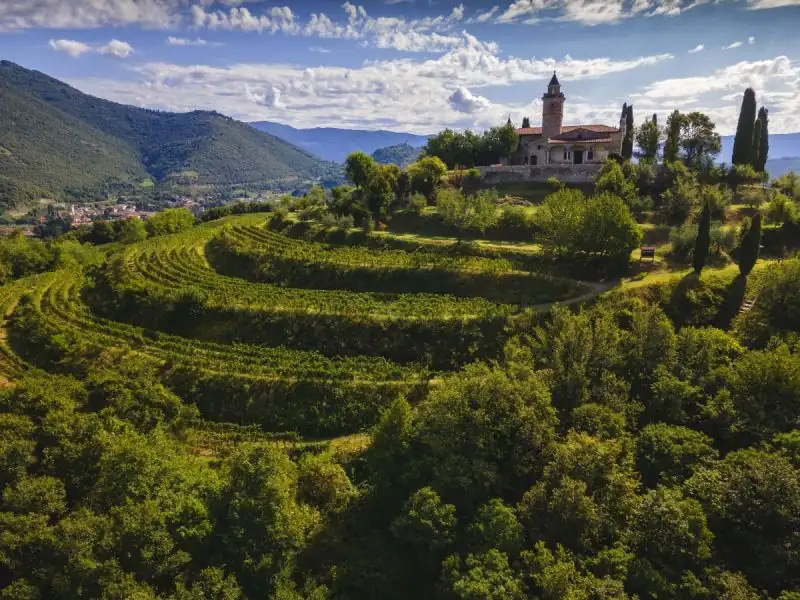
Speakers described the issue as broader than vineyard management alone. In Franciacorta, the landscape is tied to the identity of the wine region itself, but it is also shaped by town planning, architecture, transport, water systems, biodiversity, historic buildings and the expectations of local communities and visitors.
Castagno said the way people understand landscape is often influenced by art, photography and literature as much as by geography. He argued that landscape is not simply a physical setting, but also a cultural image formed over time. In Franciacorta, he said, that image is now strongly linked to wine production and to the idea of a territory where nature, craft, taste and local knowledge come together.
That view matters because Franciacorta’s international reputation increasingly depends on more than the quality of its bottles. It also depends on the visual and environmental coherence of the territory visited by wine tourists, investors and residents. Castagno said some agricultural districts in Italy produce outstanding wines and foods, yet give little visible sense of place when crossed by road. In his view, Franciacorta’s future will depend in part on whether local institutions and producers treat the landscape as a shared responsibility rather than as a secondary issue.
Colucci said landscape protection cannot be reduced to preserving a few monuments or scenic sites. She said people perceive landscape through personal experience and culture, but public authorities must still make practical choices about how to govern it. In Franciacorta, she said, the areas under direct heritage protection are relatively limited, which means much of the responsibility falls to local governments through municipal planning tools.
She pointed in particular to the Piano di governo del territorio, the local planning framework used by municipalities in Lombardy, calling it a crucial instrument for shaping development. But she said those plans are often the result of long-running compromises, especially where landowners and local administrations face pressure to allow construction in strategically located areas.
At the regional level, Colucci said Lombardy still lacks a completed landscape plan agreed with Italy’s Culture Ministry, despite years of work. Without that broader framework, she suggested, it is harder to manage growth in a coordinated way across an area whose identity extends beyond municipal boundaries. She also said one of Franciacorta’s priorities should be the protection of historic noble residences and older buildings, where public intervention often comes only after inappropriate work has already begun.
Much of the discussion centered on the Italian legal framework for landscape and environmental protection. Castagno recalled that Article 9 of the Italian Constitution, written after World War II, placed the protection of landscape and historical and artistic heritage among the republic’s fundamental principles. He said that choice reflected the view that such protection should be a national duty, not just a local one. Speakers also noted that constitutional changes adopted in 2022 explicitly added protection of the environment, biodiversity and ecosystems, including in the interest of future generations.
Colucci said that over time, the ideas of “landscape” and “environment” have often been treated as separate in Italian public policy, even though in practice they are deeply linked. For a wine region like Franciacorta, that distinction becomes especially difficult to sustain, because the same land must serve ecological, agricultural, cultural and economic functions at once.
Pilotti brought that point into focus through the example of the Torbiere del Sebino, a wetland near Franciacorta that was declared a nature reserve in 1984 and is recognized internationally under the Ramsar Convention. He said the reserve’s survival depends heavily on human management, especially on water quality and the protection of the hydraulic network. Once used for peat and clay extraction, the area is now valued for biodiversity and tourism, drawing roughly 60,000 to 70,000 visitors a year.
For Pilotti, the peat bogs show why the region cannot treat natural areas and productive areas as separate systems. Economic life, he said, remains essential because people are also part of the landscape and need jobs and functioning communities in order to remain in it. The challenge is to guide that development in a way that does not destroy the environmental systems on which the territory depends.
Donna said climate change is also changing the visual idea of what a well-kept vineyard landscape should look like. For years, he said, beauty in winegrowing was often associated with geometric order, uniform rows and tightly controlled fields. That model is now being questioned as producers look for greater resilience through shade, biodiversity and more complex ecological systems.
He said this shift is helping move Franciacorta toward forms of agroforestry in and around vineyards. Planting trees, shrubs and hedges along vineyard edges or within vineyard systems can reduce the effects of heat, create biodiversity corridors and connect cultivated land to nearby woods and other habitats. Donna described it as an alternative to strict monoculture and one of the region’s tools for adapting to a warmer and less predictable climate.
According to Donna, Franciacorta is unusual for the degree of cooperation among the consortium, wineries, research institutions and outside organizations such as Fondazione LGH. He said that cooperation has helped launch a new multidisciplinary zoning study that goes beyond traditional soil and climate analysis to include biodiversity measurement and the study of soil organisms linked to fertility and resilience.
That work is being developed with the Universities of Brescia and Milan and includes forecasting models to identify which plant species may be suited to local conditions 30 or 50 years from now, he said. Donna added that the results from early agroforestry projects will need to be widely shared if they are to become models for the rest of the region.
Throughout the discussion, speakers returned to a common point: the landscape of Franciacorta cannot be frozen in place, but it cannot be left to chance either. Its future, they said, will depend on technical skill, long-term planning and a stronger public understanding that the vineyards, wetlands, historic centers and built environment form a single territorial system. Several participants also stressed the importance of training younger generations, arguing that schools and professional education will play a key role in deciding how the region evolves.